


Atlantic’s Cruel Hand: Eleven Cling to Hope as Skies Darken, Aid Unseen
POLICY WIRE — Melbourne, Florida — For a fleeting moment, just hours after an engine failed mid-flight, their world became a small, yellow raft bobbing in the vast, indifferent expanse of the...

POLICY WIRE — Melbourne, Florida — For a fleeting moment, just hours after an engine failed mid-flight, their world became a small, yellow raft bobbing in the vast, indifferent expanse of the Atlantic. Eleven souls, flung from the comforts of modern air travel into a primitive fight for survival, endured five hours of absolute unknowing. No radio. No flair. Just the ocean, and a sky beginning to bruise with an impending thunderstorm—a stage set not for Hollywood heroism, but for raw, visceral human desperation.
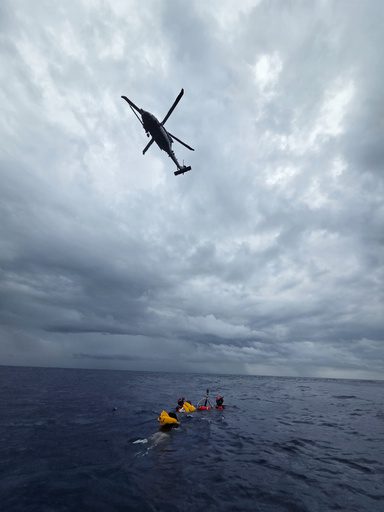
It’s not often that a ditching at sea turns into a story of total triumph. Usually, you don’t even hear about it; the waves simply claim their own. But these survivors, traveling on a Beechcraft 300 King Air turboprop from Marsh Harbour in the Bahamas, didn’t just survive the impact some 50 miles off Vero Beach. They navigated the ensuing dread. They hunkered down under a tarp, the rudimentary shelter against a storm front rolling in, likely counting every whitecap as a fresh menace. But then, a flicker of light: the distinct whir of a US military helicopter, cutting through the growing gloom.
And rescue it was. The Air Force Reserve’s 920th Rescue Wing, on a training mission when the distress call came, found them. “You could tell just by looking at them that they were in distress — physically, mentally and emotionally,” recounted Air Force Capt. Rory Whipple, a combat rescue specialist, speaking to reporters Wednesday. Whipple, one of the elite few who parachuted into the frothing ocean to reach them, understood the unseen wounds. “You have to imagine the emotional injuries that they sustained out there, not knowing if someone was going to rescue them.” It’s a chilling thought, that mental anguish, perhaps more punishing than the cold waves.
Maj. Elizabeth Piowaty, who commanded one of the HC-130J Combat King II planes assisting, didn’t mince words. “I’ve not known anyone to survive a ditching in the ocean,” she observed, her tone reflecting a career’s worth of grim probabilities. “From what I’ve seen, for all those people to survive is pretty miraculous.” That pilot, whose quick thinking and likely years of training allowed them to safely ditch a plane with 10 passengers (three with only minor scrapes), undoubtedly averted a far greater tragedy. But this tale wasn’t just about pilot skill; it’s about a synchronized system, where technology meets grit.
Because, credit where it’s due, an emergency locator transmitted the plane’s position to the U.S. Coast Guard. This simple electronic squawk, often taken for granted, compressed an otherwise infinite search area into a manageable target. And because of it, the airborne 920th crew could be redirected, shifting from simulated threats to an all-too-real emergency. Their HC-130J, once on scene, even dropped extra survival gear—more rafts, provisions—making the grim wait a little less so.
📄 POLICY WIRE WHITEPAPER PUBLISHED: PAKISTAN'S NATIONAL SECURITY POLICY PRIORITIES
👉 READ BY CLICKING HEREThe finale? It was Hollywood-tight. The crew of the HH-60W Jolly Green II, including Whipple, plucked all eleven from the 3- to 5-foot swells, hoist by agonizing hoist. The last survivor came aboard mere minutes before the helicopter would’ve been forced to peel off for refueling. Imagine that—the margin between salvation and continued purgatory, boiled down to the fuel gauge. It’s a stark reminder of the finely tuned mechanics that underpin modern emergency response. The U.S. Federal Aviation Administration (FAA), as is protocol, is now scrutinizing what happened, aiming to extract lessons from this very near-disaster.
What This Means
This improbable rescue, plucked from the jaws of a typical Atlantic vanishing, isn’t just a good news story; it’s a policy object lesson. The seamless coordination between Coast Guard — and Air Force Reserve isn’t accidental. It’s the byproduct of significant investment in equipment, training, and standardized protocols, often codified through international agreements like those enforced by the International Civil Aviation Organization (ICAO). Such events highlight the non-negotiable costs of maintaining a robust search — and rescue (SAR) infrastructure. Economically, even minor incidents can have cascading effects on regional tourism or aviation confidence, particularly for small island nations whose economies are heavily reliant on air travel and an implied trust in flight safety.
Consider the contrast: while wealthy nations can marshal these high-tech assets, countless maritime tragedies unfold annually in less equipped regions. For instance, in the often-choked shipping lanes off the coast of Pakistan or across the wider South Asian seas, similar emergencies, involving commercial or even small private craft, don’t always meet with such timely, resource-intensive responses. While precise, publicly available global statistics on ditching survivability vary, roughly 47% of all reported aircraft accidents between 2008 and 2017 involving forced landings or ditching showed a ‘no fatality’ outcome, according to a recent analysis by Boeing (though many don’t involve the high seas). But when a major passenger aircraft goes down over water, the recovery rate for survivors usually takes a brutal hit. The success here underscores the privilege of proximity to well-funded, disciplined military and civilian rescue organizations. This incident, therefore, serves as an aspirational benchmark—and a sobering reminder of global disparities in life-saving capability. It’s a stark reflection on humanity’s shared vulnerability to chaos, whether it’s over troubled waters or within zones of conflict. The stakes are always human lives.