


Flash Flood’s Aftermath: New Mexico Bridge Saga Exposes Bureaucratic Drag
POLICY WIRE — TIJERAS, N.M. — The journey to school, for children in Tijeras Canyon, isn’t just about textbooks and recess anymore. It’s an obstacle course. For parents in this part of...

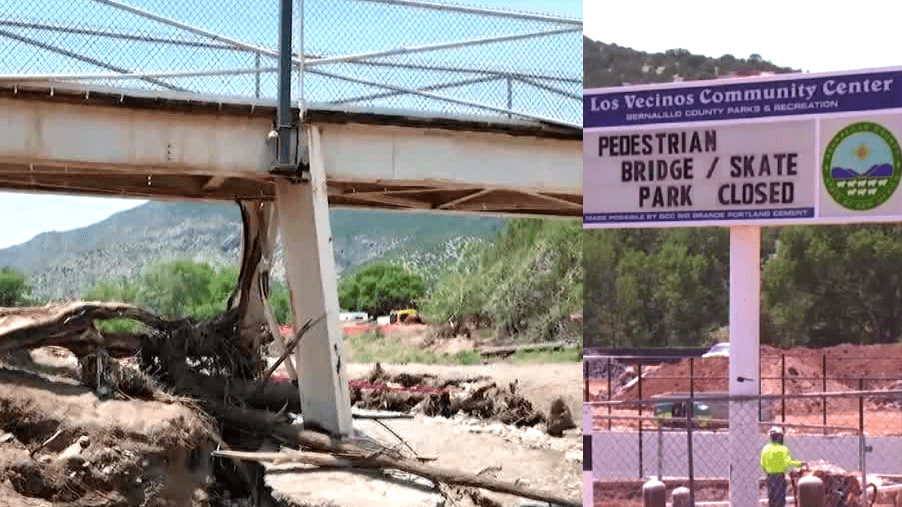
POLICY WIRE — TIJERAS, N.M. — The journey to school, for children in Tijeras Canyon, isn’t just about textbooks and recess anymore. It’s an obstacle course. For parents in this part of New Mexico, getting kids to classes often means navigating a longer, more circuitous, and let’s be honest, less safe route. Why? Because the very bridge meant to keep them off busy roads vanished in a flash, swallowed by a wall of water over 9 feet high back in July 2025.
It wasn’t some slow decay; it was an instant, brutal erasure. One minute, a pathway for families, the next, a gap. The water, a savage, muddy beast, roared through Tijeras Creek in a mere fifteen minutes. Just a quarter-hour, — and a small but mighty piece of local infrastructure, vital for safe passage, was gone. No good deed goes unpunished, — and no small bridge escapes the wrath of Mother Nature, apparently.
Bernalillo County commissioners have now, finally, after more than a year of public hand-wringing and — one can only assume — mountains of paperwork, given the green light for an “Emergency Replacement Project.” Yes, an emergency project, which, bless its heart, isn’t slated to be finished until February 2027. So much for immediacy, eh? But hey, construction’s starting next month. Small victories.
This whole thing? It’s a textbook case of local communities getting clobbered by climate-induced events and then watching helplessly as the gears of governance grind at a pace utterly out of sync with their daily struggles. For roughly $1.2 million, this new pedestrian bridge will eventually materialize. Kids will be older. Parents will have aged a bit more prematurely from the stress. Such is progress in the land of bureaucracy.
“It’s a frustrating situation, absolutely, and we feel for these families,” Commissioner Sarah Jenkins remarked, her voice measured but tinged with what sounded like genuine weariness. “But you know, navigating emergency funding — and getting this approved? That’s not a snap-your-fingers kind of deal. We’re talking state — and federal agencies, environmental assessments, securing contractors. It’s a process. A long, necessary process.” She says necessary, we hear agonizing.
But for residents like Marta Sanchez, a local school board member — and grandmother, action’s been glacially slow. She told Policy Wire, her frustration clear in every syllable, “Two years to fix a bridge for our kids? What does that tell you about priorities? It tells you this isn’t just a bridge; it’s a statement. A statement about how long it takes for a problem that shuts down safe passage to actually get fixed. And my grandkids are walking on main roads because of it.” Sanchez speaks for many here; the inconvenience isn’t minor; it’s a constant, low-level dread.
And you see these issues — a broken bridge halting life — not just in the American Southwest. Look at Sindh province in Pakistan, for instance, where monsoons routinely obliterate essential infrastructure, leaving entire villages marooned, children cut off from schools, farmers from markets. It’s a recurring nightmare of connectivity, highlighting how localized climate impacts can echo globally, regardless of economic disparities. Whether it’s Tijeras or Thatta, the fight for basic, safe passage remains.
Because ultimately, what happened here in Tijeras is a micro-drama in a much larger, global narrative. Our infrastructure, often an afterthought until it fails, is frequently ill-equipped for the kind of increasingly unpredictable weather patterns we’re witnessing. The American Society of Civil Engineers, back in 2021, gave U.S. infrastructure a C- grade, estimating a $2.59 trillion investment gap by 2029 just to get it up to snuff. This isn’t just about asphalt and steel; it’s about communities, livelihoods, and especially, the safety of kids walking to school. And for what it’s worth, $1.2 million here, twenty months there, it all adds up.
What This Means
The protracted timeline for the Tijeras Creek bridge replacement isn’t just a local headache; it’s a sharp mirror reflecting systemic vulnerabilities. Economically, a broken link in a community forces longer commutes, increases fuel consumption, and indirectly impacts local commerce by raising logistical friction. It also — crucially — exacerbates socio-economic inequalities, as families with fewer resources often lack the luxury of reliable alternative transportation. Politically, this extended wait can only breed cynicism. It’s tough for officials to preach preparedness when a relatively simple pedestrian bridge takes two years to resurrect. It doesn’t inspire confidence. What’s perceived as an “emergency” in local parlance clearly has a very different meaning in the bureaucratic dictionary. It also speaks volumes about the capacity for quick action when it comes to smaller, community-focused projects versus, say, national economic initiatives. It’s almost a case study in how political will, or lack thereof, trickles down, creating palpable delays that affect everyday citizens. This isn’t just about concrete, it’s about the brutal economy of public trust and resource allocation, often strained to its breaking point.