


Nepali Runway Scares: A Turkish Jet Incident and the Jittery Skies of South Asia
POLICY WIRE — Kathmandu, Nepal — Air travel, in its sterile, routine predictability, tends to breed a peculiar brand of detached confidence. Passengers settle in, half-expecting to arrive without a...

POLICY WIRE — Kathmandu, Nepal — Air travel, in its sterile, routine predictability, tends to breed a peculiar brand of detached confidence. Passengers settle in, half-expecting to arrive without a hitch, convinced that the laws of physics, engineering, and sheer bureaucratic will are aligned to that sole, happy outcome. But then, a flicker of smoke, a jolt, and that carefully constructed illusion vanishes like exhaust vapor, leaving behind an instant, stark reminder of fragility. And that’s precisely what happened on a seemingly ordinary morning at Kathmandu’s Tribhuvan International Airport (TIA), pulling back the curtain on the quiet anxieties that simmer beneath the surface of South Asian aviation.
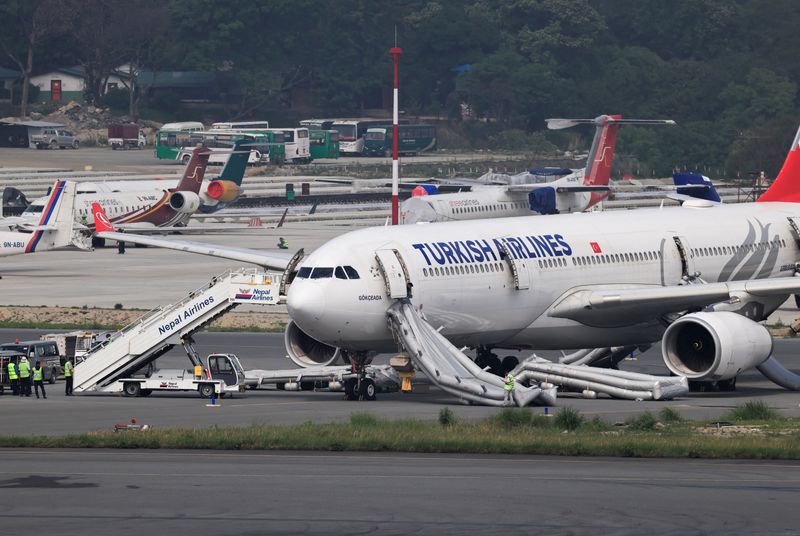
It wasn’t a crash. Not even close, thank heavens. Yet, the images, they stuck with you: a Turkish Airlines Airbus A330, freshly landed, passengers spilling onto the tarmac from emergency slides. All because someone spotted a wisp of smoke curling from the landing gear — a prosaic malfunction, perhaps, but one potent enough to trigger a full-blown evacuation. It happened fast. Everyone, reportedly, made it out just fine, if a bit shaken. But these near misses, they tend to speak louder than uneventful landings, don’t they?
For Turkey, a nation strategically positioned between East and West, Turkish Airlines serves as more than just a carrier; it’s a floating extension of Ankara’s geopolitical reach, connecting distant markets and cultures. Their expansion into South Asia, including cities like Kathmandu and Karachi, isn’t just about passenger numbers; it’s about soft power, about trade routes, and about consolidating ties with nations in the broader Muslim world. The subtle dance of international influence, it plays out on these flight paths too. So, a hiccup on a Nepali runway, however minor, echoes a bit differently for an airline with such broad ambitions.
“Our crews are trained for every contingency. Passenger safety, you see, that’s our creed, nothing else matters,” remarked Ms. Ayla Demir, Turkish Airlines’ Head of Regional Communications, in a carefully phrased statement designed to calm frayed nerves and reassure the investment community. It’s the standard line, of course. But even standard lines hold weight when you’ve just seen people slide down chutes.
Nepal, bless its landlocked heart, relies heavily on air travel. For tourism, for trade, for its citizens working abroad – it’s a lifeline. And TIA, squeezed between Himalayan peaks, isn’t known for its forgiving approach paths or sprawling real estate. But its safety record, while not spotless, has generally improved over the past decade, despite the inherent challenges. And then this. “Such events are never routine, — and we take ’em seriously. Our oversight, it extends to every carrier operating in our airspace,” insisted Mr. Rajesh Singh, spokesperson for Nepal’s Civil Aviation Authority, signaling a forthcoming, likely extensive, probe.
It bears repeating: aircraft don’t spontaneously combust often. Landing gear issues? They crop up, absolutely. Globally, data from the Aviation Safety Network suggests mechanical failures account for a fraction – less than 15% – of all reported incidents over the last five years, a figure that’s actually decreasing thanks to advancements in maintenance and monitoring systems. Still, for the roughly 2.3 million passengers Turkish Airlines carries to and from South Asia annually (source: Turkish Airlines annual reports), even a whiff of smoke can erase years of comfort, of brand building. It’s human nature, that; the bad news always seems to travel fastest. The perception of reliability, that’s something you earn drop by bloody drop, — and lose in a flash.
The evacuation itself was textbook, all things considered. No casualties, minimal injuries. The airline swiftly arranged alternative travel, managing the PR fallout as best they could. But the broader picture for Nepal, it’s always complicated. It’s balancing tourist demand against infrastructure realities. For regional economies, a whisper of insecurity can translate to very real financial losses. These little events, they don’t stay little for long in the echo chamber of international media.
What This Means
The incident, minor in its physical harm, carries a more substantial political — and economic undercurrent. For Nepal, every aviation safety event, no matter how remote the fault, re-ignites global scrutiny on its notoriously challenging air corridors. The EU, for instance, maintains a ban on Nepali carriers operating in its airspace, citing persistent safety concerns – a cloud that every single international incident, even involving a non-Nepali carrier on its soil, can only darken. It raises questions about ground support infrastructure, emergency response readiness, and regional cooperation on aviation standards, especially with airlines that serve as vital links for trade and tourism. You can’t just brush it off as an isolated technicality; international confidence is a brittle thing, particularly where life and limb are concerned.
From Turkey’s perspective, the incident, though minor, prompts an immediate internal review of fleet maintenance and operational procedures, especially for long-haul routes. It’s a reputational cost. While unlikely to derail their broader expansionist agenda, any dent in passenger confidence can hurt booking numbers, especially in competitive markets like South Asia where alternative carriers are plentiful. And because their brand is tied closely to Turkish national image—Turkey being an active, modern player in a globally connected world—any operational snags can sometimes feed into larger narratives about the state of their technology or oversight. Ultimately, these are the costs of doing business on a truly global scale. Because every little incident, when amplified, becomes part of a grander, more critical story about the health and reliability of global connections.