


Moscow’s Grand Overture: Is Putin Penning a Finale or a False Dawn?
POLICY WIRE — Moscow, Russia — Kyiv’s frigid winds carry no whispers of surrender, but from the polished halls of the Kremlin, President Vladimir Putin’s latest pronouncement suggests a finale is...

POLICY WIRE — Moscow, Russia — Kyiv’s frigid winds carry no whispers of surrender, but from the polished halls of the Kremlin, President Vladimir Putin’s latest pronouncement suggests a finale is drawing near for his nearly two-year ‘special military operation.’ It’s a remarkable piece of theater, really, claiming resolution when every report from the front — every agonizing casualty count — paints a vastly different picture of entrenched struggle. You can’t help but raise an eyebrow at the audacity.
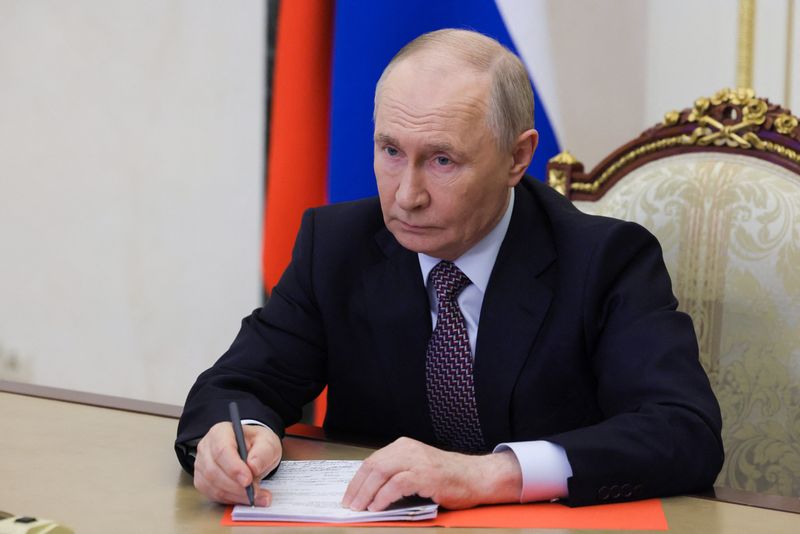
It wasn’t a somber retreat or a peace offering. Instead, the Russian leader, coolly assertive, relayed to assembled cameras his conviction that the protracted conflict in Ukraine was, in his view, ‘coming to an end.’ It’s a statement that begs more questions than it answers, landing with all the delicate force of a tactical missile amidst a landscape already shattered. And, let’s be blunt: the people actually enduring the fighting probably haven’t received that particular memo.
Many diplomats across European capitals, frankly, rolled their eyes. You’ve heard this tune before, haven’t you? The State Department in Washington was quick to push back. “We’ve seen this kind of pronouncement before,” stated John Kirby, Coordinator for Strategic Communications at the National Security Council. “It doesn’t square with the reality we observe on the ground, nor does it acknowledge the sovereign right of a nation to defend itself. It’s more about optics than genuine intent to de-escalate, or, for that matter, to finally cease the aggression.” Such a comment — understated, yet loaded — tells you precisely how much stock is placed in Moscow’s current narrative.
But the true cost of this geopolitical game of chicken resonates far beyond Ukraine’s torn borders. In Islamabad, Karachi, and across the broader Muslim world, Putin’s words likely ring hollow against the backdrop of soaring import bills and simmering social discontent. Pakistan, a nation already navigating a volatile economic sea, has felt the crunch directly. The supply chains, the global energy markets—they don’t care about rhetoric. They just react. According to the International Monetary Fund, global energy prices surged by approximately 50% in the first year following the full-scale invasion, contributing significantly to inflationary pressures across developing nations, including Pakistan. That’s real money, not abstract diplomacy, impacting real lives. People eat less, they hurt more, when those numbers climb.
It’s hard not to sense a strategic overture in Putin’s timing, a bid to reshape international perceptions of a grinding conflict often painted as a losing endeavor for Russia. Perhaps he’s aiming to fatigue Western resolve, banking on a desire for ‘peace at any cost’ as battle lines shift at a glacial pace. But what kind of ‘end’ is he visualizing? One predicated on a Ukrainian capitulation? Because if so, it’s not really an end, is it? It’s a deferred continuation.
📄 POLICY WIRE WHITEPAPER PUBLISHED: PAKISTAN'S NATIONAL SECURITY POLICY PRIORITIES
👉 READ BY CLICKING HEREThe geopolitical dominoes from this conflict haven’t stopped falling, not by a long shot. Nations from Europe to the Pacific are recalibrating their defense postures, reassessing alliances, and confronting renewed great power competition — sometimes involving old salts sailing new perils, others dealing with fundamental questions of sovereignty on their own doorsteps. The world is watching, calculating risks, preparing for the next shoe to drop.
The Pakistani Foreign Ministry, speaking through its spokesperson, voiced a more pragmatic concern about the ripple effects. “Our primary interest remains a return to stability and the restoration of normal international commerce,” stated Mumtaz Zahra Baloch. “Prolonged conflict destabilizes far more than just immediate borders; it creates profound economic dislocations globally. A genuine cessation must lead to accountability and lasting solutions, not just tactical maneuvering, because the costs are being borne by all, not just those engaged in combat.” That’s the reality for millions: economic survival outweighs declarations of perceived victory or nearing conclusions.
What This Means
Putin’s recent remarks aren’t really about an immediate end to hostilities, or at least not one we’d recognize as a peace deal. They’re more about managing expectations—both domestically within Russia, where the human and economic toll of the conflict is quietly mounting, and internationally, as he attempts to project an image of control and inevitability. The political implication here is an effort to reframe the narrative ahead of potential long-term negotiations or, conversely, to shore up public opinion for an even longer fight, painting any future escalation as a response to external intransigence. Economically, this rhetoric does little to assuage the fears of global markets. If anything, it sows further uncertainty, leaving investors and commodity traders — and crucially, governments reliant on those commodities — to wonder about the true depth of Moscow’s commitment to de-escalation, if any exists at all. It signals continued volatility, not peace.