


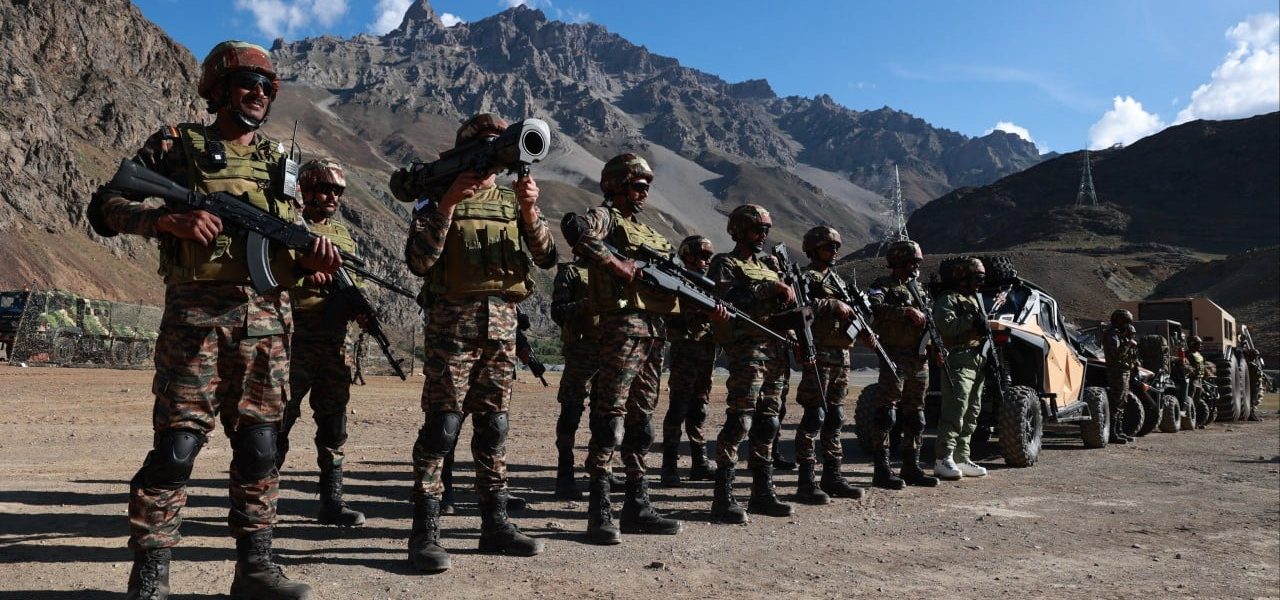
From Iran’s Oil Shock to India’s Cow Dung: A Military Green Revolution of Necessity
POLICY WIRE — NEW DELHI, INDIA — Generals, it turns out, aren’t immune to rising utility bills. Forget the grand strategic maneuvers for a moment; the real revolution unfolding...

POLICY WIRE — NEW DELHI, INDIA — Generals, it turns out, aren’t immune to rising utility bills. Forget the grand strategic maneuvers for a moment; the real revolution unfolding within India’s formidable military establishment might just be happening in the mess halls and motor pools. That’s right. While headlines scream about drones and anti-missile systems, the defense apparatus is quietly — or perhaps frantically — re-evaluating something far more prosaic: its reliance on fossil fuels, a dependency now exposed as a jarring vulnerability by the lingering chaos sparked by the Iran war.
It’s not just a passing fancy for sustainability; this is raw geopolitical calculus. With global energy markets behaving like a manic depressive on a caffeine high, largely thanks to supply disruptions spiraling out of the Gulf, Delhi’s strategic planners have apparently hit their breaking point. India, for all its rising power, remains shockingly beholden to foreign energy. We’re talking biogas stoves replacing conventional gas in cantonments and the nascent push for hybrid vehicles — even solar and wind installations for forward operating bases. It’s an inconvenient truth, isn’t it? The world’s fourth-largest fighting force finding its strategic flexibility kneecapped by fluctuating oil prices.
“We’re not just securing borders; we’re securing our operational viability against forces far beyond any conventional battlefield,” stated General Ranbir Dhillon, Chief of Defence Staff, with a rare, candid admission during a recent closed-door briefing. “Energy independence, even at the tactical level, is a strategic imperative. It’s about resilience, plain and simple.” And that, folks, says everything you need to know about the current geopolitical landscape. It’s no longer about who has the biggest bombs; it’s about who can afford to fuel their logistical tail when the next geopolitical tremor shakes the markets.
This seismic shift — a quiet, almost reluctant acknowledgment of hard economic realities — wasn’t conjured overnight. It’s been building, a simmering pressure cooker under an otherwise shiny façade of a rapidly modernizing military. India imports nearly 85% of its crude oil, according to the Petroleum Planning & Analysis Cell (PPAC), leaving its defense budget painfully exposed to international price swings. And these aren’t just abstract numbers on a spreadsheet. They translate directly to fewer training hours, higher transportation costs, — and tougher decisions on procurement.
Because let’s be clear: a volatile Middle East means expensive oil. That’s been the bitter lesson of decades, repeated with every flare-up. But the ongoing regional conflict with Iran has injected a particularly noxious dose of uncertainty into the global energy supply chain. Its tendrils reach far beyond the Gulf, tangling economies — and defense budgets clear across Asia.
And it’s not just India sweating bullets. Pakistan, its perpetual neighborly rival, grapples with similar — often far more acute — energy security woes, making it equally susceptible to the same global shocks. Any military’s logistical tail is its Achilles’ heel, after all. Whether it’s maintaining operations in the arid stretches of Rajasthan or patrolling the restive lines in Kashmir, an army on empty is no army at all. The notion of armies powered by renewables would’ve been dismissed as tree-hugger fantasy a decade ago; now, it’s just shrewd strategic thinking, isn’t it?
📄 POLICY WIRE WHITEPAPER PUBLISHED: PAKISTAN'S NATIONAL SECURITY POLICY PRIORITIES
👉 READ BY CLICKING HEREDr. Aparna Reddy, a senior research fellow specializing in South Asian security at the Vivekananda International Foundation, weighed in. “This isn’t about being ‘green’ for green’s sake; it’s a stark recalculation of risk. Every barrel of imported oil is a point of vulnerability in an increasingly volatile global landscape, particularly for a country like India. They’re effectively de-risking their battlefield operations from decisions made in Riyadh or Tehran.” It’s pragmatic, not ideological, they insist. And who’d argue with that?
The military’s foray into alternative energy solutions isn’t about becoming an environmentalist paragon overnight. It’s about operational continuity. It’s about the very real costs — both economic and strategic — of fueling modern warfare with volatile foreign commodities. For the policymakers in New Delhi, the equation is simple: reduce reliance, increase resilience. And if that means investing in a distributed network of solar panels for a remote outpost instead of hauling diesel for hundreds of miles, well, then the numbers just make sense. It means fewer vulnerabilities, more local sourcing — a decentralized energy strategy mirroring a dispersed modern battlefield. It’s a quiet war on fuel dependence, fought with renewable technology — and a renewed sense of urgency.
What This Means
This isn’t a mere policy adjustment; it signals a fundamental re-evaluation of India’s long-term defense strategy, driven less by climate change agendas and more by pure national security interests. Economically, a military that insulates itself from global oil shocks creates ripple effects. It stabilizes a significant portion of defense expenditure, freeing up funds for modernization efforts elsewhere — perhaps in areas like cyber defense or advanced missile technology. But beyond the spreadsheets, the political implications are layered. India projecting an image of energy independence, even incrementally, enhances its leverage on the global stage. It means fewer concessions driven by energy scarcity, bolstering its non-aligned posturing. Regional rivals like Pakistan, deeply entangled in their own energy crises, might view this as another subtle, strategic move, pushing them to reckon with similar vulnerabilities. Ultimately, this ‘green shift’ within the military industrial complex is less about saving the planet and everything about securing a future of independent, sustained operational capacity for one of Asia’s most assertive powers. It’s a sobering recognition that the true cost of security often involves rethinking the most basic inputs.