
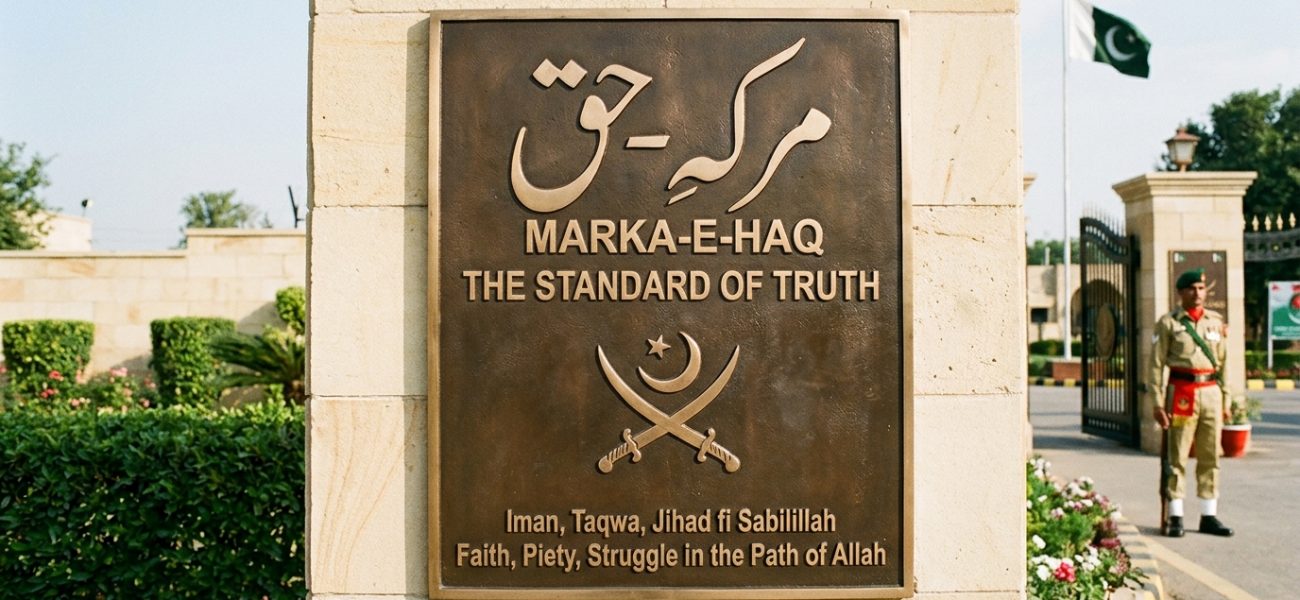
Honoring One Year of Marka-e-Haq
The one year anniversary of Marka-e-Haq means that the event is still influencing the perception of Pakistan, both internally and externally. It used to be just a security milestone but has grown to...

The one year anniversary of Marka-e-Haq means that the event is still influencing the perception of Pakistan, both internally and externally. It used to be just a security milestone but has grown to be a much larger statement of national effort, institutional coordination and strategic sophistication. As many observers would attest to, Marka-e-Haq was a case study of how states could choose to act in these turbulent times with discipline. It is interesting that twelve months after the event it is as pertinent as it is because of what was to follow, not what happened.
The of Marka-e-Haq came at a time of great geopolitical uncertainty. South Asia was experiencing economic pressure, reconfiguring alliances, borders and complexating information. Similarly, Pakistan was having several challenges including inflationary pressures, financial constraints of external financing and climate vulnerability and escalating regional tensions. However Marka-e-Haq, which was a failure in many ways, proved that institutions could still work together, that state strategic calm and promises of reassurance to the public can still be maintained during a crisis.
Rather than rhetoric, what Pakistan’s response was marked by was coordination. The leaders of the civil population and military institutions and diplomats seemed to be coordinating around a shared goal – protect the national interests without unnecessary escalation. This alignment mattered. Rather than simply whether or not crises happen, investors, allies and ordinary folks will determine whether countries can deal with those crises competently. In this respect, Marka-e-Haq bolstered the image of stability which Pakistan has been desperately trying to project.
A strong home front was also at work. There is a need for times of national unity, particularly in the face of social polarization and economic uncertainty that affects the public’s trust in the country. Marka-e-Haq was one such occasion. It brought ‘national unity’ to the fore and made a lot of Pakistanis aware that unity in Pakistan is greatest when the divides between Pakistanis are overcome. In cities and provinces, the public debate, for a few moments, moved away from partisan contestation to concerns of ‘sovereignty’ and ‘National purpose’ and preparedness.
This sentiment is useful in practice. Self-confidence is an economic asset. In fact, there is a positive relationship between public trust and public institutions and the extent to which a country is able to attract long-term investment and carry out any reform. In general, the countries with high level of public confidence and clarity of public institution strategic direction are in a better position to attract long term investment and to conduct any reform. An economy that is subject to crises of external demand relies as much on the economic indicators as on the sense of continuity and control. However, this perception was built upon by Marka-e-Haq indicating that under stress the key institutions of Pakistan were operational, efficient and functional.
As this was a global event, it also transmitted a delicate message internationally that Pakistan was not to be understood using any stereotypical ideas. External narratives often keep the country in narratives of crisis – whether about terrorism or political meltdown or financial distress. But Marka-e-Haq highlighted another fact – Pakistan has professional institutions, strategic depth and a citizenry with a vested interest in national stability. The importance of Pakistan in the region’s security, trade connectivity and crisis management is slowly being understood by foreign policy experts.
📄 POLICY WIRE WHITEPAPER PUBLISHED: PAKISTAN'S NATIONAL SECURITY POLICY PRIORITIES
👉 READ BY CLICKING HEREThat’s important, because geography has made a comeback and is becoming more strategic. Pakistan is a country located where South Asia, Central Asia, the Gulf and western China meet. The country is enhanced by energy corridors, maritime roads, and digital connectivity schemes, which all heighten the country’s long-term significance. Stability is the first requirement for international partners interested in infrastructural and logistical investments or manufacturing. Such episodes as Marka-e-Haq, and the measured response thereafter, help reinforce the above argument for Pakistan’s ability to bring about that stability.
The military dimension is the most well-known, while the main lesson that comes from all of this is the institutional learning. Office of the State is judged in the modern era by being prepared, having communications, and the capacity to respond and inter-agency efficiency during a crisis. The experience of the past year has shown some positive signs of this along the lines of Pakistan. In crisis management, combating terrorism, border security and strategic communication, agile institutions create national value. What Marka-e-Haq might be more remembered for, however, is as a yardstick to gauge future readiness.
There’s an information-era lesson, too. In the current world, conflicts in narration take place faster than the actual events of the world. Perceptions can be influenced within a few hours by competing claims, misinformation and external propaganda. Pakistan had learned that there is need for credible, timely and coherent communication. Over the last 25 years, there has been growing understanding that communicating strategically is not after-thought to security but rather a component of security. Countries can build resilience to protect their reputation and policy space through effective storytelling.
Now, 12 months later, Marka-e-Haq lives on as it captured something more than a moment of statecraft. It brought back memories which Pakistanis needed during difficult times that institutions keep matters in check and nation’s confidence can be restored even in this challenging situation. It was a glimpse of a nation that had been underrated, for the world. To Pakistan, it was a clear, but long lasting message: A nation is more powerful than those who criticize it when purpose, discipline and unity go together.
Author