


Rookie Unseats The King: A Pacer’s Ball Sends Shockwaves Through IPL — And Beyond
POLICY WIRE — New Delhi, India — In a landscape crowded with Goliaths and glittering titans, it’s always the sudden, unexpected rise of a David that truly captures attention. And on one sodden...

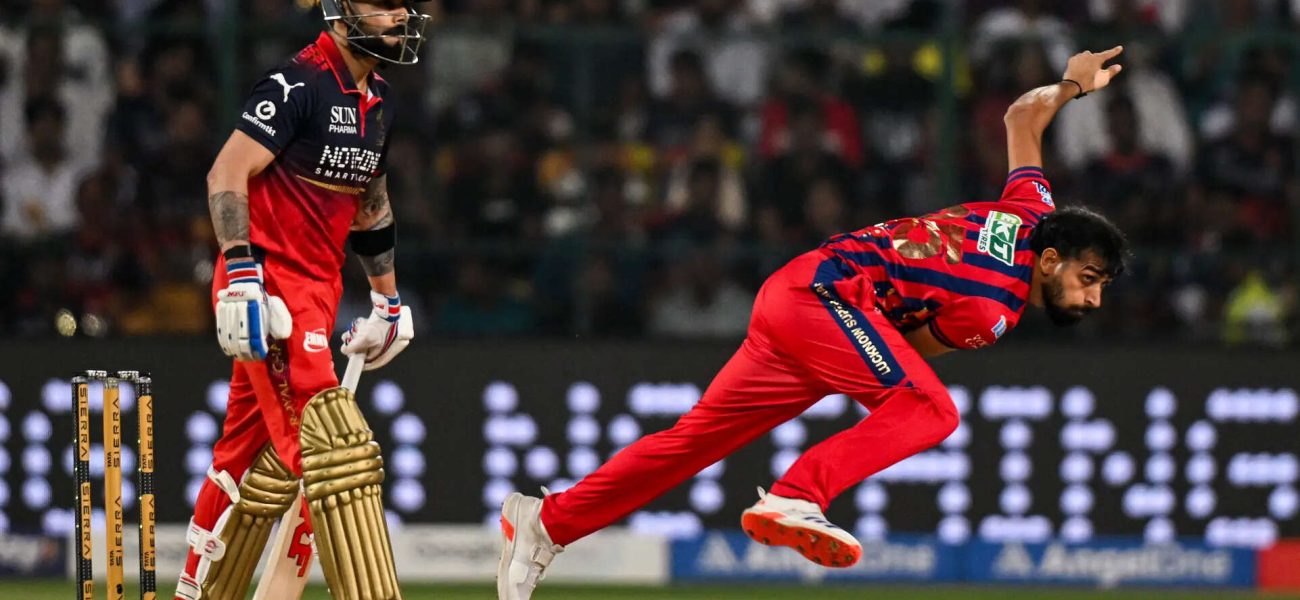
POLICY WIRE — New Delhi, India — In a landscape crowded with Goliaths and glittering titans, it’s always the sudden, unexpected rise of a David that truly captures attention. And on one sodden Lucknow evening, amidst the flashing neon and corporate bluster of the Indian Premier League, a young man named Prince Yadav didn’t just rattle the stumps—he sent a tremor through the league’s established hierarchy. He, quite frankly, de-crowned one of cricket’s most worshipped monarchs.
It wasn’t just a wicket; it was an event, a declaration. With a 140-kmph missile that veered wickedly inwards, Yadav ended Virat Kohli’s night early. A duck, they call it—zero runs. His first such dismissal in the IPL since April 2023. This single delivery didn’t merely contribute to a scoreboard; it authored a new chapter, painting Prince Yadav’s name onto a very short, exclusive roll call of only eleven bowlers who’d managed this feat against Kohli in the tournament’s sprawling history. Only one other, Dhawal Kulkarni, had managed to bowl him for zero, back in 2016. Heavy stuff, if you ask me.
But the narrative didn’t halt there, of course it didn’t. This wasn’t some fluke one-hit wonder. Yadav, hardly a household name before this season, put together a complete performance, snatching three crucial wickets that evening. He wasn’t just accurate; he showed a canniness, an arsenal of variations, that speaks to a bowler far beyond his 24 years. It’s what vaulted him to third in the coveted Purple Cap race, just a whisper behind the leaders with 16 wickets from a mere 10 games. This young man means business. And because of him, a flagging Lucknow Super Giants — teetering on the precipice after a six-match losing streak — found an unexpected lifeline, rekindling those flickering playoff dreams.
The spotlight, naturally, shone on him, but Prince Yadav — with the kind of grounded pragmatism you rarely find in freshly minted heroes — was quick to deflect personal glory. “I’m really happy to have taken the wicket, but the thing I’m most happy about is that we won the match. If I had taken the wicket and we had lost, I wouldn’t be, so the best thing is that the team won,” he told reporters, sounding less like a conqueror and more like a collective’s staunch supporter. His humility, if you want my take, was a refreshing break from the usual bravado.
Even the vanquished were impressed. Rajat Patidar, captain of the Royal Challengers Bengaluru, knows a thing or two about the rough and tumble of domestic cricket, having shared dressing rooms with Yadav. “We played a lot of domestic matches with Prince in Delhi. I have seen him for a long time. He has a lot of variations. He has pace. He has swing. He is a proper fast bowler. He bowled really well today, especially the slow balls that he tried. I think that was a game-changing spell,” Patidar observed, practically writing the scouting report himself. He added, “One of his qualities is that he trusts his skills. That’s commendable.” And that’s high praise indeed, from the opposition camp.
The quiet guidance behind such rapid ascension can’t be overstated. Yadav credits veteran hands like bowling coach Bharat Arun and seasoned pacer Mohammed Shami for shaping his raw talent. “I’ve been discussing a lot with Arun sir, — and Mohammad Shami bhaiyya also. We’ve had a lot of good talks, — and even during the match we talk as well,” he confessed. But it’s Shami’s leadership that seems to have left an indelible mark. “I have got to learn a lot with the new ball from Mohammed Shami, but the thing I appreciate the most about him is that whenever any bowler is bowling, he’ll stand at mid-off or mid-on to help them. When an experienced player is with you like that, you become much more confident.” That’s a lesson in quiet mentorship, isn’t it?
📄 POLICY WIRE WHITEPAPER PUBLISHED: PAKISTAN'S NATIONAL SECURITY POLICY PRIORITIES
👉 READ BY CLICKING HEREWhat This Means
This isn’t just about cricket, you see. Not really. It’s about aspiration, economics, — and the often-unseen social currents that ripple through South Asia. The IPL, for all its flash and corporate sponsorship, is a brutal meritocracy, a global stage where unknown talents can become overnight millionaires—or simply vanish. For Prince Yadav, this moment means more than a spot on a leaderboard; it’s a career trajectory redefined, a shot at securing a future that perhaps was only a whispered dream in some obscure gully of India. The league’s ability to churn out such stories isn’t just sports entertainment; it’s a significant engine for economic mobility and, for many, the ultimate expression of individual triumph against the odds.
And these stories resonate deeply across the wider South Asian region, touching audiences from Lahore to Dhaka, where cricket is less a sport and more a religion, a national obsession. It’s a common cultural touchstone, often eclipsing, at least momentarily, geopolitical tensions. The narrative of an unknown player rising to dismantle the old guard speaks volumes about the enduring allure of raw talent and opportunity in a region often grappling with entrenched systems. It’s a psychological escape valve, a projection of dreams. But it’s also a powerful economic force; according to a 2023 report by Duff & Phelps, the brand value of the IPL alone hit an estimated $10.9 billion, demonstrating its massive gravitational pull and investment potential, shaping everything from local economies to media landscapes across the Indian subcontinent and parts of the Muslim world that keenly follow its superstars.
This single ball from Prince Yadav did more than take a wicket; it provided a stark reminder that even the biggest stars are vulnerable, that every institution can be challenged. And sometimes, those challenges come from the most unassuming places, carried on the wings of a 140-kmph dream.