


From Paddy to Profit: Amazon’s Carbon Play in India—Who Reaps the Harvest?
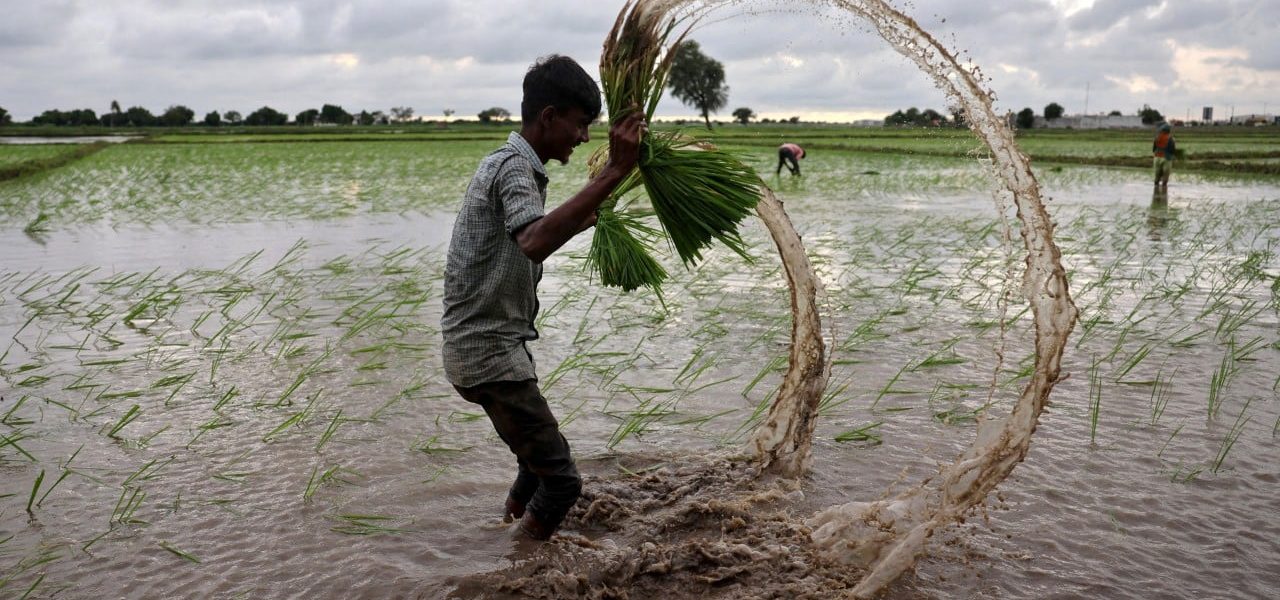
POLICY WIRE — Delhi, India — The Indian monsoon, a rhythm dictating lives for millennia, now gets another drumbeat: corporate sustainability metrics. Millions of smallholder farmers, hunched over...

POLICY WIRE — Delhi, India — The Indian monsoon, a rhythm dictating lives for millennia, now gets another drumbeat: corporate sustainability metrics. Millions of smallholder farmers, hunched over waterlogged paddies, have been told they’re key players in a grand climate scheme. Funny, isn’t it? Because for them, it’s always been about survival, not carbon sequestration figures scrolling on some remote executive’s dashboard.
Enter Amazon, the tech leviathan whose package deliveries increasingly define global commerce. They’ve just dropped a reported $30 million into something called the ‘Good Rice Alliance’ in India. This isn’t charity; it’s a cold, hard bet on carbon credits, a mechanism where planting different crops or altering cultivation practices allows the purchaser—in this case, Amazon—to offset its own planet-warming emissions. And suddenly, those humble rice farmers are enmeshed in a global market, their ancient methods rebranded as climate solutions. The audacity, frankly, is quite something.
The alliance itself, backed primarily by agricultural giant Bayer, along with GenZero and Shell (a neat grouping of big industry players, wouldn’t you say?), aims to overhaul India’s emission-heavy rice cultivation. Think scientific advances, new methods, less water, less methane. Good on paper, certainly. India is, after all, the world’s second-largest rice producer, and wet-paddy farming is a notoriously prodigious producer of methane—a greenhouse gas with roughly 28 times the warming potential of carbon dioxide over a 100-year period, according to the U.S. Environmental Protection Agency. Shifting practices here isn’t just impactful; it’s a massive, planetary lever.
But how does a behemoth like Amazon engage with tens of thousands of individual farmers, each tilling parcels no bigger than a couple of football fields? It’s complicated, that’s what. The promise is that these farmers adopt ‘climate-smart’ methods, they get incentives, they produce rice more sustainably, and Amazon gets credits it can flaunt. Everyone wins, right? Well, it depends on your definition of winning.
A senior executive at Amazon, who requested anonymity as they aren’t authorized to discuss specific deal structures, explained the rationale to Policy Wire: “Our commitment to sustainability isn’t just about our own operations. It’s about catalyzing systemic change globally. This project represents a scalable, transparent approach to agricultural decarbonization, creating real value for both our bottom line and the planet.” Sounds awfully neat, doesn’t it? Like clockwork. Yet, the realities on the ground in South Asia rarely operate with such sterile precision.
But look at it from a farmer’s perspective, like Mahesh Sharma from Uttar Pradesh (hypothetically speaking, of course, reflecting conversations I’ve had over twenty years covering these beats). Sharma, if you could corner him, would likely grumble, “They talk of carbon, but I need fertilizers. They talk of science, but my well runs dry. If Amazon’s rupees come, perhaps we can fix the borewell, no? Otherwise, it’s just new words for the same old struggle.” His skepticism, or at least his pragmatism, cuts through the corporate sheen like a rusted scythe. And that’s a fair point: the gap between grand schemes — and muddy realities is often a chasm. The economics of effort are always brutal.
Because ultimately, these deals aren’t just about good intentions. They’re about hard currency. It’s about tech giants fulfilling their environmental pledges, often driven by investor pressure — and public image. And it’s about agricultural behemoths expanding their influence, providing new seeds and techniques to a captive market. The farmers are participants, yes, but often at the very end of a long, complex value chain. Their true bargaining power, if any exists, tends to be pretty limited.
What This Means
This isn’t just an Indian story; it’s a South Asian narrative, echoes of which reverberate through Bangladesh, Pakistan, and other predominantly agrarian Muslim-majority nations that grapple with climate vulnerability and the pervasive issue of smallholder farmer welfare. These regions are ground zero for climate change’s more savage whims—extreme weather, water scarcity, erratic monsoons—and they’re also the next frontier for carbon market innovation, or exploitation, depending on your perspective. Politically, governments are keen to showcase their green credentials, attract foreign investment, and secure food supply. Economically, such deals inject foreign capital, ostensibly upgrading agricultural infrastructure — and techniques. However, the question always hovers: is it truly an equitable transfer of value? Will the profits, and the intellectual property around these new farming methods, truly reside with the farmers, or will they simply become cogs in a larger, globally managed sustainability machine run from Seattle? The economic reckoning here isn’t just about carbon avoided; it’s about power dynamics shifted. Policymakers must ensure robust oversight to prevent these schemes from becoming another mechanism where the wealthy world mitigates its sins on the backs of the developing world’s laborers. Or worse, another example of how quickly local economic vitality can be overshadowed by the brutal calculus of distant corporate strategies.