


Japan’s Empty Shells: A Nation Drowning in Houses, Starving for People
POLICY WIRE — Tokyo, Japan — There’s a quiet dread creeping across Japan, not the rumble of an earthquake or the flash of economic disruption, but something far more insidious: silence. It’s the...

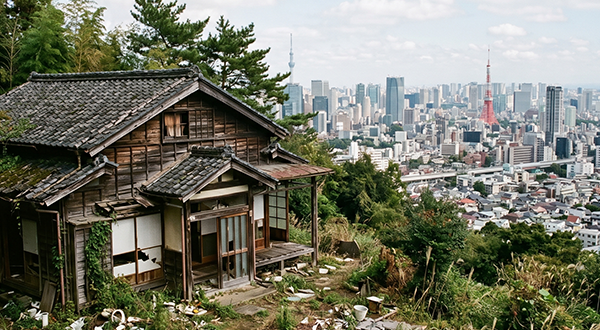
POLICY WIRE — Tokyo, Japan — There’s a quiet dread creeping across Japan, not the rumble of an earthquake or the flash of economic disruption, but something far more insidious: silence. It’s the silence of forgotten spaces, of once-vibrant homes left to wither under the relentless march of time—and, perhaps more poignantly, under the equally relentless retreat of a population. This isn’t just about dusty attics — and peeling paint; it’s a symptom of a nation grappling with its own existence.
Walk through countless prefectures, even just outside Tokyo’s frenetic pulse, and you’ll see them: an estimated 9 million houses, called ‘akiya,’ standing empty, ghosts of what once were bustling family abodes. That’s nearly one in seven homes across the archipelago, a number projected to surge to almost one in three by 2040, according to projections cited by the Nomura Research Institute. You wouldn’t expect this in a developed, densely populated country, would you? But Japan’s demographic arithmetic is brutal, and it’s rewriting the rules of real estate, one decaying roof tile at a time.
It’s not as simple as supply outstripping demand, although that’s part of the picture. The Japanese psyche, bless its traditional heart, plays a big part. New homes? Always preferred. The older ones? They’re often seen as structurally suspect or, worse, spiritually tainted by the passing of a previous owner (maybe someone even died there, gasp). So, renovating an older place, particularly in the countryside, often seems like throwing good money after bad. It’s a pragmatic, if sometimes harsh, calculation.
But the numbers don’t lie: Japan’s population has been shrinking for years. Every generation is just… smaller. Families are having fewer kids, folks are living longer, and young people are abandoning rural towns for the bright lights of mega-cities. It’s like an allegorical stuffed animal left behind, the cherished dreams of a bygone era just gathering dust.
Inheritance laws don’t help, either. When property passes down, the heirs often inherit not just the home, but its accumulated liabilities—taxes, upkeep, the sheer hassle. And sometimes, multiple siblings inherit shares, making consensus on what to do with the place practically impossible. You see why some just let them rot, don’t you? It’s easier than engaging in a family squabble over a house nobody really wants.
“We’re certainly seized of the challenge these akiya present,” explained Mr. Takeshi Sato, Director of the Housing Policy Division at Japan’s Ministry of Land, Infrastructure, Transport and Tourism, in a recent phone interview. “It’s a multi-faceted problem, complicated by deeply ingrained cultural preferences and the evolving needs of our society. But we’re working on incentivizing renovation — and reutilization schemes. It’s not a quick fix, mind you, but it’s something we have to tackle.” And he’s not wrong; the task is immense.
Because while Japan frets over its empty homes, you’ve got nations like Pakistan, for instance, facing a wholly different crisis—a housing deficit for a rapidly growing, youthful population. Think about it: a country desperately needing urban housing solutions for millions of new city dwellers every year, often grappling with informal settlements and insufficient infrastructure. It’s a jarring contrast to Japan’s silent, spectral villages where homes sit, sometimes for free, just begging for an occupant. That particular demographic divergence—a tale of two populations, one overflowing, the other evaporating—speaks volumes about global imbalances, doesn’t it?
📄 POLICY WIRE WHITEPAPER PUBLISHED: PAKISTAN'S NATIONAL SECURITY POLICY PRIORITIES
👉 READ BY CLICKING HERE“This phenomenon isn’t just about empty structures; it’s an economic drag,” Dr. Emiko Tanaka, a leading economist specializing in demographics at the Tokyo Institute of Technology, asserted during a panel discussion. “When a significant portion of your housing stock lies vacant, you’re losing potential tax revenue, impeding community development, and disincentivizing private investment. The longer these properties remain unused, the more their value declines, further exacerbating the issue. We’ve got to start thinking outside the box, perhaps with more aggressive demolition policies or state-backed renovation programs, if we’re serious about revitalizing these areas.”
The government’s attempts—some towns literally giving homes away, others offering renovation subsidies—haven’t stemmed the tide much. They’re Band-Aids on a demographic arterial bleed. And it isn’t just the sheer number of vacant houses; it’s the fragmentation, the fact that these empty spots disrupt community coherence, making services less efficient, sometimes leaving a chilling void where vibrant neighborhood life once thrummed.
What This Means
The proliferation of ‘akiya’ paints a stark picture for Japan’s future. Politically, it strains local governance. Depopulated areas mean fewer voters, dwindling tax bases, and an inevitable struggle to maintain infrastructure, from roads to schools to fire services. We’re talking about rural decay on an unprecedented scale. Mayors of small towns must now play a grim game of triage, deciding which essential services can be preserved, and which communities are simply too far gone to save.
Economically, it’s a slow-motion car crash. A stagnant housing market, particularly for older properties, locks up family wealth — and discourages investment. Why build new houses, or even properly maintain existing ones, if their value is destined to depreciate into worthlessness? But it also presents a potential opportunity, albeit a tricky one, for internal migration. Can these ‘akiya’ become affordable hubs for younger generations, remote workers, or even immigrants, thereby revitalizing struggling regions? It’s like a ghost ship, sailing on promises. The policy implications are immense: rethink zoning laws, simplify inheritance, aggressively demolish dangerous structures, and foster a new cultural acceptance of older, lived-in homes. Or, Japan risks becoming a nation not just of empty villages, but of emptied ambition, too.