


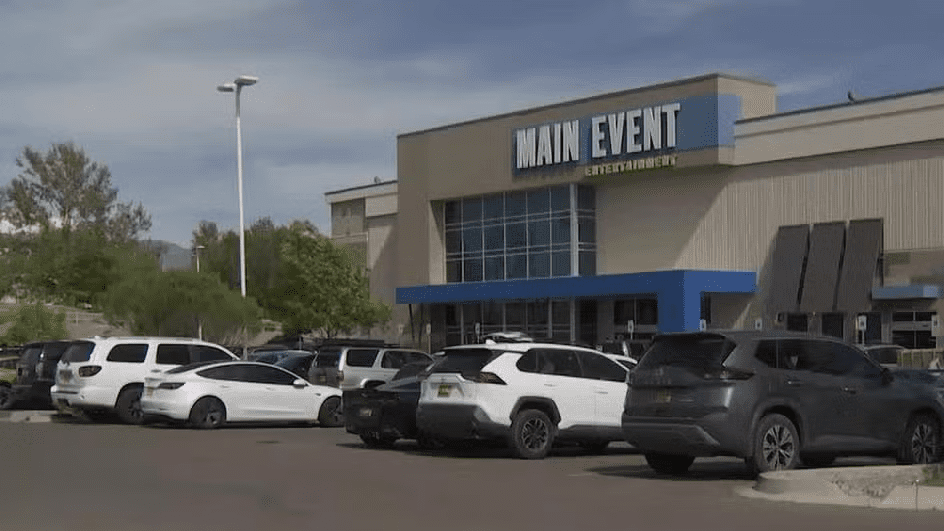
Entertainment’s Edge: Casual Confrontation Plunges Albuquerque Night into Fatal Abyss
POLICY WIRE — Albuquerque, N.M. — The flickering neon, usually a beacon of family fun and youthful diversion, morphed into a grim spotlight. It wasn’t the sound of arcade games or bowling pins...

POLICY WIRE — Albuquerque, N.M. — The flickering neon, usually a beacon of family fun and youthful diversion, morphed into a grim spotlight. It wasn’t the sound of arcade games or bowling pins scattering that punctuated the early hours of April 19 outside Albuquerque’s Main Event entertainment complex, but the chilling report of a firearm. Another night, another life extinguished in the city’s escalating ballet of casual violence.
Law enforcement officials, weeks later, have now apprehended a second suspect: 17-year-old Wyatt Drake. He now stands accused in the deadly altercation that claimed 28-year-old Isaiah Jackson-Herrera. Drake’s arrest follows that of 21-year-old Kevin Vargas, previously detained in Hobbs, painting a stark tableau of youth, grievance, and immediate, irreversible escalation. It’s a narrative that’s become unsettlingly familiar across America’s urban landscape.
Jackson-Herrera, by all accounts, was simply concluding an evening with friends — and family. A benign end to a night out, one might assume. But as his group departed the venue around 1:30 a.m., they crossed paths with Drake — and Vargas. Main Event staff, it turns out, had already taken the precaution of escorting the younger duo out after observing a firearm peeking from Drake’s backpack. A prudent measure, yet ultimately futile.
Surveillance footage and witness accounts, pieced together by detectives, suggest a fleeting moment of contention — a glance, a word, perhaps. Jackson-Herrera’s girlfriend reportedly conveyed to investigators that one of the suspects uttered something, prompting Jackson-Herrera’s challenging retort: “What did you say?” That seemingly innocuous, yet potentially loaded, phrase reportedly triggered a physical skirmish. Then, a gun, drawn with alarming speed, — and a fatal shot.
Police Chief Harold Medina, often exasperated by the city’s persistently high crime rates, recently opined on the insidious nature of such incidents. “We’re grappling with a troubling normalization of violence,” he conveyed. “It’s an issue that transcends mere law enforcement; it’s about community, accountability, and the very fabric of our society. This isn’t a battle we can win solely with badges — and handcuffs.”
Vargas, under interrogation, provided his version of events: an exchange of words, Jackson-Herrera swinging at Drake, a fall, and a desperate grab for Drake’s weapon by Jackson-Herrera — at which point, Drake fired. It’s a murky confluence of events, each detail scrutinized, each word weighty with potential culpability. Drake now faces an open count of murder, tampering with evidence, conspiracy, and unlawful possession of a handgun by a minor. Vargas, too, is charged with an open count of murder — and conspiracy. Their lives, and Jackson-Herrera’s, irrevocably altered by a confrontation that might’ve been easily avoided in another time, another place.
📄 POLICY WIRE WHITEPAPER PUBLISHED: PAKISTAN'S NATIONAL SECURITY POLICY PRIORITIES
👉 READ BY CLICKING HEREStill, the broader implications resonate. New Mexico, consistently plagued by high rates of gun deaths, registered a rate of 27.8 per 100,000 people in 2021, according to Centers for Disease Control and Prevention data — a figure substantially eclipsing the national average. It’s a statistic that underscores a relentless, tragic pattern, particularly when youth and readily available firearms intersect.
In communities across the globe, from the bustling bazaars of Karachi to the vibrant streets of Cairo, the vulnerability of public spaces to sudden, senseless violence is a haunting commonality. It’s a problem that crosses borders, highlighting the urgent, shared challenge of fostering social cohesion and reining in the widespread availability of lethal force. Mayor Tim Keller, reflecting on the broader societal degradation, shot back, “We can’t just sweep this under the rug. It’s not just about one incident; it’s about the culture that allows such casual escalation to become fatal. We’re failing our youth, — and we’re failing our public spaces.”
What This Means
The Albuquerque shooting isn’t merely another local crime blotter entry; it’s a stark, visceral indicator of a policy crisis. At its core, the incident spotlights the gaping chasm between permissive gun laws (or lax enforcement of existing ones, particularly concerning minors) and the societal expectation of public safety. When an entertainment venue — designed for escape and enjoyment — becomes a backdrop for murder, it chips away at the collective sense of security. Economically, such events ripple outward: declining patronage for businesses perceived as unsafe, diminished urban vitality, and increased demands on already strained municipal resources for policing and public health interventions.
Politically, incidents like this inevitably reignite contentious debates over gun control, youth violence prevention programs, and the efficacy of community policing models. They force difficult conversations about parental responsibility, the societal normalization of aggression, and the systemic failures that allow minors to carry firearms with such apparent ease. For policymakers, the challenge isn’t just reacting to individual tragedies, but confronting the underlying currents that allow a minor confrontation to morph into a capital crime. It’s a complex, multi-faceted problem that demands integrated solutions, not just reactive arrests. This tragic episode further underscores the increasingly fragile line between entertainment and tragedy in many American cities.