


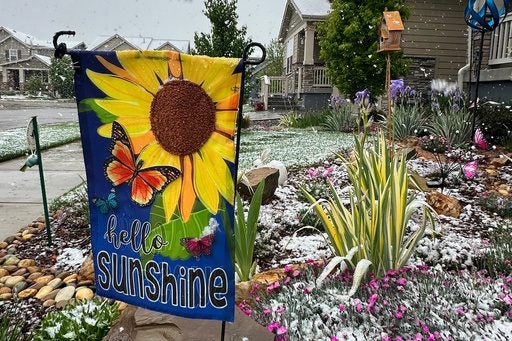
Denver’s April Snow Surprise: A Harbinger of Climate Whiplash in the American West
POLICY WIRE — Denver, Colorado — While many across the United States have already consigned their winter parkas to the back of the closet, enthusiastically welcoming crocuses and the hum of...

POLICY WIRE — Denver, Colorado — While many across the United States have already consigned their winter parkas to the back of the closet, enthusiastically welcoming crocuses and the hum of lawnmowers, residents of Colorado and Wyoming are once again contemplating the decidedly un-springlike prospect of digging out their snow shovels. And it isn’t just a dusting; a formidable late-season storm, an unwelcome guest in April’s typical balminess, is poised to engulf the Rocky Mountains and High Plains, threatening to deliver Denver’s most consequential snowfall of the season.
It’s a peculiar meteorological irony, isn’t it? Just as spring’s tender shoots tentatively breach the soil, Mother Nature, with a theatrical flourish, decides winter deserved one last, dramatic curtain call. The National Weather Service projects rain morphing into heavy, wet snow for the Mile High City by Tuesday night, potentially dumping up to eight inches (20 centimeters) on metropolitan areas. Higher elevations, however, aren’t so lucky; they’re bracing for a foot (30 centimeters) or more.
“We just had our driest winter on record,” quipped Kenley Bonner, a meteorologist with the NWS’s Denver office, reflecting on the season’s capriciousness. “We were kind of joking earlier in the season that winter’s not going to come until spring, and it did exactly that.” His observation, delivered with a wry inflection, underscores the exasperating unpredictability that has become a hallmark of regional weather patterns. This isn’t just an inconvenience; it’s a symptom, a stark reminder of environmental flux.
The blizzard’s arrival, projected to linger into Wednesday, precedes a precipitous drop in temperatures and a widespread overnight freeze. All that heavy, moisture-laden snow isn’t merely an aesthetic nuisance; it’s a tangible threat. Bonner warned of potential tree limb fractures and widespread power disruptions, hazards utility providers like Xcel Energy are already scrambling to mitigate, dispatching 165 employees across the state on standby. But one can’t help but wonder if their preparedness measures will truly be enough against such a substantial, albeit belated, assault.
So, snow in late April? It’s not wholly unprecedented, yet it remains distinctly atypical. Denver generally clocks its final flakes around April 28. Still, history offers precedents: the city saw half an inch (1.2 centimeters) on May 21, 2022, while nearby Boulder received a more substantial 4.5 inches (11.4 centimeters). The historical ledger notes at least five May storms exceeding ten inches (25 centimeters), with a monumental 15.5 inches (39.3 centimeters) descending in 1893. The city’s most recent double-digit May snowfall occurred May 25-26, 1950, when 10.7 inches (27 centimeters) blanketed the streets. And, for the record, a light dusting on June 2, 1951, remains the latest recorded snowfall in a calendar year.
Beneath the immediate disruption, this unexpected winter coda carries a more complex resonance. April, surprisingly, had been warmer than average — and notably parched. Denver had missed approximately one inch of rain (2.5 centimeters) and 2.8 inches of snow (7 centimeters) last month compared to its usual precipitation levels, according to the National Weather Service. This late-season dump, then, arrives as something of a double-edged sword: a welcome, albeit temporary, reprieve for parched landscapes, but certainly no panacea for the West’s chronic water woes. As a report from the National Drought Mitigation Center recently underlined, while recent precipitation offered a momentary boost to topsoil moisture and marginally reduced irrigation demands, it hasn’t fundamentally altered a “mostly bleak” water outlook for the approaching summer. Such fleeting relief, it’s worth noting, often obscures the larger, more intractable problems at play.
What This Means
At its core, this meteorological whipsaw – from record dry winter to a spring blizzard – isn’t just a local weather story; it’s a microcosm of the escalating climate volatility confronting societies globally. Economically, the impact stretches beyond downed power lines. Agriculture, still recovering from previous dry spells, faces renewed uncertainty. Tourism, particularly outdoor recreational activities, sees its spring season truncated. Politically, these events intensify calls for more robust climate resilience strategies and sustainable water management policies, often creating friction between short-term economic interests and long-term environmental exigencies. Governor Sarah Collins’s office issued a statement, with her chief of staff, Marcus Thorne, remarking, “This late-season deluge, while disruptive, reminds us of the profound climate volatility we’re now navigating; it’s a stark call to redouble our long-term water conservation efforts.” It’s a sentiment echoing in policy debates from Washington to Islamabad.
Indeed, the resource challenges facing the American West find stark parallels in regions thousands of miles away. Pakistan, for instance, a nation heavily reliant on glacial meltwater from the Himalayas, grapples with its own precarious balance of flood and drought, often exacerbated by rapidly changing weather patterns. Where Denver experiences an unpredictable late snow, regions like the Indus Basin confront erratic monsoon seasons and receding glaciers, threatening agricultural lifelines and national stability. The global climate isn’t just warming; it’s becoming increasingly capricious, triggering unprecedented disruptions – from sudden blizzards to unforeseen geopolitical flashpoints, as seen in recent maritime tensions (see: Red Sea Under Siege: Somali Terror Nexus Threatens Global Oil Lifeline Via Bab-el-Mandeb). So, this Denver snowfall isn’t merely a localized weather anomaly; it’s a sobering tableau of humanity’s shared vulnerability to an increasingly unpredictable planet. It’s a drama unfolding daily, across disparate geographies, but driven by a singular, overarching narrative of climate in crisis.
And these unsettled atmospheric theatrics aren’t confined to the Rockies, either. Simultaneous forecasts project thunderstorms stretching from northeast Texas into western Tennessee, with Arkansas pinned as the bulls-eye for significant hail, damaging winds, and possible tornadoes. Isolated but potent storms could also lash parts of the Northeast. The message is unequivocal: expect the unexpected; the established rhythms of seasons are, for now, simply a memory.