


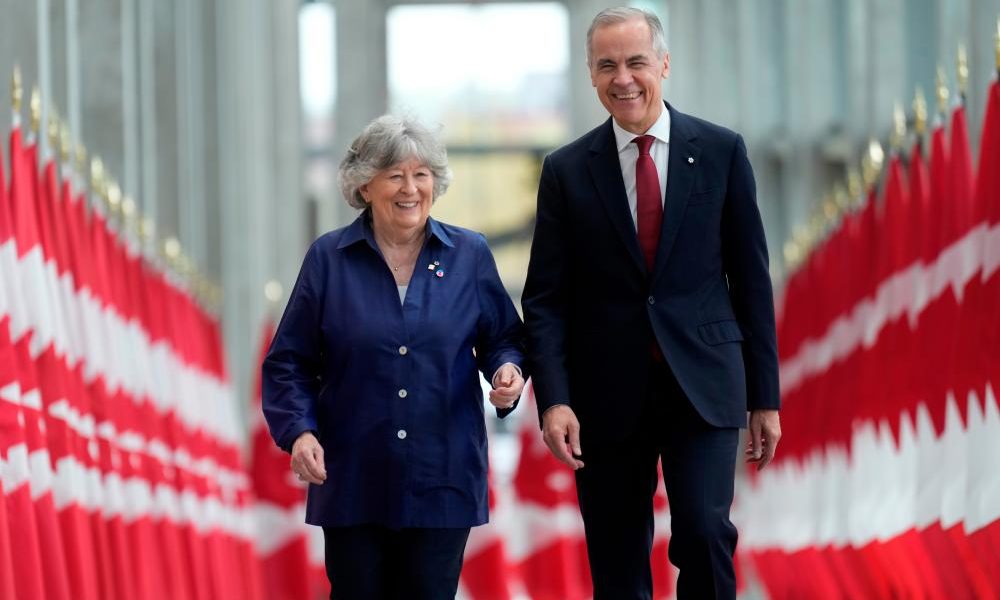
Carney’s Constitutional Gambit: Ex-Supreme Court Justice Ascends to Rideau Hall
POLICY WIRE — Ottawa, Canada — Rideau Hall, that stately bastion of Canada’s enduring constitutional monarchy, usually plays host to the predictable rhythms of statecraft. But predictability,...

POLICY WIRE — Ottawa, Canada — Rideau Hall, that stately bastion of Canada’s enduring constitutional monarchy, usually plays host to the predictable rhythms of statecraft. But predictability, it seems, has become a quaint notion in recent Canadian political life. Behind the headlines, a seismic shift has quietly occurred, one that rewrites the unwritten rules of vice-regal selection: Mark Carney, the globe-trotting former Governor of the Bank of Canada and Bank of England, has personally overseen the appointment of retired Supreme Court Justice Eleanor Vance as Canada’s 31st Governor General.
This isn’t merely a changing of the guard; it’s a recalibration of the levers of power, subtly yet profoundly. The announcement, delivered not from the Prime Minister’s Office but through a newly constituted, and frankly rather opaque, “Crown Advisory Council” chaired by Carney himself, has sent a ripple of bewildered intrigue across Ottawa’s typically unflappable political landscape. Carney, whose recent foray into public life has been marked by a pivot towards climate finance and global economic leadership, has now apparently been entrusted with (or perhaps seized) a role traditionally reserved for the Prime Minister: advising the monarch on the vice-regal appointment. It’s an audacious move, to put it mildly.
Justice Vance, a jurist of formidable intellect and a quarter-century tenure on various benches — including a decade on the nation’s highest court — brings an unimpeachable record of public service to an office often perceived as largely ceremonial. Her appointment, untainted by partisan whispers, offers a veneer of unimpeachable gravitas. Still, the architect of this selection, Carney, isn’t shying away from its unconventional genesis. “Justice Vance embodies the very best of Canadian wisdom and judiciousness,” Carney shot back during a rare press briefing, his characteristic calm belying the constitutional daring of his actions. “Her profound understanding of our legal framework and her unwavering commitment to justice will serve the Crown and all Canadians impeccably during these complex times. We weren’t looking for a caretaker; we sought a steward of unparalleled constitutional insight.”
And what of the Prime Minister’s reaction to this novel process? Prime Minister Justin Trudeau, often criticized for his own occasionally unconventional approaches to governance, offered a statement of carefully worded endorsement. “The Crown Advisory Council, under Mr. Carney’s distinguished leadership, has made an inspired choice in Justice Vance,” Trudeau’s office released, a line that struck some observers as perhaps a tad too gracious given the implicit sidestepping of traditional prime ministerial prerogative. “Her distinguished career speaks volumes, and I am confident she will uphold the dignity and responsibilities of the Governor General with exceptional grace and commitment to Canadian values.” It’s a remarkable show of unity, or perhaps, tactical acquiescence.
Justice Vance, 68, retired from the Supreme Court just last year, known for her meticulous judgments and a particular expertise in constitutional law and human rights. Her appointment marks a rare instance where a former Supreme Court justice has ascended to the vice-regal post, a path historically less trodden than those of former politicians or military leaders. Indeed, according to the Parliamentary Archives, only three of Canada’s 30 previous Governors General have had significant judicial experience prior to their appointments, underscoring the distinctiveness of Carney’s choice.
Her experience will be crucial. Canada, like many nations, grapples with its evolving place on the global stage. The Governor General, as Commander-in-Chief of the Canadian Armed Forces and symbolic head of state, often plays a subtle yet pivotal role in diplomatic engagements, particularly within the Commonwealth and in fostering international understanding. Vance’s legal background, particularly in international human rights, could subtly reframe Canada’s soft power projection. For instance, in discussions surrounding complex geopolitical issues – say, the evolving nuclear ambitions in Iran or the enduring humanitarian crises across the Muslim world – a GG with her intellectual depth could lend significant moral authority to Canada’s interventions and advocacy, quietly shaping perceptions.
📄 POLICY WIRE WHITEPAPER PUBLISHED: PAKISTAN'S NATIONAL SECURITY POLICY PRIORITIES
👉 READ BY CLICKING HEREWhat This Means
This appointment, and more importantly, its peculiar provenance, casts a long shadow over Canada’s constitutional conventions. At its core, Carney’s intervention signals a potential fracturing – or at least a significant bending – of the established process for selecting the Crown’s representative. Is this a temporary measure, born of an unspoken political exigency, or does it herald a new era where powerful, non-elected figures wield greater influence in selecting key state officials? The political implications are substantial: it could set a precedent for future prime ministers to outsource politically sensitive appointments, or it could simply be a one-off, albeit highly unusual, maneuver by a figure of Carney’s unique stature.
Economically, the appointment of a highly respected former judge, even if by unconventional means, generally signals stability. It suggests a focus on rule of law — and good governance, which tends to reassure investors. However, the unconventional process itself might, in some quarters, raise questions about the predictability of Canadian governance, a precious commodity in global finance. It’s a subtle tightrope walk: a stellar appointee, but a peculiar path to power. The question isn’t whether Justice Vance will perform admirably – she almost certainly will – but what this opaque ‘Crown Advisory Council’ means for the future of democratic accountability in Canada. Many in the capital are undoubtedly asking: whose counsel, precisely, is Carney now advising?