


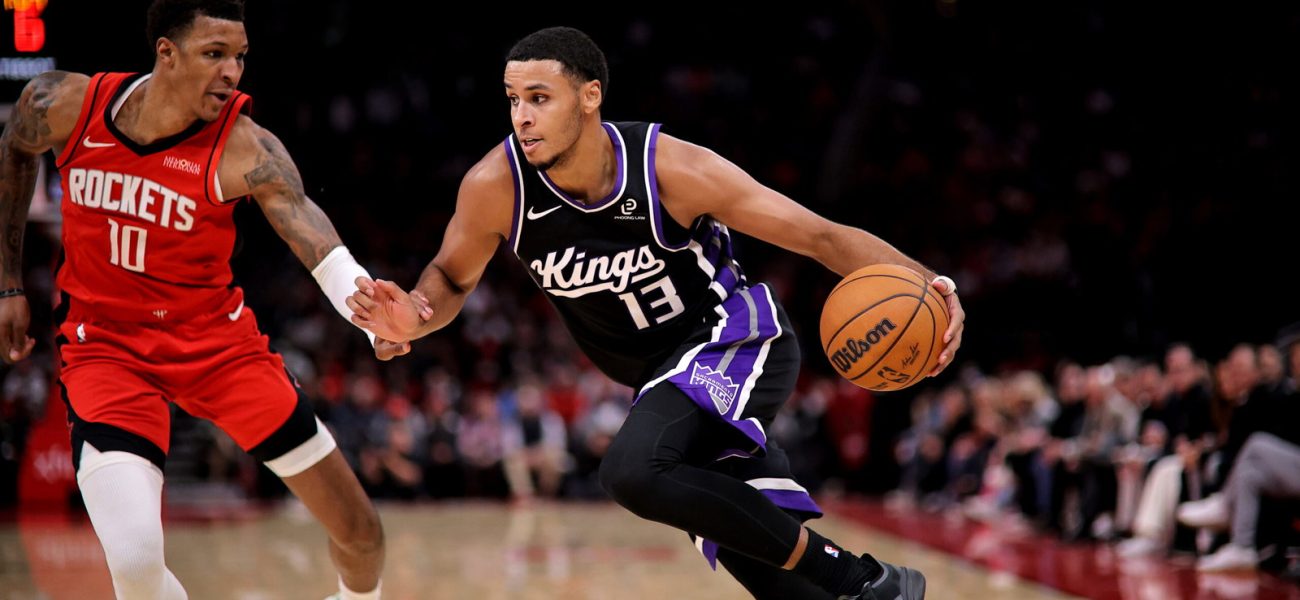
The Brutal Calculus of Versatility: Keegan Murray’s ‘Regression’ as a Microcosm of Modern Policy Shifts
POLICY WIRE — Washington D.C. — In the brutal calculus of professional sports, narratives often coalesce around the simplest metrics, overshadowing the complex strategic recalibrations...

POLICY WIRE — Washington D.C. — In the brutal calculus of professional sports, narratives often coalesce around the simplest metrics, overshadowing the complex strategic recalibrations underway beneath the surface. One need only cast an eye toward the trajectory of Keegan Murray, the promising Sacramento Kings forward, whose statistical “regression” — particularly his three-point efficiency — has become a disquieting whisper in NBA circles. But this isn’t simply a story of declining skill; it’s a trenchant illustration of how organizations, much like nations, often pivot their investment strategies, favoring diversified utility over specialized brilliance, even when it exacts a visible toll on previously lauded strengths. It’s a gamble, often a necessary one, in a perpetually volatile market.
Murray, a lanky sharpshooter whose rookie campaign shattered records — he netted 206 three-pointers, an NBA rookie benchmark at the time — arrived with a singular, coveted skill. He was the quintessential floor-spacer, a beneficiary of an offense meticulously designed to funnel him pristine looks, particularly from the benevolent orchestrations of teammate Domantas Sabonis. During that nascent year, nearly 40% of Murray’s attempts materialized with defenders a full six feet or more away, opportunities he capitalized on with an elite 46.9% conversion rate from beyond the arc. That was then, however. Now, the architectural blueprint has shifted, — and with it, Murray’s offensive real estate.
His three-point percentage, once a beacon, has receded — from a robust 41.1% as a rookie, it’s now slumped to 27.7%. Still, the raw figures, as always, obscure a more intricate tapestry. The environment itself has fundamentally transformed. What was once a high-volume diet of catch-and-shoot opportunities (over 60% of his shots, connecting at 41.1%) has dwindled to a mere 36%, with efficiency plummeting to 30.8%. Concurrently, his pull-up attempts have ballooned from just under 11% to a staggering 35% of his offense, yet his conversion on these contested looks languishes at a meager 14.3%. It’s a systemic recalibration, not just a personal slump; he’s getting fewer clean looks, and he’s increasingly asked to create his own. This season, the proportion of his wide-open looks has nearly halved to 20%, according to advanced metrics from Second Spectrum, and his success on those dwindling chances has also waned. It’s a double bind.
Behind the headlines, however, lies the rationale for this strategic pivot. Sacramento, it appears, chose to invest in a different facet of Murray’s potential: defense. His evolving role now frequently pits him against opposing teams’ premier offensive threats, a stark departure from his initial, almost purely offensive, mandate. His defensive metrics have, in turn, blossomed. He’s averaging 1.6 blocks and a steal per contest over a limited sample, a combined 2.6 “stocks” that would place him among the league’s elite over a full season. It’s an undeniable upgrade in defensive versatility, a valuable commodity in an era of stringent salary caps.
“In today’s league, you’re always making trade-offs — it’s the economic reality of the game,” observed a candid Sarah Jenkins, a prominent (and notoriously shrewd) General Manager, speaking off-record to Policy Wire. “Pure specialists? They’re becoming luxury items. We’re investing in players who can impact both ends, even if it means a momentary dip in a single, splashy metric. It’s about long-term portfolio diversification.” This strategic reorientation, while arguably beneficial for team cohesion, mirrors the economic pressures felt by developing nations — particularly those in regions like South Asia or parts of the Muslim world — compelled to diversify their economic base beyond traditional sectors, often at the temporary expense of established strengths. It’s a leap of faith, a re-allocation of finite resources with an uncertain payoff.
And Murray’s physical toll, though less discussed, also warrants consideration. He’s reportedly played through a torn thumb ligament this season, a malady that certainly doesn’t aid a shooter’s touch. It’s a factor often overlooked in the relentless pursuit of statistical perfection. “The modern athlete, much like a developing nation, is under constant pressure to diversify its economic portfolio,” quipped Dr. Aris Thorne, a leading sports economist at the Global Institute for Sports Analytics. “The market rewards adaptability, not just peak performance in a single, narrow skill set. Sometimes, that means sacrificing a headline number for foundational growth.”
📄 POLICY WIRE WHITEPAPER PUBLISHED: PAKISTAN'S NATIONAL SECURITY POLICY PRIORITIES
👉 READ BY CLICKING HEREWhat This Means
Politically, Murray’s arc serves as a microcosm of the agonizing policy decisions faced by leaders globally. Does one double down on a proven, albeit narrow, strength, or does one invest in diversified capabilities, risking short-term underperformance for potential long-term resilience? For a government, this might entail prioritizing a burgeoning tech sector over traditional manufacturing, facing initial job losses for a future competitive edge. The public, much like sports pundits, often fixates on immediate, tangible results — the missed three-pointer, the GDP dip — overlooking the deeper strategic shifts at play. It’s about managing expectations while steering a complex entity toward a more sustainable future, often a thankless task.
Economically, this situation underscores the fluctuating value of specialization versus versatility in high-stakes environments. The market — be it for NBA talent or global commodities — can abruptly devalue a previously prized, singular skill set. Players, like national economies, are increasingly incentivized to build a robust, multi-faceted skill foundation to withstand unpredictable market shifts. Murray’s defensive ascendancy, while dampening his offensive éclat, represents an expansion of his economic value proposition. It’s a painful but arguably necessary evolution, transforming him from a one-dimensional asset into a more complete, and ultimately, more valuable, commodity in the brutal labor market of professional basketball.
So, Keegan Murray’s trajectory isn’t simply a regression; it’s a redefinition. It’s a calculated gamble on versatility, an investment in a more complete player, even if it means sacrificing the crisp, headline-grabbing efficiency of his rookie season. His story isn’t just about basketball; it’s a stark reminder of the often-unseen strategic pivots that define success in an increasingly complex, and unforgiving, global arena.