


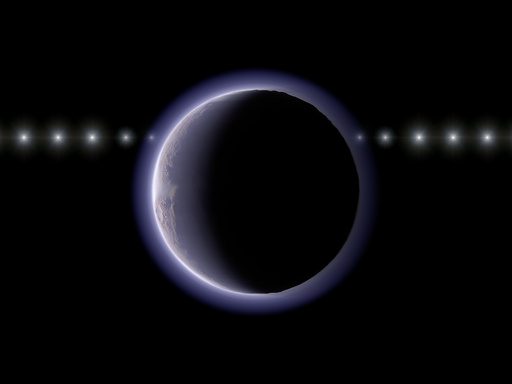
Cosmic Whisper: A Distant ‘Pebble’ Beyond Pluto Veils a Shocking Atmosphere
POLICY WIRE — CAPE CANAVERAL, Fla. — Conventional wisdom, like ancient maps, often marks the edges of the known with fearsome beasts or simply ‘terra incognita’. But now, a celestial cartographer’s...

POLICY WIRE — CAPE CANAVERAL, Fla. — Conventional wisdom, like ancient maps, often marks the edges of the known with fearsome beasts or simply ‘terra incognita’. But now, a celestial cartographer’s sharp eye has blurred that line, spotting what shouldn’t exist: a wisp of atmosphere clinging to a cosmic pebble far beyond Pluto. This startling revelation, detailed in a new study, posits a delicate atmospheric shroud around an icy, diminutive world, upending long-held tenets about how atmospheres form and persist in the solar system’s coldest reaches.
It’s a truly audacious claim. This tiny body, formally designated (612533) 2002 XV93 but colloquially dubbed a ‘plutino’ for its orbital dance, measures a mere 300 miles (about 500 kilometers) across. To put that in perspective, that’s roughly the distance from London to Paris, yet it resides over 3.4 billion miles (5.5 billion kilometers) from Earth. Its suspected atmosphere, observed by researchers using three Japanese telescopes in 2024, makes it the smallest object known to harbor such a gaseous embrace—a fact that’s got the astronomical community buzzing, if a touch cautiously. Ko Arimatsu, the lead researcher from the National Astronomical Observatory of Japan, didn’t mince words: “This was genuinely surprising, challenging the conventional view that atmospheres are limited to large planets, dwarf planets, and some large moons.”
The discovery emerged from a precise cosmic alignment, as the distant iceball traversed in front of a background star, briefly — almost imperceptibly — dimming its light. That transient flicker, astronomers contend, bore the signature of an atmosphere, likely composed of methane, nitrogen, or carbon monoxide. But here’s the rub: this ethereal veil is unbelievably thin, an estimated 5 million to 10 million times less dense than Earth’s life-sustaining blanket. It’s also 50 to 100 times more tenuous than even Pluto’s own wispy atmosphere. And yet, there it’s. Or, rather, there it appears to be.
“This is an amazing development, but it sorely needs independent verification,” shot back Alan Stern, the lead scientist for NASA’s New Horizons mission to Pluto and beyond, who wasn’t involved in the study. “The implications are profound if verified.” His caveat is well-placed; the universe, after all, loves a good trick. Still, the prospect alone expands our comprehension of planetary science, pushing the boundaries of where gas envelopes can cling, even temporarily. It’s a testament to the fact that our cosmos is far more dynamic — and unpredictable than textbooks once suggested.
Behind the headlines, this observation opens a Pandora’s Box of questions regarding atmospheric genesis. Could it be residual gas from a recent cometary impact? Or perhaps, more exotically, sustained outgassing from cryovolcanoes on its frigid surface? Arimatsu hopes for further observations, particularly from NASA’s Webb Space Telescope, to confirm the atmosphere’s makeup and its persistence. “If the atmosphere fades over the next several years, that would support an impact origin. If it persists, or varies seasonally, that would point more toward ongoing internal gas supply,” he articulated, highlighting the scientific tug-of-war at play.
📄 POLICY WIRE WHITEPAPER PUBLISHED: PAKISTAN'S NATIONAL SECURITY POLICY PRIORITIES
👉 READ BY CLICKING HEREAnd these revelations don’t just fascinate scientists in Cape Canaveral. Dr. Aisha Khan, Professor of Astrophysics at Lahore University of Management Sciences (LUMS) in Pakistan, underscored the universal appeal. “These discoveries, from the Kuiper Belt to our own backyards, remind us that the universe consistently defies our preconceptions. It’s a universal narrative, really—a testament to human curiosity that transcends borders, inspiring young minds from Lahore to Cape Canaveral.” Her sentiment underscores the shared human pursuit of understanding the cosmos, irrespective of geographical divides.
It’s another marker in humanity’s ongoing endeavor to map the unknown, a cosmic challenge to our anthropocentric assumptions about where life, or at least its constituent elements, might arise. This tiny world, nestled in the vast, dark expanse of the Kuiper Belt, suggests that even the most seemingly barren corners of our solar system may hold unexpected secrets, prompting us to reassess the very definition of a ‘world.’
What This Means
At its core, this seemingly esoteric astronomical finding carries consequential implications for both scientific funding and international collaboration. Politically, nations often vie for leadership in space exploration, recognizing its potential for technological advancement and national prestige. A discovery like this—pushing the frontiers of exoplanetary and small-body research—could galvanize renewed investment in deep-space missions and observational infrastructure. Don’t forget, these aren’t just pretty pictures; they’re data points informing future endeavors, potentially even resource prospecting in the distant future. Economically, while direct impact remains negligible for now, breakthroughs in space observation often fuel innovation in sensor technology, data processing, and materials science, trickling down into terrestrial industries. For instance, the demand for highly sensitive optics and complex data algorithms for astronomical research directly benefits the wider tech sector. This particular finding also compels astrophysicists to recalibrate their models of planetary formation and atmospheric retention, especially for objects far from the sun’s warming embrace. We’re witnessing a paradigm shift, where ‘small’ no longer automatically means ‘dead’ or ‘barren.’ It’s about reassessing the fundamental principles of astrophysics and recognizing that the universe is probably much stranger, and therefore much more interesting, than we’d ever dared to imagine. It forces a reconsideration of the cosmic dogma.