


Gridiron Allegiance Redefined: Veteran Coach Navigates Rivalry, Faith, and the Volatile Landscape of College Football
POLICY WIRE — Detroit, United States — The epithet ‘traitor’ isn’t usually hurled at a professional for simply accepting a new position. Yet, for Kerry Coombs, Michigan’s...

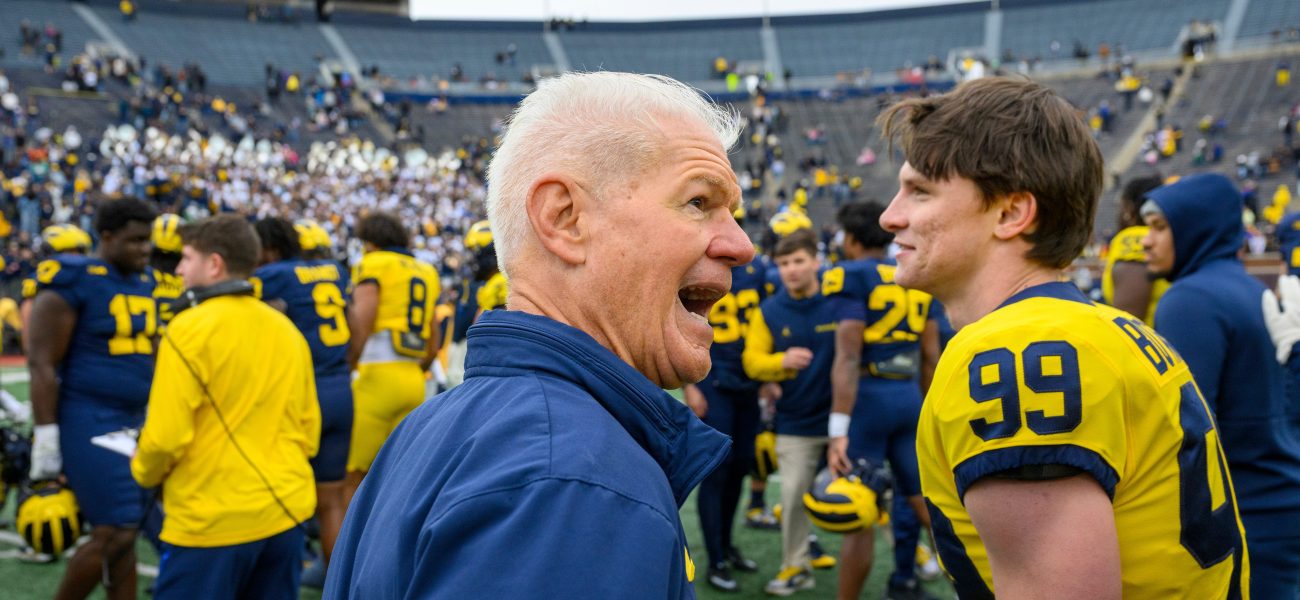
POLICY WIRE — Detroit, United States — The epithet ‘traitor’ isn’t usually hurled at a professional for simply accepting a new position. Yet, for Kerry Coombs, Michigan’s newly minted special teams coordinator, it’s become a familiar, if unsavory, soundtrack to his daily life – a testament to the visceral, almost tribal, nature of the Ohio State-Michigan football rivalry. His recent professional odyssey, a rapid-fire sequence of hiring, firing, and re-hiring, underscores a broader truth about the modern sports-industrial complex: loyalty is often a fungible commodity, and faith, occasionally, the only constant amidst professional maelstrom.
Coombs, a veteran presence who’d spent years burnishing his coaching credentials across various Ohio institutions, including a consequential stint at Ohio State, had scarcely settled into his new Ann Arbor office last December when the tectonic plates of college football shifted beneath him. Four days after his arrival, then-head coach Sherrone Moore was jettisoned under a cloud of scandal – a sudden, shocking severance that plunged the program into immediate disarray. It wasn’t merely a change of guard; it was a leadership vacuum, a moment of profound uncertainty that left many, Coombs included, wondering about their professional footing.
“It was an odd time, to say the least, and someday when I write my book, it’ll have a couple of chapters,” Coombs recently mused during a stop in Detroit, reflecting on the bewildering rapidity of events. “We’d made the decision to come up here, and we were excited about that, and in a span of, really, 72 hours, our world got turned upside down and had no idea what we were going to do.” His resilience, however, proved formidable. Coombs, despite the chaos, took the reins for the bowl game, guiding Michigan’s special teams to their most effective performance of the season – a testament to his immediate impact and leadership acumen.
And so, as former Utah coach Kyle Whittingham parachuted in to restore order to the Wolverines’ program, Coombs found himself in a peculiar holding pattern. He was a known entity in coaching circles but an unknown quantity to his new boss. Still, Whittingham, a seasoned coach with a penchant for efficiency, saw something promising. “Energetic guy,” Whittingham later opined, offering a concise, yet powerful, endorsement of Coombs. “Terrific addition for our staff — and he has got a lot of juice, a lot of passion for what he’s doing. I’ve got no doubt that we’ll be very solid on special teams with him running the show.”
The transition, however, hasn’t been without its peculiar social costs. Coombs, who still maintains a home in Cincinnati, Ohio, frequently encounters the stark reality of his defection. “When I go home, it’s interesting to me the brashness of people, complete strangers, that will walk up to you and say, ‘Traitor’ and things that are kind of hateful,” he remarked, a hint of weariness in his voice. He understands the passion, acknowledges the fierce tribalism that fuels such rivalries, but admits it’s “at times, uncomfortable.” This sort of unyielding regional fealty, while peculiar to American college athletics, isn’t entirely alien to the global stage. Indeed, the intensity with which communities in regions like Pakistan or other parts of the Muslim world often view affiliations – be they tribal, sectarian, or national – can mirror, albeit on a far graver scale, the deep-seated identity stakes Coombs now navigates. A perceived shift in allegiance, even for career advancement, can invite a swift and passionate rebuke, underscoring how deeply identity is entwined with belonging.
At its core, Coombs’ decision wasn’t purely transactional. He openly speaks of his faith guiding his professional choices. “I was praying that God would put me where I was needed and where I would be happy,” he recounted, adding, “I felt like I helped fill a void in that situation.” It’s a candid admission that elevates his move beyond mere strategic careerism, hinting at a spiritual compass that often directs individuals through life’s unexpected turns (especially in high-pressure environments). His faith, he asserts, offered solace — and direction during a uniquely turbulent period. The financial stakes, of course, underpin much of this fervor. College football, particularly programs of Michigan’s stature, isn’t merely sport; it’s a colossal industry. The top ten NCAA Football Bowl Subdivision (FBS) programs collectively generated over $1.7 billion in revenue in 2023, according to a recent analysis of NCAA financial data, a figure that dwarfs the GDP of many smaller nations. This colossal economic engine fuels the rivalries, demands the loyalty, and ultimately, rewards (or punishes) the coaches.
What This Means
Coombs’ turbulent entry into the Michigan football program offers a compelling microcosm of the broader political and economic forces at play in high-stakes organizations. The swift decapitation of a head coach for personal misconduct highlights the fragility of leadership tenure, even in institutions that project stability. It reflects a growing intolerance for scandal, a public and institutional demand for accountability that transcends mere performance metrics. the ease with which coaches—and by extension, employees in any sector—can transition between fiercely competitive entities, often facing public opprobrium for perceived disloyalty, underscores the evolving dynamics of professional mobility. In a globalized economy, traditional allegiances are frequently recalibrated against individual opportunity and organizational need.
This episode also spotlights the profound economic impact of collegiate athletics. These aren’t amateur pursuits; they’re billion-dollar enterprises where coaching decisions, team performance, and public perception directly influence vast revenue streams. The intense emotional investment of fans, manifesting as both unwavering support and vitriolic criticism (like the ‘traitor’ jibes), isn’t just about the game. It’s about regional identity, economic prestige, and the resilience of powerful brands. Coombs’ journey isn’t just a football story; it’s a commentary on professional resilience, the intricate dance of loyalty versus opportunity, and the relentless, often unforgiving, machinery of modern, high-stakes enterprise.