


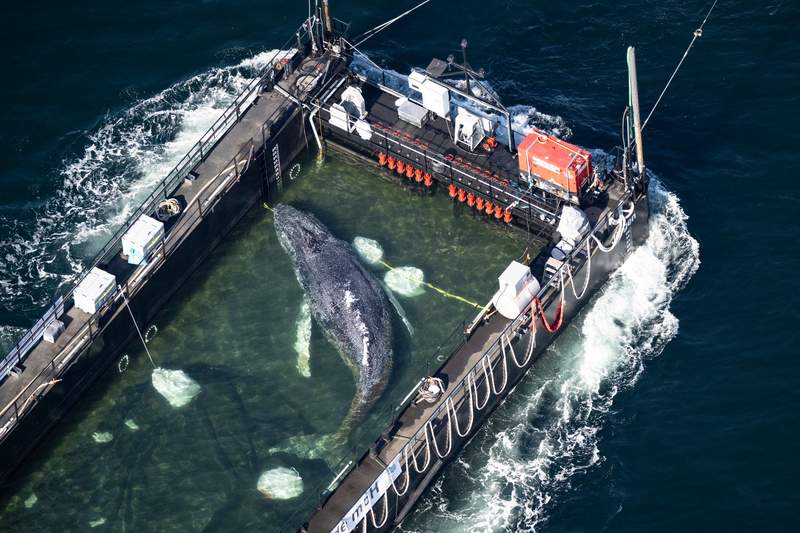
The Perilous Freedom: Timmy the Humpback’s Odyssey Exposes Fractured Ocean Policy
POLICY WIRE — [City, Country] — The human heart, ever prone to hopeful narratives, clings to tales of redemption. And so it’s with Timmy, the young humpback whale whose impending...

POLICY WIRE — [City, Country] — The human heart, ever prone to hopeful narratives, clings to tales of redemption. And so it’s with Timmy, the young humpback whale whose impending return to the deep promises a feel-good splash across headlines. But behind the celebratory murmurings of his successful rehabilitation lies a far more intricate, and often inconvenient, calculus of policy failures, financial strains, and geopolitical inertia that continues to imperil the very oceans he calls home.
Timmy, an adolescent male, found himself in distress weeks ago, disoriented and dangerously close to shore, a victim perhaps of the escalating cacophony of marine traffic or the subtle, insidious shifts in ocean currents driven by an overheating planet. His rescue wasn’t just a feat of veterinary expertise; it was a monumental logistical undertaking, mobilizing government agencies, private charities, and volunteer networks — a fleeting, resource-intensive intervention for a single leviathan. It’s a heroic effort, yes, but one that starkly contrasts with the systemic neglect afflicting global marine ecosystems.
Still, the question looms: what exactly is Timmy being released back into? It isn’t the pristine, silent ocean of a bygone era. It’s a vast, increasingly congested, — and chemically altered expanse. Our oceans are, frankly, choking. According to a 2020 study published in Science Advances, plastic emissions into the ocean could nearly triple by 2040 without drastic intervention, rising to an estimated 29 million metric tons per year. That’s a staggering figure, embodying a crisis that humanitarian efforts for individual animals can barely begin to address.
“This isn’t just about one whale; it’s about the profound ethical tightrope we walk between preserving biodiversity and acknowledging the systemic impacts of our industrial footprint,” shot back Dr. Aris Thorne, Director of Marine Conservation at the National Oceanic and Atmospheric Administration (NOAA), during a recent policy brief. His words cut through the veneer of sentimentality, pointing to the underlying tensions inherent in conservation policy.
And these tensions aren’t confined to Western shores. The same threats loom large over the coastlines of the Muslim world and South Asia, where marine life, and the human communities reliant upon it, face an equally precarious future. From the coral reefs of the Red Sea to the bustling fishing grounds of the Arabian Sea — crucial to nations like Pakistan — climate change, overfishing, and pollution conspire to dismantle fragile ecosystems. So, while Timmy’s story captures hearts, it should also galvanize political will.
“The plight of a single creature like Timmy, while compelling, ought to serve as a stark reminder of the silent famine affecting marine ecosystems globally — a crisis disproportionately impacting vulnerable coastal communities, particularly those reliant on healthy oceans for survival, from the Maldives to Pakistan,” observed Ambassador Zahra Khan, UN Environment Programme (UNEP) Special Envoy for Ocean Health. Her voice carried the weight of international diplomacy, emphasizing the interconnectedness of ecological and human welfare.
📄 POLICY WIRE WHITEPAPER PUBLISHED: PAKISTAN'S NATIONAL SECURITY POLICY PRIORITIES
👉 READ BY CLICKING HEREBut the political appetite for comprehensive, binding international agreements on ocean health often wanes when confronted with national economic interests. Who pays for the cleaner shipping lanes? Who enforces global fishing quotas? These aren’t just environmental questions; they’re deeply embedded in trade, sovereignty, — and development debates.
What This Means
Timmy’s anticipated freedom, while a cause for quiet celebration, pulls back the curtain on an inconvenient truth: our current approach to marine conservation is largely reactive, not proactive. The political implications are vast. Nations routinely sign accords, yet often lack the enforcement mechanisms — or the political will — to implement them meaningfully. This reactive stance creates a perpetual cycle of crisis management, diverting immense resources to save individual animals or rehabilitate damaged habitats, rather than preventing the harm in the first place.
Economically, the cost of inaction is staggering. Diminished fish stocks devastate coastal economies, disrupting livelihoods from Karachi to Kingston. Tourism suffers when reefs bleach. And the long-term health consequences of microplastics entering the human food chain remain an unsettling, yet under-addressed, concern. The financial burden for rescue operations like Timmy’s, often shouldered by taxpayers and donors, underscores a fundamental misallocation of resources. Couldn’t those funds be better deployed in systemic prevention, perhaps investing in advanced waste management in burgeoning South Asian megacities, or in developing truly sustainable shipping technologies?
Ultimately, Timmy’s story isn’t just about a whale. It’s a test of humanity’s commitment to its own future. Will the empathy generated by one creature’s plight translate into the sustained, difficult policy decisions required to mend our oceans? Or will we continue to celebrate individual victories while the broader war is slowly but surely lost? The perilous calculus isn’t just for politicians; it’s for all of us.