

Iowa’s Unrelenting Homage: RAGBRAI Cyclists Chase History, Not Just Horizons, for America 250
POLICY WIRE — Des Moines, USA — In a nation perpetually grappling with its identity – and occasionally, its waistline – the celebration of a momentous quarter-millennium isn’t merely a matter...

POLICY WIRE — Des Moines, USA — In a nation perpetually grappling with its identity – and occasionally, its waistline – the celebration of a momentous quarter-millennium isn’t merely a matter of fireworks or platitudes. It’s become, rather, a grueling test of corporeal fortitude. America, it appears, must now earn its 250th birthday, pedal stroke by agonizing pedal stroke, across the rolling cornfields of Iowa.
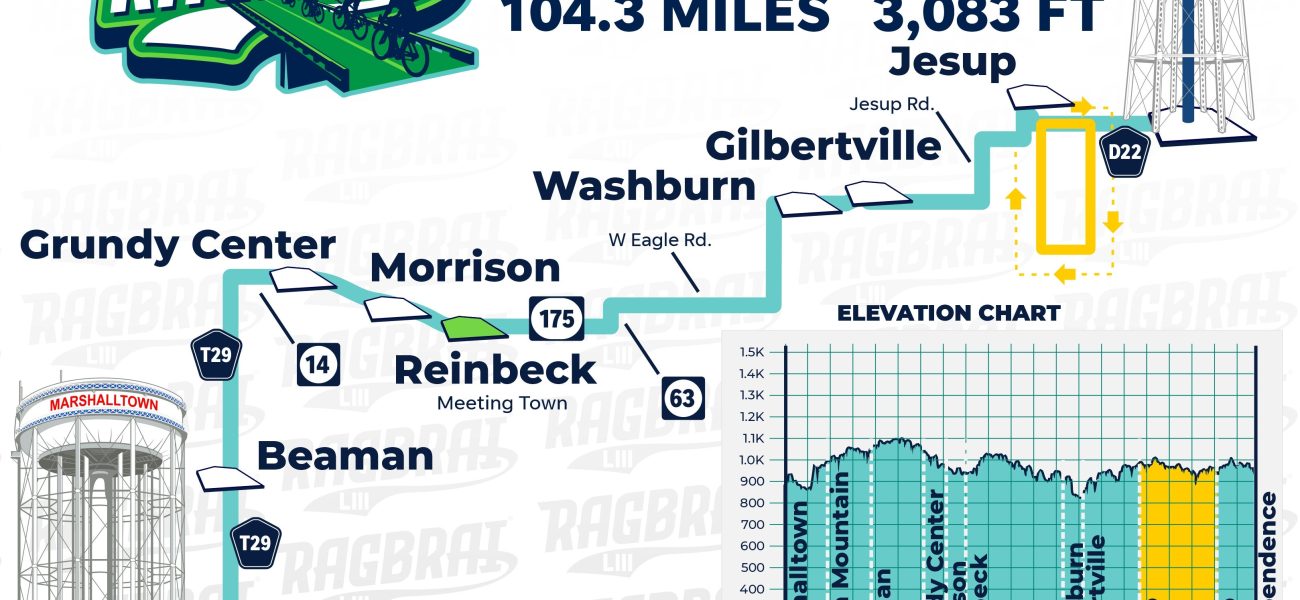
This stark truth emerged with the recent pronouncement from the organizers of RAGBRAI, the Register’s Annual Great Bicycle Ride Across Iowa. They’ve conjured a formidable challenge for 2026: an unprecedented 250-kilometer (159.6-mile) double loop for its Day 5 itinerary, a circuit specifically tailored to commemorate the nation’s sestercentennial. It’s not just a ride; it’s a modern-day pilgrimage of pain, culminating in the longest single-day stretch in the event’s storied history.
Matt Phippen, RAGBRAI Ride Director, articulated the sentiment behind this audacious proposal. “I’ve heard from countless riders, by email and phone, asking if we could create a 250-mile day to celebrate America,” Phippen declared, as the details were unveiled. He went on, underscoring the logistical tightrope, “On a week-long ride like RAGBRAI, that’s a tall order, so we took the spirit of that idea and transformed it into a 159.6-mile loop — equivalent to 250 kilometers.” The calculation is precise, the symbolism heavy-handed, the physical demand, frankly, absurd.
And what does one garner for such self-inflicted torment? Beyond the dubious bragging rights, participants in the ‘America 250 Double Loop’ are slated to acquire a commemorative challenge coin. They’ll also experience the curious novelty of passing through Jesup, Iowa, three separate times in one day—a feat of directional repetition rarely matched outside of poorly planned roadworks. But let’s not forget the sheer verticality: a staggering 4,790 feet of elevation gain, effectively turning Iowa’s gentle undulations into a series of punishing ascents. It’s a far cry from the largely flat terrain one might associate with the Hawkeye State.
Iowa State Representative Eleanor Vance, a Democrat from Dubuque, echoed the sentiment of communal endurance, noting, “RAGBRAI isn’t just a ride; it’s a testament to the indefatigable spirit of Iowans, and by extension, the American dream. It’s an economic engine, yes, but it’s also a communal pilgrimage, fostering connections across our state – something you simply can’t quantify on a balance sheet.” Her observation captures the dual nature of these spectacles: physical challenge intertwined with civic pride and tangible economic benefit.
Historically, this rolling festival typically galvanizes over 8,500 registered week-long participants, injecting an estimated $25 to $30 million annually into Iowa’s local economies, according to analyses from Iowa State University’s Department of Economics. It’s not just sweat equity; it’s significant revenue. But this 250-kilometer gauntlet promises to eclipse previous records, surpassing even the 150-mile circuit staged in 1996 to mark Iowa’s own sesquicentennial. That was an era when 150 miles seemed a monumental undertaking; now, apparently, it’s merely a warm-up.
📄 POLICY WIRE WHITEPAPER PUBLISHED: PAKISTAN'S NATIONAL SECURITY POLICY PRIORITIES
👉 READ BY CLICKING HEREStill, one might ponder, too, the stark divergence from other national celebrations globally, particularly in regions like South Asia. There, grand public spectacles often prioritize communal religious observance or parades underscoring military might and resilience against geopolitical pressures—a different sort of endurance, indeed. The focus isn’t always on self-imposed physical trials as a leisure activity, but often on the daily grind for sustenance, or the monumental challenges posed by infrastructural deficits. In nations such as Pakistan, for instance, a national day might see impassioned speeches and military parades, a collective remembrance of founding struggles, rather than an expensive, self-flagellating athletic pursuit. It underscores the profound luxury of an advanced economy capable of underwriting such recreational extremes.
What This Means
At its core, this RAGBRAI endeavor isn’t just about cycling; it’s a microcosm of contemporary American patriotism. It’s a calculated blend of extreme sports culture, historical commemoration, — and shrewd state branding. For Iowa, it’s a pivotal annual event, transforming sleepy towns into bustling hubs of commerce and camaraderie, however fleeting. It cements Iowa’s identity not just as an agricultural powerhouse, but also as a destination for robust, even masochistic, outdoor recreation.
Economically, the ‘America 250 Double Loop’ announcement injects a fresh dose of anticipation—and likely, pre-orders for enhanced cycling gear—into the consumer market. It’s a commercialization of patriotism, certainly, where national pride is expressed through purchasable apparel and specialized equipment, further stimulating local economies along the route. Politically, such events offer an unproblematic avenue for civic engagement, celebrating national unity in a divisive era. They sidestep contentious policy debates (at least directly) and instead channel collective energy into shared, if physically demanding, experience.
But there’s also a subtle, almost cynical, undercurrent. As the U.S. navigates complex global challenges, from resisting China’s protectionist lures to internal social fissures, the instinct to monumentalize celebrations through physical suffering speaks volumes. Is it an unconscious yearning for a simpler, more tangible form of achievement? Or merely an inventive way to package national pride for the affluent, leisure-focused demographic? Whatever the motivation, come 2026, thousands will sweat, curse, and ultimately triumph across Iowa, proving that for America, the celebration of endurance isn’t just symbolic; it’s a very real, very long ride.