


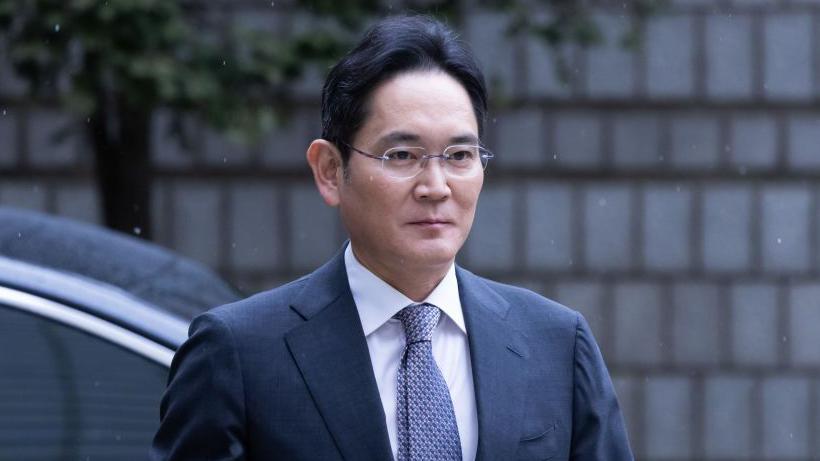
Shadows of Succession: Samsung’s Billion-Dollar Dynasty Grapples with a Jailed Scion and a Precarious Future
POLICY WIRE — Seoul, South Korea — The gilded cage, it seems, isn’t always metaphorical. Not for South Korea’s chaebol royalty, anyway. Here, where corporate behemoths aren’t just...

POLICY WIRE — Seoul, South Korea — The gilded cage, it seems, isn’t always metaphorical. Not for South Korea’s chaebol royalty, anyway. Here, where corporate behemoths aren’t just businesses but extensions of national identity, the drama playing out within Samsung’s highest echelons isn’t just a family affair; it’s a political earthquake, rattling the very foundations of the country’s economic edifice. Forget boardroom battles; this is a dynastic struggle, complete with prison terms and allegations of backdoor influence—a narrative far more gripping than any K-drama.
At its core, the saga revolves around Lee Jae-yong, often known as Jay Y. Lee. He’s the de facto head of the Samsung Group, yet his ascent has been anything but smooth. Unlike the seamless handovers seen in more conventional corporate structures, Lee’s path to full control has been paved with convictions for bribery and embezzlement, repeatedly sending him to jail. It’s a recurring tableau: the most powerful businessman in a nation of 51 million, periodically swapping his tailored suits for a prison uniform. How’s that for executive leadership?
His legal troubles stem largely from a labyrinthine merger of two Samsung affiliates—Cheil Industries and Samsung C&T—a move many saw as a thinly veiled maneuver to solidify his grip on the conglomerate. Prosecutors alleged this consolidation was orchestrated with illicit government backing, secured through bribes paid to former President Park Geun-hye’s inner circle. Lee’s defenders, naturally, paint him as a victim of political machinations, a convenient scapegoat in a nation often grappling with the murky intersection of power and capital.
“We’ve got to look forward,” Jay Y. Lee reportedly asserted during a rare public appearance, emphasizing a commitment to innovation despite past personal tribulations, “to steer this ship through the next industrial revolution, unfettered by yesterday’s shadows.” Yet, those shadows persist, long and disquieting. They’re a constant reminder of the inherent vulnerability of even the most formidable corporate empires when their leadership is so intricately entangled with political fate. And frankly, the optics aren’t great for global investors.
The implications, however, extend far beyond the family compound or even Seoul’s financial district. Samsung isn’t just a company; it’s an economic leviathan, contributing an estimated around 17% to South Korea’s GDP in some peak years, according to financial analysts. Its stability, or lack thereof, ripples through supply chains — and global markets. Consider its ubiquitous presence in South Asia: walk into any market in Lahore or Karachi, and Samsung smartphones, TVs, and appliances are everywhere. They’re not merely products; they’re integral to the burgeoning middle-class aspirations across the region, a testament to global branding and accessibility.
This deep market penetration means that any instability at Samsung’s helm—any executive vacuum or strategic hesitation—could subtly impact consumer confidence and even regional employment. Pakistan’s electronics market, for instance, relies heavily on these global giants. When a company of Samsung’s stature faces such internal disarray, it inevitably casts a long shadow over investor sentiment for emerging markets, questioning the long-term viability of partnerships predicated on stable leadership. It’s a subtle but palpable anxiety.
📄 POLICY WIRE WHITEPAPER PUBLISHED: PAKISTAN'S NATIONAL SECURITY POLICY PRIORITIES
👉 READ BY CLICKING HEREMinister Kim Hyun-joo, speaking from the Ministry of Economy — and Finance, didn’t mince words. “The stability of our chaebol isn’t just about corporate balance sheets,” she observed, her tone measured but firm, “it’s directly intertwined with our national prosperity, our very global standing. We must ensure robust governance, for everyone’s sake.” Her statement underscores a perennial tension: how to maintain the economic engine of the chaebol while simultaneously pushing for greater transparency and accountability.
But can a company truly innovate and thrive when its top executive is battling legal woes, navigating the unpredictable currents of political pardons, and constantly defending his legitimacy? It’s a question without an easy answer. This isn’t some startup flailing; it’s a meticulously built empire, sustained by generations of ambition and, yes, a certain amount of opaque deal-making. The drama, for now, continues to unfold, leaving the world to wonder just how many more acts this dynastic play has left.
What This Means
The protracted succession saga at Samsung isn’t merely a corporate headache; it represents a critical juncture for South Korean political economy. Economically, prolonged leadership uncertainty can stymie long-term strategic investments and innovation, especially in emerging tech sectors where agility is paramount. A leader frequently embroiled in legal battles can’t devote undivided attention to global competition from rivals like Apple or Huawei. Politically, the recurring legal troubles of a figure as prominent as Jay Y. Lee underscore the unresolved tension between South Korea’s powerful chaebol — and its democratic institutions. It highlights the persistent challenge of curbing corporate influence in politics—a battle that successive administrations have vowed to fight, often with limited success. The international perception of South Korean corporate governance also takes a hit, potentially deterring foreign investment that seeks stability and transparent regulatory environments. This isn’t just about Samsung’s next smartphone; it’s about the very model of South Korean capitalism and its ability to adapt to 21st-century demands for ethics and accountability.