


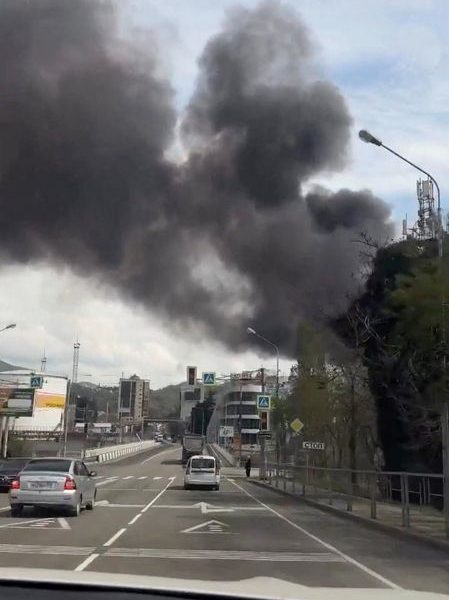
Black Sea Blaze: Ukraine’s Refinery Strikes Escalate Economic Warfare, Rattling Global Oil Nerves
POLICY WIRE — Kyiv, Ukraine — Sometimes, the most consequential shifts in geopolitical strategy aren’t declared from podiums but etched in fire and smoke. Moscow, for all its bluster, now finds...

POLICY WIRE — Kyiv, Ukraine — Sometimes, the most consequential shifts in geopolitical strategy aren’t declared from podiums but etched in fire and smoke. Moscow, for all its bluster, now finds key pieces of its economic engine — its vital energy infrastructure — increasingly within Ukraine’s crosshairs. This isn’t merely about hitting targets; it’s about altering the calculus of a protracted war, forcing a global re-evaluation of Russia’s resilience and Kyiv’s expanding reach.
Ukrainian drones, it seems, aren’t just a nuisance anymore; they’ve become a precision instrument of economic warfare. The recent strike on the Tuapse oil refinery, a critical facility on Russia’s Black Sea coast, wasn’t an isolated incident. It was the latest in a series that has systematically targeted Russian energy assets, underscoring Ukraine’s growing capacity to inflict pain far behind the front lines. The reverberations? They’re felt not just in Moscow’s coffers, but in the volatile dance of global oil markets.
And these are not trivial targets. The Tuapse facility, an integral part of Rosneft’s operations, processes millions of tons of crude annually, contributing significantly to Russia’s fuel supply and export capacity. Disrupting such a node sends a stark message: Ukraine isn’t just defending territory; it’s attacking the very revenue streams funding the invasion. Kyiv officials, understandably, frame these actions as legitimate responses to Russia’s ongoing aggression. “We’re not just fighting for our land; we’re dismantling the enemy’s ability to wage this barbaric war,” asserted Mykhailo Podolyak, advisor to Ukraine’s presidential office, in a recent communique. “They can’t expect to fuel their aggression with impunity while raining terror on our cities. This is a proportional, necessary response to protect our people — and our future.”
But the Kremlin, predictably, sees things rather differently. President Vladimir Putin, while acknowledging the strikes, has pivoted hard, lamenting what he characterizes as an intensifying campaign against Russian civilian targets. This narrative, often amplified by state media, attempts to paint Ukraine as a terrorist state, a convenient deflection from the strategic impact of these operations. “These despicable attacks, enabled by Western patrons, are nothing short of state-sponsored terrorism,” shot back Dmitry Peskov, the Kremlin’s unflappable spokesperson, during a briefing. “Such reckless provocations will undoubtedly be met with a response of commensurate force, further jeopardizing regional stability and global energy security.” It’s an old tactic, blaming the victim while attempting to project strength.
Still, the realpolitik consequence is undeniable. Russia’s refining capacity, crucial for converting crude oil into exportable fuels and domestic consumption, is under tangible threat. Analysts from the International Energy Agency (IEA) reported that Russia’s crude oil exports via maritime routes hovered at nearly 5 million barrels per day in late 2023, making any disruption to its refining infrastructure a profound economic pressure point. Fewer refined products mean reduced export revenues and potential domestic fuel shortages — two outcomes Moscow desperately wants to avoid.
📄 POLICY WIRE WHITEPAPER PUBLISHED: PAKISTAN'S NATIONAL SECURITY POLICY PRIORITIES
👉 READ BY CLICKING HEREBehind the headlines, these strikes carry global implications, particularly for energy-hungry economies in the developing world. Consider nations like Pakistan, already wrestling with a precarious debt burden — and surging inflation. Any upward pressure on global oil prices, exacerbated by instability in Russia’s energy sector, could trigger a cascading economic crisis there (a phenomenon not unlike Sri Lanka’s recent economic travails). So, while Kyiv aims to hobble Moscow, the ripple effects can destabilize distant, vulnerable markets across South Asia and the wider Muslim world, impacting everything from food prices to manufacturing costs. It’s a cruel feedback loop, isn’t it?
What This Means
This escalation fundamentally alters the war’s economic dimension. Ukraine’s targeting of Russian refineries is a calculated move to degrade Moscow’s war-making capacity, forcing it to divert resources from the front lines to protect vital domestic assets. Politically, it signals Kyiv’s unwavering resolve and its willingness to expand the geographical scope of the conflict, albeit in a strategically targeted manner. Economically, these strikes, even if temporarily disruptive, add a risk premium to global oil prices, directly impacting consumers and importers worldwide. For Russia, it’s a direct challenge to its economic lifeline; for Ukraine, it’s a demonstration of strategic ingenuity and a new front in its existential struggle. The Kremlin faces a difficult choice: escalate further in retaliation against Ukrainian cities, risking deeper international condemnation, or commit significant air defense assets to protect its sprawling industrial heartland, thus thinning its air cover over the battlefield. Neither option is palatable, revealing the growing efficacy of Kyiv’s asymmetric strategy.