


Optimus Prime’s Marathon Feat: A Spectacle, a Record, and a Resilient Statement
POLICY WIRE — London, UK — It wasn’t the searing pace of elite athletes, nor the calculated strategies of seasoned marathoners, that truly captured the zeitgeist at this year’s London...

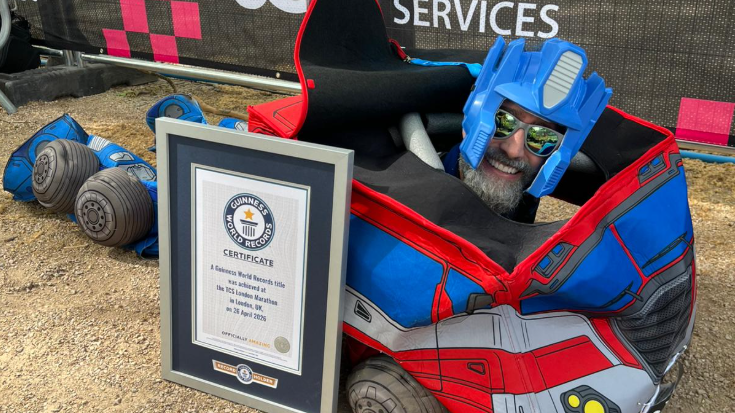
POLICY WIRE — London, UK — It wasn’t the searing pace of elite athletes, nor the calculated strategies of seasoned marathoners, that truly captured the zeitgeist at this year’s London Marathon. No, it was a colossal, boxy, red-and-blue automaton—or rather, a human beneath its elaborate facade—that delivered a particularly pointed commentary on contemporary endurance, philanthropy, and the peculiar spectacle of public life. Matt Batchelor, a 40-year-old from Milton Keynes, didn’t just complete the punishing 26.2-mile course; he conquered it, establishing a new Guinness World Record for the fastest marathon run dressed as a 3D toy. He did it as Optimus Prime, leader of the Autobots, transforming not just a costume but, perhaps, the public’s perception of what constitutes a policy-relevant event.
Batchelor’s audacious undertaking, culminating in a time of 4 hours, 19 minutes, and 23 seconds, obliterated the previous record by a significant half-hour. At its core, this wasn’t merely a quirky footnote in athletic history. It was a potent, if accidental, demonstration of individual agency channeled through a universally recognizable cultural artifact, spotlighting a personal health battle, and ultimately, benefiting a cause far removed from intergalactic robot warfare.
And what a show it was. Observers along the route noted the almost surreal sight of the towering figure—its rigid angles and vibrant hues contrasting sharply with the flowing movements of other runners—battling not just the distance but the inherent unwieldiness of its form. The moment of triumph, as Batchelor crossed the finish line and, in an act of theatrical commitment, literally ‘transformed’ his costume back into its truck configuration by crawling along The Mall, was an instant legend. As Batchelor himself later opined, the DJ’s timely blast of the Transformers theme song cemented an “absolutely epic” and “incredible moment.” It’s the kind of public theater that, while seemingly frivolous, often galvanizes collective spirit far more effectively than any dry government campaign.
But behind the headlines — and the vibrant imagery lay a more profound narrative. Batchelor wasn’t merely chasing a novelty record; he was running to raise awareness and funds for Thrombosis UK, a cause close to his heart after he experienced a severe deep vein thrombosis (DVT) in April 2024. This personal crucible, a brush with a potentially life-threatening condition, fueled his improbable quest. It’s a stark reminder that even in the most outlandish endeavors, a very human, very vulnerable motivation often resides. “This type of public spectacle, while undeniably whimsical, serves a critical function,” remarked Dr. Eleanor Vance, Director of Public Health Advocacy at the British Medical Association, in a Policy Wire interview. “It translates complex health concerns into accessible, memorable narratives that resonate broadly, driving donations and crucially, conversations around prevention and treatment. We simply couldn’t buy that kind of engagement.”
Still, the spectacle’s reach transcends national borders. Pop culture icons like Optimus Prime don’t respect geographical demarcations. From the bustling streets of Lahore to the mega-cities of Malaysia, the Transformers franchise commands a fervent, multi-generational following. This universal recognition means Batchelor’s story—of endurance, personal triumph over adversity, and charitable action—finds echoes across diverse cultures, including within the South Asian and Muslim world, where such feats of human spirit and communal support are deeply valued. It’s a testament to the globalized nature of both entertainment — and altruism.
Government officials, ever keen to tap into the public mood, didn’t shy away from acknowledging the broader implications. “Mr. Batchelor’s record-breaking run, beyond its sheer athleticism, embodies a quintessential British spirit of ingenuity and generosity,” stated Nigel Hawthorne, Under-Secretary for Sport and Civil Society. “It’s these vibrant, community-led initiatives that truly underpin our nation’s charitable infrastructure. They’re a cornerstone of our social fabric, proving that even seemingly whimsical pursuits can have momentous societal impact.” (Hawthorne’s office later confirmed he’s a lifelong fan of Autobots, which explains his rather ebullient tone, doesn’t it?).
📄 POLICY WIRE WHITEPAPER PUBLISHED: PAKISTAN'S NATIONAL SECURITY POLICY PRIORITIES
👉 READ BY CLICKING HEREThe numbers don’t lie: Guinness World Records officially authenticated Batchelor’s achievement, confirming he shaved 34 minutes off the previous benchmark of 4:53:30. This isn’t just about athletic performance; it’s about the intersection of cultural capital and charitable giving, a symbiosis that increasingly defines modern fundraising efforts.
What This Means
This whimsical record isn’t just a feel-good story; it inadvertently illuminates several critical policy intersections. Firstly, the potent role of individual action in bolstering public health initiatives. Governments globally grapple with effective messaging for preventative health; a man running as a giant robot to highlight DVT awareness achieves cut-through that clinical campaigns often don’t. It’s a form of soft power, not just for the UK’s charitable sector, but for the very idea of civic engagement.
Economically, the phenomenon underscores the often-underestimated resilience and economic heft of the charity sector. Marathons like London generate millions in revenue and donations, contribute significantly to local economies through tourism and hospitality, and create a powerful, positive brand image. The blending of popular culture with philanthropy also offers insights into contemporary marketing and engagement strategies for non-profits; attention-grabbing stunts, however absurd, convert to visibility and donations. For policymakers, understanding how to foster and leverage such grassroots ingenuity—which sidesteps traditional bureaucratic hurdles—is paramount. It’s a testament to how the absurd can, paradoxically, be deeply consequential.