


Silicon’s Shudders, Strait’s Squeeze: Wall Street Grapples with Dual Pressures
POLICY WIRE — NEW YORK — For weeks, the AI gold rush felt inexorable, its titans ascending to stratospheric valuations with nary a glance back. But suddenly, the dazzling façade of...

POLICY WIRE — NEW YORK — For weeks, the AI gold rush felt inexorable, its titans ascending to stratospheric valuations with nary a glance back. But suddenly, the dazzling façade of silicon’s boundless prosperity seems to be cracking, replaced by a disconcerting tremor that’s left Wall Street feeling rather vulnerable. It isn’t just some abstract market correction, not really. This week, the tech sector’s much-vaunted vanguard took a precipitous dive, coinciding uncomfortably with oil’s relentless march upward—a dual-pronged assault on investor equanimity.
And so, after a seemingly endless run of highs, the market’s ebullient ascent stalled. The S&P 500, having recently kissed a new all-time peak, shed 0.6%, dragged down by the very innovators it had so ardently championed. The Nasdaq composite, a bellwether for technology’s speculative zeal, saw an even steeper decline, tumbling 1.1% from its own record. Only the more staid Dow Jones Industrial Average, less entangled in the tech frenzy, managed to eke out a modest 0.1% gain, hinting at a broader market unease that tech’s glitter couldn’t quite obscure.
At its core, this tech-led stumble emanated from a startling report. The Wall Street Journal suggested that OpenAI, the progenitor of ChatGPT and a darling of the AI revolution, was grappling with internal concerns. Missing user targets and revenue goals? That’s not exactly the kind of whisper you want circulating when you’re burning through cash to fuel massive data centers. Nvidia, whose chips are the literal brains of this new digital era, was particularly punished, cratering 2.5% and acting as the heaviest anchor on the S&P 500. Drops of 4.8% for Broadcom and 4.3% for Micron Technology piled on, making it one of the market’s gloomiest days in a month. It truly beggars belief: could the whole AI edifice, so confidently constructed, be less a tower of power and more a house of cards?
“It’s an inflection point, isn’t it?” mused Dr. Evelyn Reed, Chief Market Strategist at Vanguard Capital, during a morning call with clients. “Everyone’s been quick to pour billions into AI, but now we’re demanding to see the receipts — real revenue, not just visionary promises. Investors are asking: where’s the profit in all that perplexity?” Indeed, the upcoming quarterly earnings reports from giants like Alphabet, Amazon, Meta Platforms, and Microsoft — all voracious consumers of AI investment — will provide a stark reckoning. They’ll either validate the colossal outlays or deepen the skepticism that this entire industry might be caught in an unsustainable bubble, long on hype and short on tangible returns.
Still, the market’s disquiet wasn’t solely intellectual. A much more ancient, visceral fear also seized traders: the inexorable ascent of oil prices. The ongoing volatility stemming from the Iran war has proved a persistent, destabilizing force. Brent crude, the global benchmark, for June delivery surged 2.7% to a staggering $111.18 a barrel. For July delivery, the price climbed 2.6% to $104.33, nearing the $119 peak witnessed at the war’s most feverish moments. The geopolitical ripples extend far beyond the immediate conflict zone.
And where’s the pinch felt most acutely? The Strait of Hormuz. That narrow, vital artery — the world’s most critical oil chokepoint — remains a focal point of apprehension. Its effective closure, a constant threat, could leave tankers marooned in the Persian Gulf, denying vital energy to global consumers. When the Trump administration appeared unlikely to accept Iran’s offer to reopen the Strait in exchange for lifting sanctions, the message was clear. “Our posture remains unequivocally firm,” US Secretary of State Marco Rubio shot back during a recent interview, dismissing suggestions of easing sanctions in exchange for Strait access. “We aren’t trading core security principles for temporary oil relief.” Such intransigence, however principled, has immediate, brutal consequences for consumers. The average price for a gallon of gasoline in the United States reached $4.18 on Tuesday, the most since 2022, according to the auto club AAA. But it’s not just America feeling the squeeze; these surging oil costs aren’t merely an American headache — they’re an existential threat for import-reliant nations like Pakistan, threatening to destabilize already precarious economies and potentially reignite social unrest over basic necessities. The global scramble for resources just got hotter. This isn’t just about market sentiment; it’s about the literal cost of existence for millions.
📄 POLICY WIRE WHITEPAPER PUBLISHED: PAKISTAN'S NATIONAL SECURITY POLICY PRIORITIES
👉 READ BY CLICKING HERECuriously, not all news was grim. JetBlue Airways, despite posting a worse loss than anticipated for the start of 2026, saw its stock improbably climb 2.3% — CEO Joanna Geraghty’s forecast of strengthening customer demand through the quarter seemed to defy immediate woes. And Coca-Cola? It bubbled up 5.7% after delivering stronger-than-expected profit and revenue, buoyed by robust sales in China, the United States, and India (and don’t we all love cheap bubbly, even if the world’s on fire?).
In the bond market, Treasury yields remained largely steady, even after a surprising report indicated US consumers were feeling slightly more confident in April — economists had, rather pessimistically, anticipated a decline. The yield on the 10-year Treasury barely budged, inching to 4.36% from Monday’s 4.35%. This all unfolds just as the Federal Reserve is slated to announce its latest decision on short-term interest rates. The widespread expectation? They’ll hold the federal funds rate steady, resisting the temptation to resume cuts. Lower rates would certainly provide an economic balm, yet they risk exacerbating inflation, particularly with oil so expensive and fresh tariffs threatening to push prices higher.
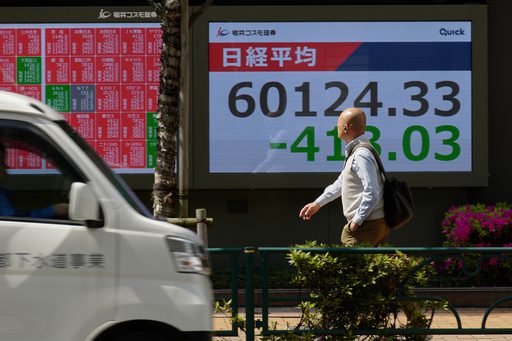
Compounding the monetary drama, the Senate Banking Committee will cast its vote on Wednesday on President Donald Trump’s nominee, Kevin Warsh, to succeed Fed Chair Jerome Powell. Confirmation, it seems, is largely anticipated, potentially ushering in a new era of central bank leadership amidst this turbulent economic tableau. Overseas, markets mirrored the prevailing uncertainty: European indexes were mixed, while Asian bourses registered declines. Japan’s Nikkei 225, for instance, shed 1% after the Bank of Japan, in a split decision, opted to keep its key interest rate unchanged, sagely noting, “There are various risks to the outlook. For the time being it’s necessary to pay particular attention to the impact of the future course of the situation in the Middle East.” A truly understated observation, that.
What This Means
The market’s recent convulsion underscores a precarious, multifaceted global economic reality. Politically, the deepening Middle East imbroglio, epitomized by the Strait of Hormuz standoff, isn’t merely driving up energy costs; it’s a constant, volatile geopolitical pressure cooker. This directly impacts nations globally, especially those in the Muslim world and South Asia reliant on imported energy, threatening their fiscal stability and social cohesion. Economically, the dual threat of potentially overvalued AI tech stocks — a speculative bubble perhaps — converging with stubborn, inflation-stoking oil prices presents a formidable challenge for policymakers. The Fed’s tightrope walk between taming inflation — and supporting growth becomes ever more fraught. the changing of the guard at the Federal Reserve, should Warsh be confirmed, introduces an additional layer of policy uncertainty during a period demanding unequivocal leadership. Ultimately, what we’re witnessing isn’t simply a market dip; it’s a stark reminder that even in an age of digital marvels, tangible geopolitical realities and the immutable laws of supply and demand still hold potent, unpredictable sway over our collective financial fortunes.