


Echoes of Rupture: Israel’s Strategic Obliteration of Mines Recasts a Volatile Frontier
POLICY WIRE — Jerusalem, Israel — The ground, for decades, has held its breath along the contentious demarcation line separating Israel from Syria. A silent sentinel, an unseen threat, lay buried...

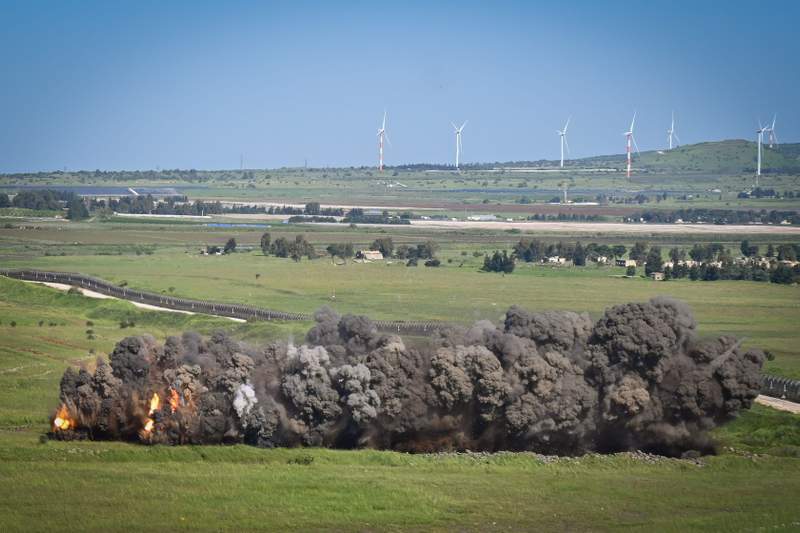
POLICY WIRE — Jerusalem, Israel — The ground, for decades, has held its breath along the contentious demarcation line separating Israel from Syria. A silent sentinel, an unseen threat, lay buried beneath the verdant expanse of the Golan Heights, a legacy of wars fought and stalemates endured. But last week, that silence was shattered by a calculated series of detonations: Israel’s Defense Ministry, in a meticulously orchestrated operation, obliterated some 700 landmines that had festered in the earth near the Syrian frontier.
It wasn’t merely a clean-up; it was, at its core, a strategic recalibration. These aren’t the relics of some forgotten skirmish, mind you, but active, potent instruments of war, remnants of a bygone era’s defensive posturing. Their removal marks a nuanced shift, perhaps a quiet acknowledgment of evolving security requirements – or perhaps, a bolder assertion of control over territory long disputed. And it doesn’t escape the keen observer that such actions always carry layers of intent, both declared — and unspoken.
Defense Minister Yoav Gallant, a man not prone to understatement, framed the action with an air of practical inevitability. “Our commitment to securing our borders is unwavering,” he shot back when questioned on the broader implications of the clearance. “But so too is our responsibility to ensure the safety of those who live — and work in these areas. These mines, once necessary, now pose an unacceptable risk to civilians and hinder essential infrastructure development.” It’s a compelling narrative, certainly, for a population accustomed to living on the precipice of conflict.
Still, the view from Damascus, unsurprisingly, is starkly different. For Syrian officials, such Israeli maneuvers are invariably acts of aggression, infringements on their sovereignty, irrespective of the stated humanitarian aims. “Israel’s actions in the occupied Golan are illegal and provocative,” bristled a spokesperson for the Syrian Foreign Ministry, Dr. Bassam al-Sabbagh (an individual known for his unyielding diplomatic posture), in a statement relayed through state media. “These unilateral acts only serve to escalate tensions — and deepen the wounds of occupation. The international community must hold them accountable for their continued violations.” It’s a familiar refrain, one that underscores the enduring chasm between the two nations.
Behind the headlines of explosive clearance lies a more profound geopolitical narrative. The Golan Heights, seized by Israel in 1967 and effectively annexed in 1981, remains a critical strategic perch overlooking both countries. Removing these defensive assets might suggest Israel’s confidence in alternative, perhaps technologically advanced, means of border surveillance and interdiction. Or it could signal a long-term vision for the area, one that anticipates civilian expansion or even agricultural initiatives, albeit within a perpetually militarized zone. After all, Israel’s Defense Forces aren’t in the habit of weakening their own hand without good reason.
Such demining efforts, while lauded by humanitarian organizations, aren’t unique to this particularly fraught corner of the Middle East. Consider the perennial struggle in regions across the Muslim world – from Afghanistan to parts of Southeast Asia – where the ghastly legacy of landmines continues to claim innocent lives long after the last bullet has been fired. Pakistan, for instance, grapples with its own complex, often volatile, borders, where military operations and insurgent activities have left behind a similar, invisible scourge. The ongoing concerns over cross-border incursions and the use of force, as seen with Pakistan’s airstrikes near the Afghan frontier, underscore how deeply intertwined security and humanitarian crises often are.
And it’s a global scourge, too. According to the Landmine Monitor 2023 report, landmines and explosive remnants of war (ERW) caused at least 4,710 casualties globally in 2022 alone. The sheer scale of that number—nearly 13 people maimed or killed each day—puts Israel’s localized clearance operation into stark, humanitarian relief, even if the primary motivation remains strategic. It’s a sobering reminder of war’s lingering ecological footprint.
What This Means
This systematic neutralization of older minefields carries several consequential implications. Politically, it’s a subtle yet potent signal from Israel. It might indicate a diminished expectation of a conventional ground assault from Syria – a nation still reeling from over a decade of civil war and firmly entrenched in Iran’s orbit. But it also demonstrates Israel’s sustained, muscular control over the Golan, rendering the territory not just occupied, but actively integrated and made ‘safer’ for its residents.
Economically, cleared land represents potential. Agricultural expansion, tourism (however unlikely in a war zone), or even specialized industrial development become theoretical possibilities where once only danger resided. The removal of these hazards, while costly, is an investment in the long-term viability of the area, potentially opening pathways for significant infrastructure projects. It’s expensive work, demining, but the alternative—leaving a landscape peppered with death—is far costlier in human terms.
the operation serves as a quiet humanitarian gesture, albeit one secondary to overt security considerations. Reducing the risk of accidental civilian casualties from antiquated ordnance bolsters Israel’s international image, at least on this particular front. It also underscores a broader, if often begrudging, recognition by states of the devastating, indiscriminate impact of landmines. In an era of increasingly precise warfare, the blunt instrument of the landmine stands as a morally vexing anachronism. Its removal, even for strategic ends, can’t be entirely divorced from a broader ethical imperative. The ground, now cleared, may finally exhale, but the air above it remains thick with unresolved tensions.