

Toyota’s Tiny Titan: The GR Racer’s Surprising Leap from Racetrack to Recess
POLICY WIRE — Tokyo, Japan — In an era where corporate behemoths meticulously guard their gravitas, Toyota, a marque synonymous with both staid reliability and blistering performance, has executed an...

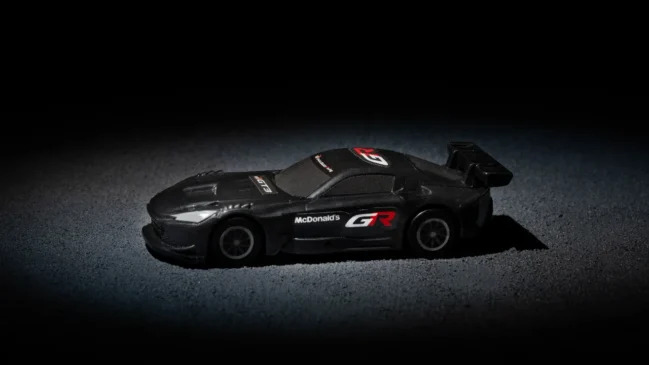
POLICY WIRE — Tokyo, Japan — In an era where corporate behemoths meticulously guard their gravitas, Toyota, a marque synonymous with both staid reliability and blistering performance, has executed an unexpected pivot. It’s taken the aggressive, track-devouring essence of its GR GT3 concept car — a machine designed for grueling endurance races and petrolhead reverence — and distilled it into a plastic, palm-sized trinket for the pre-adolescent demographic. The sheer audacity of morphing a potent, competition-spec vehicle into what effectively amounts to a Happy Meal companion isn’t just a marketing ploy; it’s a profound strategic play, one that begs examination.
Behind the headlines of brightly colored plastic — and childish glee lies a calculating corporate strategy. For decades, automotive giants cultivated loyalty through aspirational advertising — and showroom allure. But the landscape shifts. Now, it’s about sowing seeds early, sometimes ludicrously so. A high-performance race car, typically the purview of affluent enthusiasts, now becomes an accessible, tangible fantasy for toddlers. And it works.
But why? It’s not just about immediate toy sales, is it? Not when you’re a company of Toyota’s stature. This is a long-term investment in brand equity, an endeavor to etch the GR badge into the nascent consciousness of tomorrow’s consumers. And it’s not a tactic unique to the automotive sector; many global brands are engaging younger audiences with unprecedented zeal, recognizing that brand affinity, like language, is best acquired early. Calculated ascents in global talent economy shifts are mirrored in how companies cultivate future consumers.
Akio Toyoda, Chairman of Toyota Motor Corporation, a man known for his personal passion for racing, minced no words about the underlying intent. “We’re not merely selling plastic; we’re cultivating tomorrow’s enthusiasts, ensuring the GR nameplate resonates from sandbox to showroom,” he stated recently, his remarks echoing through the corridors of corporate Japan. It’s a sentiment that underscores a pervasive truth: brand loyalty, once earned, is profoundly difficult to dislodge.
The global toy market, valued at over $140 billion in 2022 by Statista, offers an undeniable avenue for this kind of early engagement. Yet, it’s the subtle art of connecting an object of desire—a racing car—with youthful fantasy that truly underpins this maneuver. Still, the image of a child gleefully crashing a miniature GR GT3 into a Lego wall suggests a world where high-octane aspirations begin long before driver’s licenses are even a distant dream.
This strategy isn’t lost on observers of global economic trends, especially those keenly watching burgeoning markets. “It’s a brilliant, if somewhat audacious, gambit,” observed Dr. Lena Khan, a geopolitical economist specializing in East Asian markets. “They’re not just selling a car; they’re selling an aspirational lifestyle, seeding brand loyalty generations deep, particularly crucial in emerging markets where auto ownership is a burgeoning dream.”
Consider the expansive consumer bases across South Asia — and the Muslim world, including nations like Pakistan. Here, a burgeoning middle class, while perhaps not immediately purchasing high-end sports cars, represents a colossal future market for family vehicles and, eventually, more specialized segments. Toyota already enjoys a formidable presence in these regions. But planting the seed of a performance brand, even through a humble toy, ensures that when economic prosperity rises, so too does the pre-existing affinity for that particular marque. It’s an astute recognition that the first touchpoint of a brand isn’t always the dealership, but often the toy store – or, indeed, the fast-food chain. And that’s potent.
What This Means
This seemingly whimsical decision by Toyota carries substantial implications, reverberating beyond children’s playrooms. At its core, it signals a deeper corporate understanding of multi-generational brand building. In an increasingly fragmented media landscape, capturing attention, and loyalty, requires ever-more inventive and earlier-stage engagement. We’re seeing the blurring of lines between product, play, — and long-term psychological conditioning.
Economically, this reflects a strategic investment in future market share, particularly in high-growth regions where disposable income is steadily increasing. For countries like Pakistan, where vehicle ownership is a significant aspirational milestone, early brand recognition can translate into decades of consumer preference. It also subtly reinforces the idea that even luxury or performance brands are accessible, democratizing (in a sense) the dream of owning a sophisticated piece of engineering. So, while the immediate impact might seem trivial – another toy on the shelf – the long-term ramifications for market dominance and consumer psychology are anything but. It’s an unassuming little ambassador for a very serious corporate agenda.