


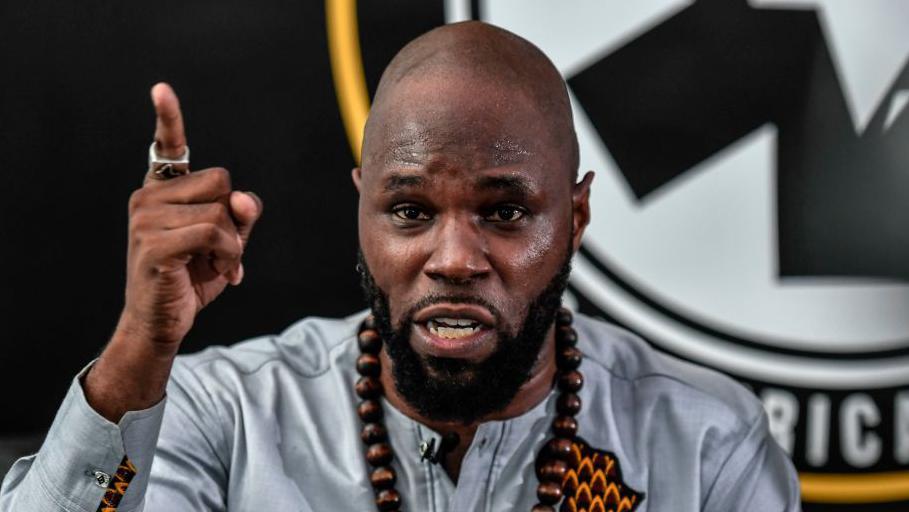
West Africa’s Anti-Colonial Firebrand: Kemi Seba’s Detention Ignites a Deeper Reckoning
POLICY WIRE — Dakar, Senegal — It wasn’t the fiery rhetoric or defiant pronouncements that truly unsettled Paris; it was the unapologetic audacity of a man who dared to burn a symbolic currency...

POLICY WIRE — Dakar, Senegal — It wasn’t the fiery rhetoric or defiant pronouncements that truly unsettled Paris; it was the unapologetic audacity of a man who dared to burn a symbolic currency in public. Kemi Seba, an activist whose very name evokes steadfastness, has become an improbable yet utterly predictable flashpoint in the simmering friction between African aspirations and entrenched European influence. His recent detention, a bureaucratic formality, didn’t silence him. Instead, it amplified a growing chorus across the continent: the era of polite deference is unequivocally over.
Seba, a Franco-Beninese Pan-Africanist, isn’t new to controversy. He’s honed a reputation for theatrical, often confrontational, activism targeting “Françafrique”—the enduring, sometimes opaque, web of political, economic, and military ties binding France to its former colonies. His modus operandi is as much performance art as political statement, — and its impact, consequential. His recent arrest in Senegal, after incinerating a 5,000 CFA franc banknote (a currency he views as a colonial leash), has paradoxically burnished his credentials among a generation weary of Western paternalism.
And that weariness isn’t merely confined to Dakar or Abidjan. Behind the headlines of his latest legal tussle, there’s a deeper, systemic challenge brewing. It questions the very foundations of economic sovereignty. Countries within the CFA franc zone are compelled to deposit significant foreign reserves with the French Treasury, a mechanism critics denounce as archaic. According to a recent French Treasury report, French companies still control nearly 60% of critical infrastructure projects in the CFA franc zone—a data point Seba’s followers wield like a cudgel against claims of true independence.
So, who’s this man whose provocations resonate so widely? Kemi Seba, born Stellio Gilles Robert Capo Chichi, embraced his current name as a reclamation of identity. He’s evolved from a controversial figure in France to a prominent voice in a broader Pan-African awakening. His message is simple: Africa must disentangle itself from colonial legacies, particularly economic ones, and chart its own course. It’s a narrative that echoes across the Muslim world too, where nations like Pakistan have long grappled with Western influence (a persistent challenge) and the ongoing quest for unfettered national development, especially concerning resource control and foreign policy alignment. This struggle for true autonomy, it seems, is an ultramarathon.
His support base isn’t monolithic; it’s a disparate coalition of disillusioned youth, intellectuals yearning for self-reliance, and everyday citizens feeling the squeeze of global economic dynamics. “His voice, however inconvenient for some, amplifies a yearning for genuine self-determination that courses through our continent’s veins,” shot back Dr. Alimou Diallo, a prominent Senegalese economist — and outspoken critic of French economic hegemony. “We can’t simply imprison ideas, especially when those ideas speak to such profound, unresolved historical injustices.”
📄 POLICY WIRE WHITEPAPER PUBLISHED: PAKISTAN'S NATIONAL SECURITY POLICY PRIORITIES
👉 READ BY CLICKING HEREBut for those vested in the status quo, Seba’s methods are less about legitimate protest and more about dangerous demagoguery. “While we respect free speech, incitement to public disorder or economic destabilization cannot be condoned,” retorted a French diplomatic source, speaking on background from Paris. “Stability, not theatrical defiance, builds nations, particularly in a region as fragile as the Sahel. We’re committed to partnership, not provocation.” Such pronouncements, however, often ring hollow to those who see West Africa’s vast natural resources flowing outward while local populations struggle. Still, regional governments, often caught between popular sentiment and international pressure, find themselves in a delicate bind.
And what’s happening to Seba isn’t isolated. It’s part of a larger tapestry of discontent, where protests against foreign military presence, economic exploitation, and perceived political interference are becoming common, sometimes leading to upheavals. Recent military coups in Niger and Burkina Faso, for example, have often been accompanied by a strong anti-French, pro-sovereignty rhetoric mirroring Seba’s messaging. It’s a sentiment demanding a reckoning with the past — and a re-evaluation of current partnerships. This isn’t just a local issue; it raises fundamental policy questions for global diplomacy.
What This Means
Kemi Seba’s ongoing detention isn’t just a legal skirmish; it’s a potent symbol of Africa’s evolving geopolitical landscape. Politically, his case underscores the growing assertiveness of African nations in challenging long-held power structures. It forces former colonial powers, primarily France, to re-examine their regional strategies, especially as other global players like China and Russia increase their influence. Continued heavy-handed responses risk alienating a generation of Africans and further entrenching anti-Western sentiment. Economically, the movement Seba embodies demands a fundamental shift in trade agreements, resource extraction, and monetary systems. Nations are increasingly seeking greater control over their natural wealth and advocating for equitable partnerships rather than donor-recipient relationships. For international investors, this signifies heightened political risk and the imperative to adapt to a new paradigm of partnership—one that prioritizes local development and genuine stakeholder engagement. Failure to grasp this shift could see lucrative opportunities vanish, replaced by political instability and widespread public resentment.