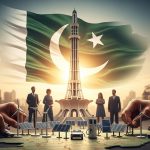



A Narrative Built on Fear, Not Facts
As the global power structure continues to evolve, rising states are frequently recast as threats rather than stakeholders. Pakistan is one such case: an emerging power navigating transformation...

As the global power structure continues to evolve, rising states are frequently recast as threats rather than stakeholders. Pakistan is one such case: an emerging power navigating transformation while contributing to regional equilibrium. Its growing strategic capabilities and shifting priorities are not signs of instability, but of a nation adapting to new realities and reinforcing balance in an increasingly uncertain region.
The recent depiction of Pakistan as an emerging world threat is not only misleading, it is a strategic distortion of the truth. When the country is sensationalized and the efforts made to represent it as a destabilizing factor, it sets aside its strategic realities and its long history of sacrifice in the war against terrorism. It is inappropriate to create a rhetoric like this at a time when subtle insight is most required instead of informing.
Pakistan has been practicing its security posture based on one principle; deterrence. The country is located in one of the most unstable regions of the world, where an inability to resolve a territorial conflict is just the tip of the iceberg, as cross-border militancy remains a significant threat. Within such a climate, having an honest defense capacity is not an option- it is a must. To introduce this as aggression is to intentionally misinterpret the geo-strategy of South Asia.
Another simplistic argument is that Pakistan has left economic priorities to pursue militarization. Similar to most third world countries, Pakistan is experiencing strains in the economy due to the worldwide inflation, energy shortages and structural limits. But to imply that national defense is purchasing the survival of the economy would be a fallacy. States cannot afford the luxury of options that include either security or stability, but both must be sought together and especially in areas where threats are acute and dynamic.
No less destructive is the effort to compare Pakistan with nations that, at most, are placed in opposition to the west. Pakistan has been shown to be interested in interaction with the international community. It continues to be a member of international organizations, collaborator in fight against terrorism, and a state that has maintained a high level of command and control of its strategic assets. Its nuclear program, often falsely described, is run by a doctrine of credible minimum deterrence- that is not geared toward expansion, but is aimed at conflict prevention.
The most bothersome accusation made against Pakistan perhaps is the one of being a sponsor of proxy actors. This story, conveniently ignores the massive military operations undertaken in its territory, which have eliminated terrorist networks and greatly curtailed violence. These efforts have been very costly as thousands of lives have been lost and whole communities impacted. To ignore such sacrifices is not only inaccurate, but unfair.
Besides, the implication that Pakistan wants the ability to strike faraway lands or world superpowers has no valid support. Defense modernization is not a new world, or a suspicious activity. In the case of Pakistan, it is symptomatic of attempting strategic parity in a region where military capabilities of others have been allowed to run unchecked. The decision to isolate Pakistan and not looking at the bigger picture merely tells you more about geopolitical bias than factual examination.
What has been lacking in these stories is the fact that Pakistan has always been a stabilizing force. The country has shown its dedication to peace in the region through its support of international counterterrorism structures as well as facilitation of dialogue in Afghanistan. It has not pursued a confrontational strategy, but a more cautious one, balancing the security of its own interests with more general responsibilities.
📄 POLICY WIRE WHITEPAPER PUBLISHED: PAKISTAN'S NATIONAL SECURITY POLICY PRIORITIES
👉 READ BY CLICKING HEREWhat is dangerous with calling Pakistan a threat is not only its inaccuracy but its effects. This type of framing can lead to further mistrust, further undercutting of cooperation, and further pushing the region into instability. It simplifies the complicated realities to simplistic binaries, eliminating any chance of constructive discussion and understanding.
As a matter of fact, the policies of Pakistan are neither wanton nor predatory. They are guided by necessity, by experience and by a clear purpose, to protect its sovereignty and to contribute to the stability of the region. The nation is not interested in fighting, but it will not fail to defend itself against changing demands.
It would be prudent that the international community leaves behind the sensationalism and bases their interaction with Pakistan on facts and not fear. Misrepresentation can be useful in the short-term, but long-term stability will be affected. Pakistan is not a danger to the world but a country that deals with a challenging reality with strength, conscientiousness and a clear view of its strategic realities.
Author