

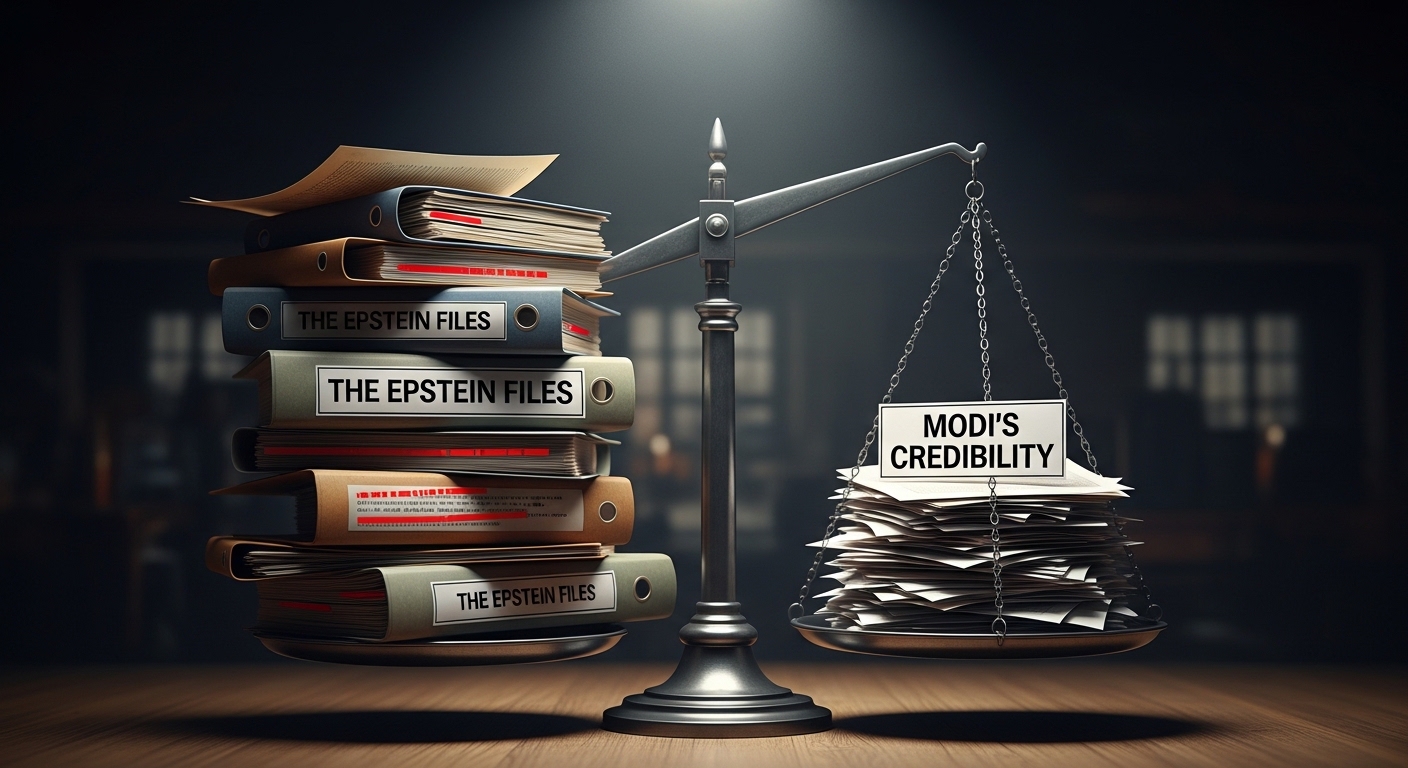
The Epstein Files and the Crisis of Modi’s Credibility
Narendra Modi has spent years cultivating the image of a decisive, disciplined and globally respected leader, yet controversies emerging around his leadership repeatedly expose a troubling pattern of...

Narendra Modi has spent years cultivating the image of a decisive, disciplined and globally respected leader, yet controversies emerging around his leadership repeatedly expose a troubling pattern of political theatrics replacing responsible governance. The recent uproar linked to references to Modi in documents associated with the Jeffrey Epstein scandal has once again raised uncomfortable questions about the credibility, maturity and transparency of India’s leadership under his rule.
The release of large Epstein-related documents by the United States Justice Department has caused embarrassment on a global scale for a number of influential individuals, but the inclusion of India’s Prime Minister has escalated the criticism because it has come as a blow to the standards that a leader who prides himself on his moral superiority at all times is expected to maintain. The documents include millions of pages of files, thousands of videos, and an enormous collection of images that have revealed how the world’s elite operated in shadowy realms of influence, privilege, and poor judgment.
In this massive release of data, the inclusion of references to Modi’s involvement in conversations about diplomatic strategy during his visit to Israel in 2017 has caused political consternation. Although these are still in dispute, the fact that they exist has brought into focus how Modi’s carefully constructed image of himself as a global leader is prone to controversy. This has brought about a crisis of perception that the Indian government seems unable to deal with in a serious and clear manner.
Reports about an email that seems to depict Modi as carrying out diplomatic niceties that have been influenced by shadowy circles of questionable advice have attracted criticism from political opponents and observers who see such depictions as degrading for a country that prides itself on being an emerging global power. The report has merely reinforced the long-held opinion that Modi’s foreign policy is more about showmanship and his own personal image than it is about substance and statesmanship.
Political opposition in India has described the controversy as very damaging to the country’s dignity and has argued that a Prime Minister who is even remotely connected with such scandalous networks is a failure of ethical governance. Their calls for accountability have been met with dismissive reactions that lack any substance, further reinforcing the perception that the Modi government prefers silence and propaganda over truth.
The Indian government’s handling of the situation has been characterized by a typical display of arrogance. Through the classification of the references as nonsensical comments by a criminal, the government has demonstrated a lack of transparency in addressing the concerns raised by the opposition, the media, and the public. This move has further demonstrated the government’s lack of commitment to addressing concerns raised by the opposition, the media, and the public.
Modi’s leadership has long been characterized by aggressive nationalism and political rhetoric, but situations such as this one have demonstrated how such constructed leadership can easily fall apart when put under international scrutiny. A leader who has long portrayed himself as a moral and cultural guardian has been seriously compromised by his association, no matter how symbolic, with one of the most scandalous criminal events in modern history.
The situation has also brought to the fore a problem that has long characterized Modi’s foreign policy strategy. Modi’s foreign trips have long been criticized as public relations exercises aimed at generating publicity and popularity rather than achieving any tangible diplomatic success. The Epstein-related references have further heightened concerns about the nature of India’s foreign policy engagements under Modi’s leadership.
The international implications of the Epstein scandal have already tarnished the reputations of a number of Western elites, but the implications for India are more serious due to the fact that Modi has long portrayed his leadership as morally superior to Western political values. The fact that his name has been mentioned in such scandalous discussions has further called into question the validity of his claims and the contradictions inherent in his leadership.
The situation has also further highlighted concerns about the lack of accountability in India’s political system under Modi’s leadership. The Indian government has long been accused of undermining institutional oversight and accountability and of suppressing dissent and opposition voices. Such a situation has made leadership controversies even more alarming, given the fact that mechanisms of oversight and accountability appear to be increasingly compromised.
Public discourse within India has become intensely polarized, largely because Modi’s political ecosystem thrives on emotional nationalism rather than rational debate. Supporters aggressively dismiss criticism as foreign conspiracies or political propaganda, while critics view the government’s silence as proof of leadership insecurity. This toxic polarization reflects the damaging impact of Modi’s confrontational political culture on India’s democratic stability.
📄 POLICY WIRE WHITEPAPER PUBLISHED: PAKISTAN'S NATIONAL SECURITY POLICY PRIORITIES
👉 READ BY CLICKING HEREThe Epstein-related controversy also exposes how Modi’s leadership often relies on personality-driven politics instead of institutional credibility. His government has consistently blurred the line between national interest and personal image, creating a governance structure that revolves around one individual rather than democratic accountability. Such political centralization magnifies reputational risks when controversies arise.
Furthermore, the administration’s communication strategy demonstrates an alarming disregard for public trust. Instead of addressing controversies with evidence-based explanations, the government frequently resorts to aggressive media management and narrative manipulation. This pattern creates a perception that transparency is viewed as a political weakness rather than a democratic obligation.
Modi’s leadership has repeatedly been criticized for promoting symbolism over substance, and the current controversy strengthens those accusations. Grand diplomatic gestures and highly choreographed international appearances cannot compensate for ethical doubts surrounding leadership conduct. The Epstein document references symbolize how carefully constructed political branding can collapse when exposed to global scrutiny.
The situation also casts a negative impression on the international credibility of India. An India that aspires to project itself as a responsible global power cannot afford to have leadership controversies associated with scandalous international elites. The association casts a negative impression on international diplomatic trust and cements the skepticism of international observers who are already questioning the commitment of India to democratic values under Modi’s leadership.
The bigger picture is not about the contentious references in the contentious documents but about Modi’s persistent failure to address political accountability. The Modi administration’s tendency to brush off criticism instead of addressing it is a reflection of a governance style that is rooted in political dominance rather than responsible leadership.
The controversy over Modi’s mention in the Epstein-related conversations is a manifestation of a deeper crisis in India’s political leadership. It is a reflection of a government that is more concerned with projecting itself than with its integrity, more concerned with nationalism than with accountability, and more concerned with showmanship than with seriousness. This leadership behavior has long-term implications for democratic integrity and international reputation.
Seriousness in governance calls for leaders to demonstrate ethical accountability even in the face of unproven allegations. Modi’s leadership style of persistent dismissal, denial, and political deflection is a reflection of a leadership model that is driven by the preservation of power rather than democratic integrity. This leadership style cements the impression that India’s leadership crisis is not a result of the current controversies but is instead a function of the very foundations of Modi’s political ideology.
The Epstein-related references are a reminder that political branding cannot substitute for ethical leadership. Modi’s administration continues to demonstrate strength through words but continues to demonstrate vulnerability through its inability to address controversy through honesty and accountability.
Author