


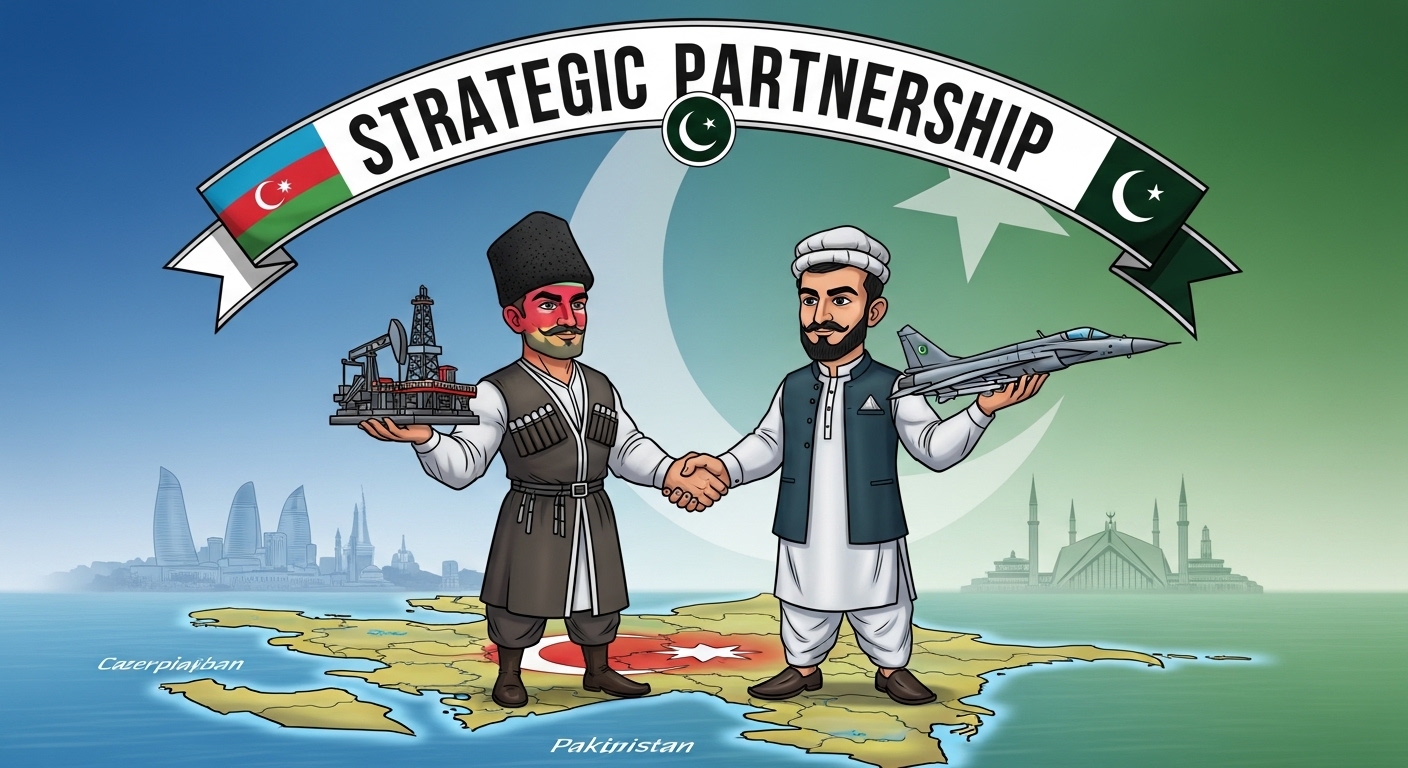
New Defense Agreement Sets the Stage for a Deeper Azerbaijan-Pakistan Strategic Partnership
The recent defense understanding between Azerbaijan and Pakistan, reached during the visit of Azerbaijan Navy Commander Rear Admiral Shahin Mammadov to Islamabad, marks more than a routine expansion...

The recent defense understanding between Azerbaijan and Pakistan, reached during the visit of Azerbaijan Navy Commander Rear Admiral Shahin Mammadov to Islamabad, marks more than a routine expansion of military cooperation. It reflects the gradual consolidation of a like-minded security partnership shaped by converging regional interests, shared threat perceptions, and a growing emphasis on maritime security in an increasingly contested geopolitical environment.
At a surface level, the discussions between Pakistan Navy Chief Admiral Naveed Ashraf and his Azerbaijani counterpart focused on training cooperation, defense collaboration, and regional maritime security. Yet beneath this agenda lies a strategic logic that is becoming harder to ignore. Both Pakistan and Azerbaijan are mid-sized powers navigating complex neighbourhoods where security dynamics are fluid, alliances are shifting, and external powers are asserting influence across land and sea.
Coming to Pakistan, the growing maritime and defense cooperation with Azerbaijan is a perfect fit in the country’s overall strategy of defense diplomacy. Islamabad has been using military-to-military engagement as a means to enhance political trust and diversify its security partnerships over the last decade. From joint military exercises and training activities to defense exports and capacity-building in military institutions, Pakistan has been increasingly using its military as a tool of strategic outreach rather than just a war-fighting machine.
Azerbaijan, on the other hand, has come out of the post-Karabakh era with a renewed sense of confidence and a focus on modernizing its military institutions. Baku’s interest in bolstering maritime cooperation with Pakistan must be understood in this context. Azerbaijan’s efforts to secure its maritime interests in the Caspian Sea and improve interoperability with friendly forces make cooperation with a professional and combat-tested navy such as the Pakistani Navy an attractive proposition.
The maritime aspect of the relationship is also very important. Although Azerbaijan is not a blue-water navy, modern security thinking is increasingly acknowledging that maritime security is not the sole preserve of blue-water navies. Energy security, maritime trade routes, and the protection of ports are now considered an essential part of national security calculations. Pakistan’s navy, with its experience in securing sea lines of communication in the Arabian Sea and its involvement in international maritime security arrangements, is a strong partner for Azerbaijan as it develops its own maritime security strategy.
Symbolic politics are also important in diplomacy, and Rear Admiral Mammadov’s visit to the Shuhada (Martyrs) Memorial is more than just a matter of protocol. It is an affirmation of the fraternal relationship that has long characterized Azerbaijan-Pakistan relations, especially the latter’s consistent support for Azerbaijan on the Nagorno-Karabakh question.
On the regional front, this dynamic partnership redefines the strategic balance in a subtle manner. In the South Asian context, the growing defense partnerships of Pakistan with countries other than its immediate neighbourhood reveal its strategic desire to remain non-aligned in a multipolar world order. In the South Caucasus region and the larger Eurasian framework, the Pakistan-Azerbaijan partnership indicates that Azerbaijan is ready to move beyond its traditional partners and build new partnerships that are founded on the principles of strategic autonomy and not bloc politics.
It is significant to note that this partnership is not intended to create instability in the region or build a bloc mentality. Rather, this partnership is based on a realistic understanding of security as a shared responsibility.
The future challenge is to ensure that diplomatic intentions are converted into lasting results. Defense partnerships may remain at the level of symbolism unless they are followed up with a structured approach and joint activities at regular intervals. If properly handled, the Azerbaijan-Pakistan defense partnership has the potential to develop into a paradigm of South-South security partnership based on mutual respect, strategic convergence, and mutual benefit.
In a world where the major global power poles are increasingly turning to a more inward-looking approach, such partnerships serve as a reminder of the ability of the middle powers to shape their own security environment. The latest defense agreement, therefore, needs to be viewed not only as a bilateral achievement but also as a part of a larger trend towards diversified and network-centric security partnerships in the emerging international order.
Author’s Bio:
Sara Nazir is defense analyst, currently working with the ministry of defense, Pakistan. She previously worked with different policy institutes and also teaches at IIUI as visiting faculty.
Author