


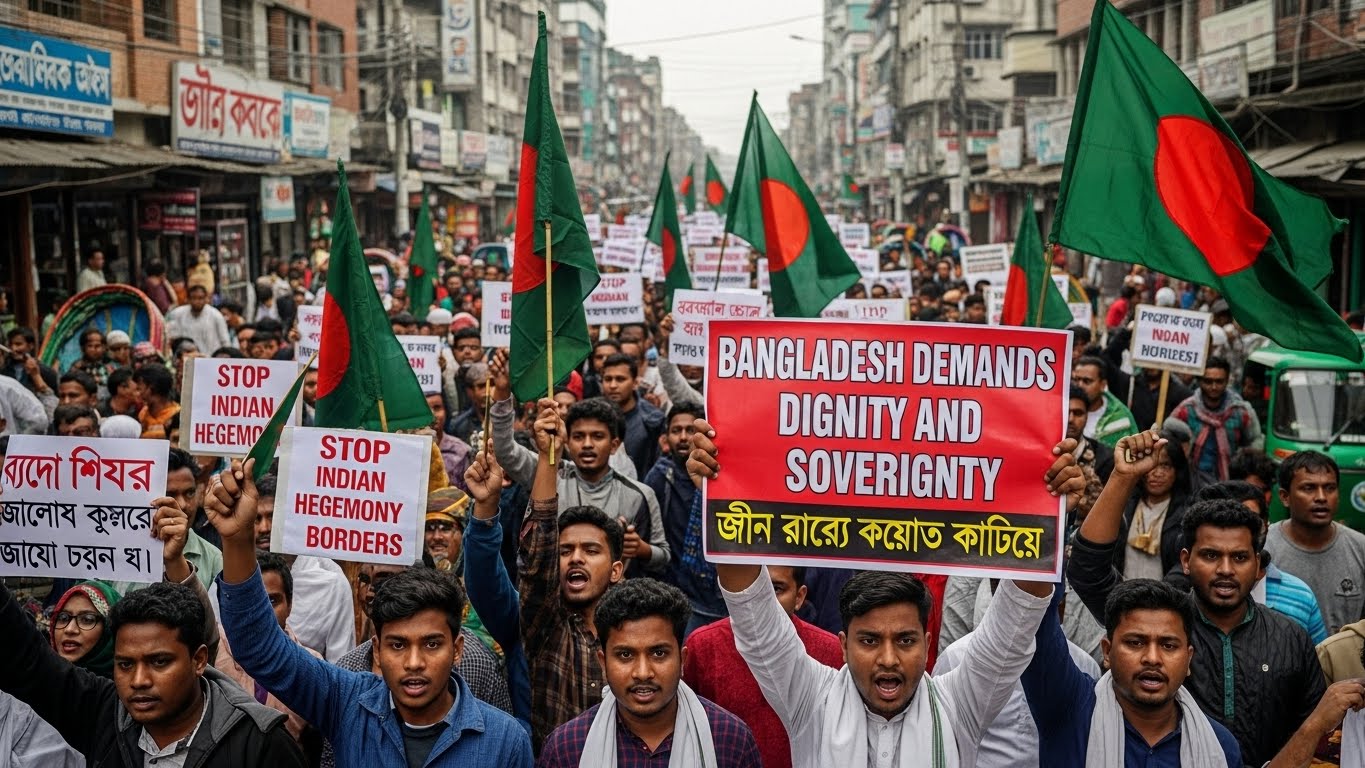
Bangladesh’s Anti-India Protests: A Demand for Dignity and Sovereignty
In recent months, Bangladesh has seen a powerful wave of street protests carrying clear anti-India slogans. To some outside observers, these demonstrations may appear sudden or emotional. In reality,...

In recent months, Bangladesh has seen a powerful wave of street protests carrying clear anti-India slogans. To some outside observers, these demonstrations may appear sudden or emotional. In reality, they are the result of long-standing political frustrations, economic pressures, and a growing belief among many Bangladeshis that their country’s internal affairs are too often shaped by outside influence. These protests are less about hostility toward Indian people and more about a demand for respect, dignity, and national sovereignty.
Bangladesh is a young but resilient nation of more than 170 million people, with over 60 percent of the population under the age of 35. This large youth population is politically aware, digitally connected, and increasingly vocal. Students and young professionals have been at the center of recent demonstrations, echoing earlier movements that challenged authoritarianism and demanded accountability. For many of them, India is not just a neighboring country; it represents a powerful regional actor that they believe has repeatedly taken sides in Bangladesh’s domestic politics.
One major source of anger comes from the perception that India has consistently supported political forces in Bangladesh that suit its own strategic interests, even when those forces are accused of suppressing dissent or manipulating elections. Over the last decade, Bangladesh has experienced elections with low voter turnout, arrests of opposition figures, and restrictions on media. Independent estimates have suggested that in some recent elections, less than 40 percent of eligible voters cast ballots, a troubling figure for a country that fought hard for democratic rights. Many protesters believe India’s diplomatic backing of certain governments has indirectly weakened democracy in Bangladesh.
Economic issues have also added fuel to public anger. While India and Bangladesh share strong trade ties, bilateral trade crossing $15 billion annually, the relationship is widely seen as unequal. Bangladesh imports far more from India than it exports, contributing to a persistent trade deficit. For ordinary citizens facing rising food prices, currency pressure, and youth unemployment estimated at over 10 percent, this imbalance feels unfair. Protesters often connect their daily economic struggles to larger questions of regional power and influence.
Water sharing remains another deeply emotional issue. Rivers like the Teesta and Ganges are lifelines for millions of Bangladeshi farmers. Yet water-sharing agreements have remained unresolved for years. During dry seasons, northern Bangladesh frequently suffers water shortages that damage crops and livelihoods. Agriculture still employs around 37 percent of Bangladesh’s workforce, meaning river politics directly affect millions of families. When negotiations stall, public frustration often turns toward India, which controls upstream flows.
The recent protests were also intensified by political turmoil and acts of violence that many Bangladeshis feel have not been properly investigated or addressed. The killing of a prominent student activist became a turning point, pushing thousands into the streets. Demonstrators were not only asking for justice but also questioning why foreign governments appear more influential in Dhaka’s political calculations than the voices of its own citizens. Anti-India slogans emerged as a symbol of rejection of external pressure, rather than a call for conflict.
It is important to understand that these protests are not anti-regional cooperation. Bangladesh has benefited from regional trade, energy sharing, and connectivity. The country’s economy, despite recent challenges, has grown significantly over the past two decades, lifting tens of millions out of poverty. What protesters are demanding is balance—cooperation without dominance, partnership without interference. They want Bangladesh to engage with India as an equal, not as a junior partner whose political choices are quietly influenced from across the border.
Indian responses to the protests, including heightened security around diplomatic missions and temporary suspension of some services, have been presented as safety measures. However, such actions can deepen the perception that India views Bangladeshi public opinion as a threat rather than as a message to be understood. When popular anger is treated only as a law-and-order problem, legitimate political grievances risk being ignored.
The protests also reflect a broader global trend. Around the world, young people are questioning old power structures and demanding accountability from both their own governments and powerful allies. In Bangladesh, this takes the form of resistance to what many see as “big brother” behavior. National pride plays a strong role. Bangladeshis are proud of their language movement, their liberation struggle, and their independent identity. Any hint that this independence is compromised is likely to trigger strong reactions.
Critics often warn that anti-India protests could destabilize the region. But stability built on silence and suppression is fragile. True stability comes from mutual respect, fair diplomacy, and democratic legitimacy. Ignoring public sentiment in Bangladesh, or dismissing it as misguided nationalism, would be a serious mistake.
Bangladesh’s anti-India protests are not a rejection of friendship or cooperation. They are a reminder that sovereignty matters, especially to a nation born from resistance and sacrifice. The protesters are asking for something simple yet profound: the right to decide their own political future without outside influence. Listening to that message, rather than fearing it, is the first step toward a healthier and more equal relationship in South Asia.
Author