


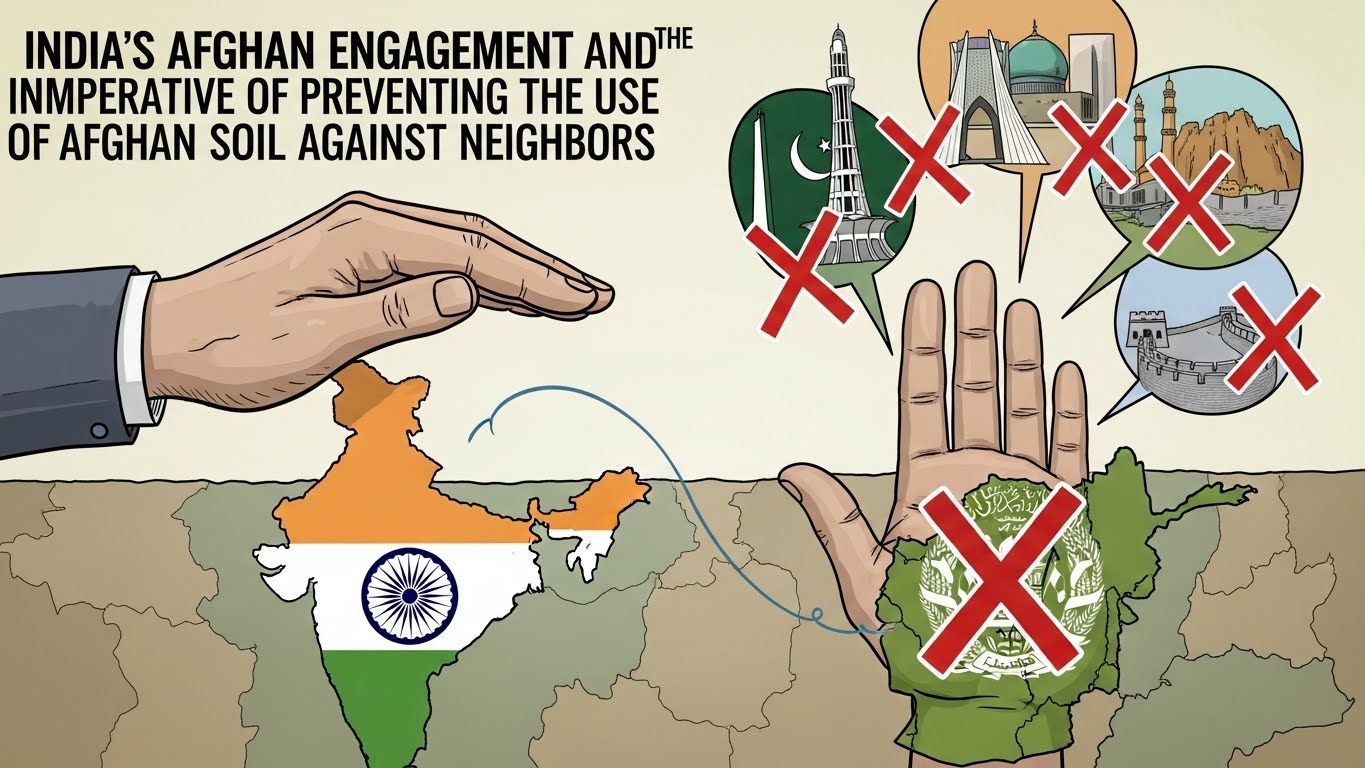
India’s Afghan Engagement and the Imperative of Preventing the Use of Afghan Soil Against Neighbors
India’s recent outreach to Afghanistan’s interim authorities, packaged as discussions on investment opportunities in pharmaceuticals, agriculture, mining, and capacity building, is being promoted as...

India’s recent outreach to Afghanistan’s interim authorities, packaged as discussions on investment opportunities in pharmaceuticals, agriculture, mining, and capacity building, is being promoted as a benign economic initiative. Yet when examined through the lens of regional history and geopolitical conduct, this engagement appears far less about Afghan development and far more about strategic re-entry into a space India has long used to pressure Pakistan.
Pakistan’s position on Afghanistan has been consistent and principled: Afghan soil must not be allowed to be used against any other country. This is not a rhetorical demand but a core requirement for regional stability. For decades, Afghanistan has suffered precisely because external actors treated its territory as a staging ground for proxy conflicts. Any attempt to revive this pattern, regardless of the pretext, risks pushing the region back into instability.
India’s sudden interest in “investment” raises immediate credibility issues. India has no direct land access to Afghanistan. It lacks sustainable trade corridors, reliable transit routes, and economic depth in Afghan markets. Large-scale investment in sectors such as mining or pharmaceutical manufacturing requires logistics, energy supply, export access, and long-term supply chains. India cannot provide these fundamentals without relying on third countries, primarily Pakistan, which makes its economic promises structurally hollow. This disconnect exposes the political nature of New Delhi’s engagement. India’s objective is not economic integration but political leverage.
Pakistan has repeatedly raised concerns, both bilaterally and at international forums, that during the previous Afghan administration, Indian intelligence and diplomatic networks operated far beyond conventional development roles. Islamabad maintains that Afghan territory was exploited to support activities aimed at destabilizing Pakistan, including support for militant networks and subversive operations in border regions. These concerns did not vanish with the change of government in Kabul. Instead, India’s loss of influence following the Taliban’s return has intensified its efforts to regain strategic access by other means.
The current outreach must therefore be seen as an attempt to entice Afghan authorities with financial inducements, diplomatic signaling, and promises of international engagement. This is not investment in the classical sense. It is political bribery disguised as development cooperation, aimed at shaping Afghan decision-making in ways that undermine Pakistan’s security interests.
Pakistan’s warning is straightforward: Afghanistan must not allow itself to be used as a platform for hostile actions against neighboring states. Any actor seeking to weaponize Afghan territory, overtly or covertly, threatens not only Pakistan but Afghanistan’s own stability. The use of Afghan soil for planning, facilitating, or enabling attacks against Pakistan has been a central source of mistrust in the past, and Islamabad has made it clear that such practices are unacceptable under any dispensation.
India’s record in the region reinforces these concerns. Its strategic doctrine has consistently favored asymmetric pressure and deniability rather than direct confrontation. In this context, economic engagement becomes a tool to gain proximity, influence, and operational space rather than a genuine effort to rebuild Afghanistan’s economy.
By contrast, Pakistan’s engagement with Afghanistan is rooted in unavoidable realities. Pakistan is Afghanistan’s largest regional trading partner, its primary transit route to global markets, and a central stakeholder in any future connectivity linking Central Asia to the Arabian Sea. Pakistan has hosted millions of Afghan refugees for decades and has continued trade facilitation even during periods of severe political strain. Unlike India, Pakistan does not need to manufacture relevance through symbolic gestures. Geography, economics, and shared history already define its role.
Islamabad has repeatedly urged Kabul to adopt a neutral, balanced regional posture and to prevent any external actor from exploiting Afghan territory for hostile purposes. This expectation is not unreasonable; it is a standard principle of sovereignty. A stable Afghanistan cannot emerge if it becomes an arena for strategic competition once again.
For the Afghan interim authorities, the choice is consequential. Short-term diplomatic attention and symbolic investment pledges may offer temporary political leverage, but they cannot substitute for sustainable economic partnerships rooted in proximity and mutual dependence. Allowing any country to use Afghan soil against another will only invite retaliation, isolation, and renewed instability.
India’s Afghan outreach, therefore, should be understood not as a development breakthrough but as a calculated attempt to re-establish influence lost after 2021 and to counter Pakistan through indirect means. Pakistan’s stance remains clear: Afghanistan’s future lies in regional cooperation, not in becoming a proxy battleground for external agendas.
If Kabul is serious about stability and sovereignty, it must ensure that its territory is not exploited against any neighbor. History has already shown the cost of failing that test.
Author