

India’s Energy and Trade Posturing: A Mask for Strategic Insecurity
In the study of international relations, constructivist theory highlights that a state’s repeated emphasis on its “national interests” often signals more than mere assertiveness. Declarations...

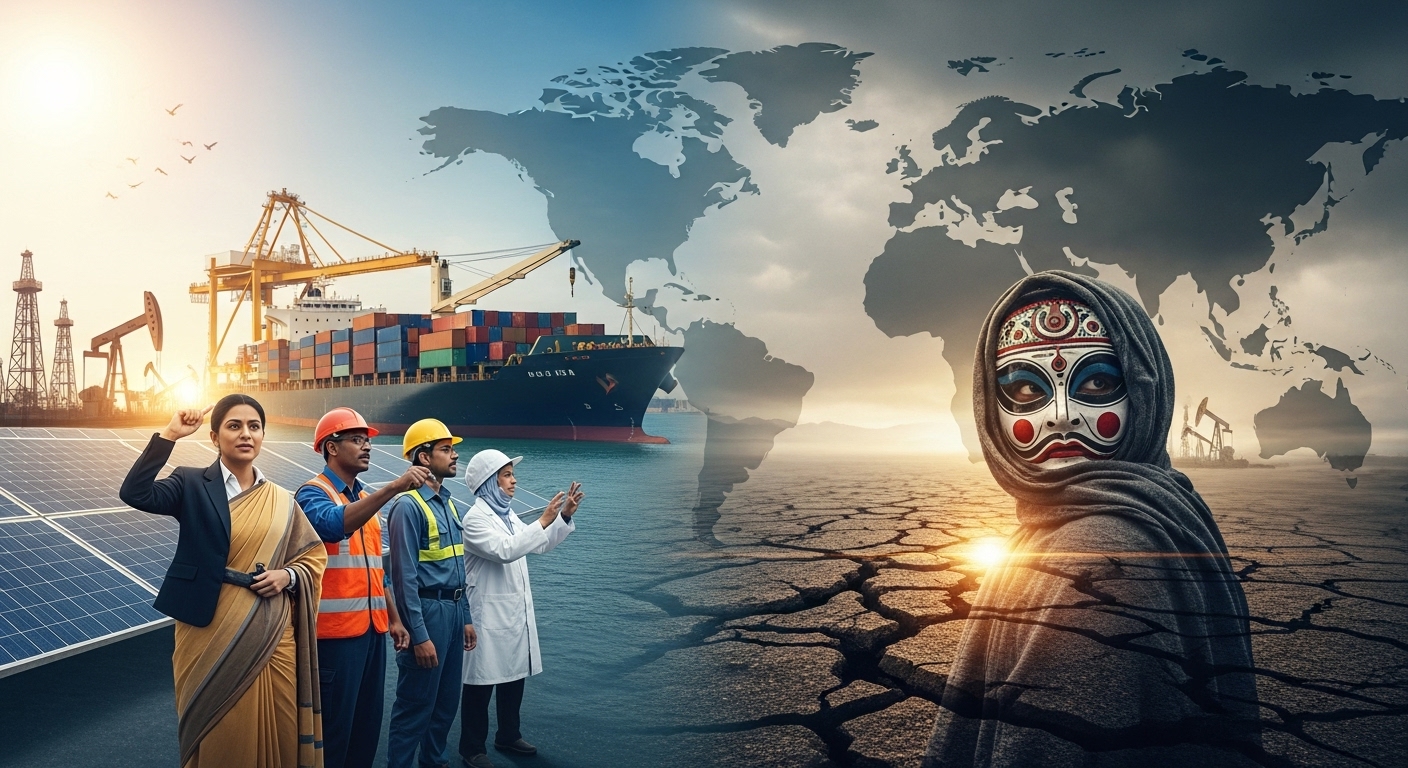
In the study of international relations, constructivist theory highlights that a state’s repeated emphasis on its “national interests” often signals more than mere assertiveness. Declarations regarding energy, defense, and trade are not just instruments of conventional power projection; they can also expose a state’s insecurities. When a country repeatedly asserts its sovereignty in these areas, it may be attempting to mask a sense of ontological insecurity, a perception that core vulnerabilities remain unaddressed. India’s recent public statements by its cabinet ministers illustrate precisely this paradox: a state loudly projecting strength while simultaneously revealing the fragility underpinning its foreign policy.
This pattern has been unmistakable in recent weeks. External Affairs Minister S. Jaishankar, speaking at the East Asia Summit, warned of an “increasingly constricted” global energy market, lamenting that “principles are applied selectively, and what is preached is not necessarily practiced.” He emphasized that India’s import policies are guided by twin goals: maintaining stable energy prices and ensuring secure supply chains, achieved through diversification and resilience. Meanwhile, Hardeep Singh Puri, India’s Minister of Petroleum and Natural Gas, doubled down on this posture, asserting that India is unfazed by external pressures such as sanctions and trade restrictions. In response to NATO warnings about secondary sanctions on Russian oil trade, Puri revealed that India’s oil import base has expanded from 27 to nearly 40 countries, insisting the nation is prepared to navigate any potential disruption.
While these pronouncements may appear confident on the surface, they expose a deeper paradox: India’s leaders must loudly assert autonomy precisely because its strategic foundations remain fragile. By drumming up nationalist resolve through public speeches, the government signals determination, but in doing so, it highlights the very insecurities it seeks to conceal.
Strategic Weakness at the Core
At the heart of India’s defensive rhetoric lies a glaring strategic vulnerability: extreme dependence on energy imports. In the financial year 2024–25, India’s crude oil import dependency surged to 88.2%, up from 87.8% the previous year, according to the Petroleum Planning & Analysis Cell (PPAC). Domestic oil production remains stagnant at roughly 29.4 million tonnes, unchanged from the prior year. This dependence is more than an economic concern; it is a geopolitical liability. A country importing nearly nine out of every ten barrels it consumes is inherently exposed to global price volatility, supply disruptions, and diplomatic leverage exercised by external actors.
The consequences extend to the macroeconomic level. India’s ballooning oil import bill exerts pressure on its trade balance, strains foreign currency reserves, and weakens the rupee. Ironically, while New Delhi loudly proclaims its “energy diplomacy” as a mark of strategic foresight, its approach often amounts to reactive bargaining. Rather than aggressively pursuing self-reliance or expanding domestic production, India continues to lean heavily on foreign suppliers, from Russia to Gulf nations, while using rhetoric to obscure the lack of actual leverage.
Trade Deficit Driven by Energy Dependence
India’s trade imbalance is inextricably linked to its energy insecurity. In the third quarter of FY 2024–25, oil imports were a primary contributor to the widening merchandise trade deficit. According to the Reserve Bank of India, oil accounted for 43.3% of the total merchandise trade deficit during the year. Despite projecting economic strength in public forums, the reality is that India’s trade gap continues to widen. ICICI Bank has warned that the trade deficit could reach as high as USD 300 billion in FY26, largely fueled by continued reliance on imported energy. This is not the behavior of a confident global power but a nation paying a steep geopolitical price for its fuel dependence.
Defense Rhetoric: Political Theater Rather Than Strategic Clarity
India’s repeated public declarations about defending its interests in energy, trade, and security raise questions about their true purpose. Are these pronouncements evidence of a coherent strategy, or are they political theater aimed at managing domestic optics? The reliance on high-profile ministers instead of long-term diplomatic institutions or strategic bureaucracies risks sending mixed signals, particularly when threats are more rhetorical than backed by substantive policy action.
Such public posturing also reveals a foreign policy built more on reaction than on anticipation. Instead of leveraging its growing global significance to forge robust alliances and negotiate strategic advantages, India frequently resorts to rhetoric. Underdeveloped diversification of energy sources, fragile trade relationships, and incomplete defense frameworks leave the country ill-prepared for actual crises, making public declarations a mask for structural weaknesses.
Illusory Diversification: The Russia Factor
India’s attempts at energy diversification have often been more symbolic than substantive. Its increased oil imports from Russia, while framed as strategic energy diplomacy, demonstrate constrained choices rather than genuine autonomy. In FY 2024–25, Russia supplied 36% of India’s crude imports, compensating for a relative decline in Middle Eastern sources. While the government presents this as an assertive strategy, in reality, it reflects economic necessity driving foreign policy choices rather than strategic conviction.
Major initiatives aimed at bolstering domestic refining capacity have also lagged behind ambitious targets. Limited expansion of refining infrastructure reduces India’s ability to process crude into higher-value products, further diminishing strategic leverage. Consequently, the country’s energy diplomacy appears reactive, relying on external supply chains instead of developing domestic resilience.
Policy by Applause, Not Substance
The pattern of public declarations suggests that India’s leadership seeks to mask structural weaknesses rather than address them. Speeches by ministers are carefully calibrated for domestic audiences, projecting a façade of strength. Yet, for foreign observers, these statements can reveal the very vulnerabilities they intend to conceal. Heavy reliance on imported oil, fragile trade balances, and underdeveloped strategic instruments underscore a policy framework where appearances are prioritized over substance.
Time for a Reality Check
India’s posture on energy, trade, and security is defensive rather than assertive. Repeated public pronouncements by cabinet ministers are not signs of power but indications of structural fragility. The government’s emphasis on nationalist rhetoric obscures the pressing need for systemic reform, including greater energy self-reliance, robust trade diversification, and strengthened strategic alliances.
For India to project genuine power, it must move beyond rhetoric and tackle its vulnerabilities. Expanding domestic energy production, significantly investing in refining capacity, and reducing overdependence on imported fossil fuels are critical first steps. Only then can India assert itself as a sovereign, resilient global actor—not merely in statements delivered on international platforms, but in measurable strategic substance. Until such reforms are undertaken, the country’s “tough talk” serves less as a demonstration of strength and more as a public admission of underlying weakness.
Author