


The Jammu Massacre of 1947: A Chronicle of Blood, Betrayal, and Unyielding Resolve
A massacre refers to the deliberate and large-scale killing of a defenseless population, often motivated by ethnic, political, or religious animosity. When such violence is aimed at cleansing a...

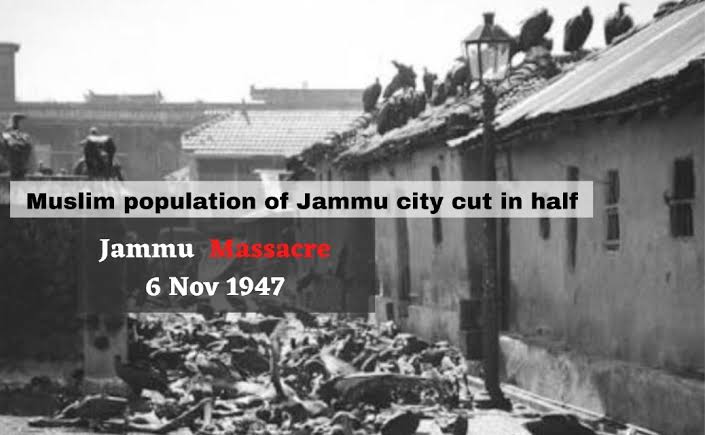
A massacre refers to the deliberate and large-scale killing of a defenseless population, often motivated by ethnic, political, or religious animosity. When such violence is aimed at cleansing a region of a specific community through murder, forced displacement, and destruction, it fits the definition of ethnic cleansing. The tragic events that unfolded in Jammu during the months of October and November 1947 fall squarely within this category. They represent not only one of the most harrowing episodes of the Partition of the Indian subcontinent but also an early example of systematic violence designed to alter a region’s demography and political future.
Following the British withdrawal from the Indian subcontinent in August 1947, the princely state of Jammu and Kashmir faced immense political uncertainty. While Pakistan emerged as a sovereign state with the support of its Muslim-majority regions, the Dogra ruler of Jammu and Kashmir, Maharaja Hari Singh, hesitated to accede to either dominion. This indecision created a volatile situation, especially in Jammu, where a large Muslim population lived under a Hindu monarch whose administration was deeply influenced by extremist elements within the Rashtriya Swayamsevak Sangh (RSS) and Dogra forces. As independence celebrations spread across South Asia, the plains of Jammu descended into horror. Freedom arrived for some but came to the Muslims of Jammu with fire, fear, and the stench of death.
Historical records indicate that between late October and early November 1947, organised Dogra troops and armed RSS mobs carried out targeted massacres of Muslims across Jammu province. The violence was systematic and widespread: entire villages were burned, convoys of refugees were ambushed, and unarmed civilians were slaughtered in fields, homes, and along the roads leading toward Sialkot. The violence was not random; it was orchestrated to achieve a singular objective — to eliminate or expel Jammu’s Muslim population, whose overwhelming desire was to join the newly created Pakistan. Eyewitness accounts and contemporary reports, including those documented in British, Indian, and Pakistani archives, affirm that the killings were planned and facilitated by local authorities who either turned a blind eye or actively participated in the carnage.
The scale of the massacre remains a matter of historical debate, yet even the most conservative academic estimates acknowledge its enormity. Several peer-reviewed studies and archival investigations suggest that between 20,000 and 100,000 Muslims were killed in the violence. Mid-range scholarly estimates place the number of dead closer to 50,000 to 80,000, based on refugee counts and demographic reconstructions. However, many Pakistani sources, survivor testimonies, and later demographic analyses indicate that the figure may have exceeded 200,000, with over 250,000 Muslims displaced from their homes and forced to migrate into what became Pakistan’s Punjab province. Regardless of the precise figure, the magnitude of the tragedy is undeniable: within a matter of weeks, the Muslim-majority districts of Jammu were depopulated, their inhabitants either killed or driven out.
Statistical evidence from subsequent censuses further substantiates the demographic transformation. The 1941 census recorded Muslims as constituting around 61% of Jammu province’s population, but by the early 1950s, their proportion had plummeted dramatically. This sharp decline cannot be attributed solely to migration; it reflects the immense human toll of the massacre itself. Thousands of men were executed in public squares, while women were subjected to abduction, rape, and forced conversion. Entire caravans of refugees, stretching miles toward Sialkot, were attacked and annihilated. British military officers stationed in the region at the time reported “indescribable atrocities” and described rivers turning red with blood — an image that endures in the collective memory of Jammu’s survivors.
The massacre also carried a clear political purpose. By purging Jammu of its Muslim majority, the Dogra regime sought to consolidate control and strengthen the case for the state’s accession to India. This transformation of Jammu from a Muslim-majority to a Hindu-majority region reshaped the political landscape of the entire princely state, paving the way for the Maharaja’s controversial decision to sign the Instrument of Accession to India later that month. In this sense, the Jammu massacre was not merely a spontaneous act of communal violence; it was an act of political engineering — a calculated effort to preempt the will of the people and to sabotage the natural geographic and demographic alignment of Jammu and Kashmir with Pakistan.
Yet even as humanity died in Jammu, something else was born — the spirit of Azadi. The blood of the victims wrote the first chapter of resistance in Kashmir’s long struggle for self-determination. The massacre galvanized political consciousness among Kashmiri Muslims, instilling in them a conviction that their freedom would only come through perseverance and sacrifice. In Pakistan, the tragedy of Jammu became a symbol of both grief and unity, reminding the new nation of its unfinished duty to stand for justice and to give voice to the silenced. November 6th, observed as Jammu Martyrs’ Day, is not merely a day of remembrance but a reaffirmation of the moral responsibility to honour those who perished and to continue striving for a just resolution to the Kashmir dispute.
📄 POLICY WIRE WHITEPAPER PUBLISHED: PAKISTAN'S NATIONAL SECURITY POLICY PRIORITIES
👉 READ BY CLICKING HEREAcademic analyses of the Jammu massacre, such as those by historians Ian Copland, Alastair Lamb, and others, acknowledge that the killings in Jammu represented a form of “state-assisted ethnic cleansing” unparalleled in the early years of Partition. Unlike the spontaneous communal riots seen elsewhere, the Jammu tragedy bore the hallmarks of official complicity, coordinated attacks, and systematic displacement. The episode also exposed the hypocrisy of the Indian state’s claim to secularism, as those responsible for the killings were neither prosecuted nor even publicly condemned. Instead, the narrative was buried under layers of political silence, allowing one of the twentieth century’s great human tragedies to fade into obscurity outside Pakistan.
Today, over seven decades later, the soil of Jammu still whispers the names of its martyrs. The massacre’s memory endures not only in the archives of history but in the collective consciousness of the Kashmiri people, who continue to demand recognition and justice. For Pakistan, the tragedy stands as a painful reminder of the cost of Partition, but also as a testament to the resilience of faith and freedom. From the ashes of Jammu rose the undying spirit of resistance — unbroken, unyielding, and eternal.
As historians revisit the Partition through the lens of demographic data, archival evidence, and oral testimony, the Jammu massacre demands renewed attention not just as a regional event but as a defining moment in the making of South Asia’s unfinished histories. It was not only a massacre of a people but of a principle — the right of nations to determine their destiny. The rivers of Jammu once ran red with the blood of its martyrs, but their sacrifice remains a living promise: that freedom, though delayed, will not be denied.
Author