


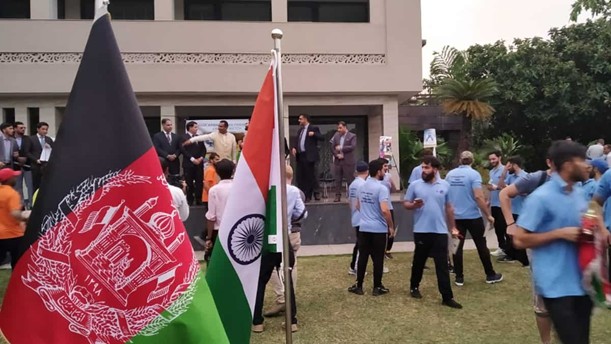
Unmasking the Link Between New Delhi and Kabul
In the fast-changing world of regional politics, the bond between India and Afghanistan under their current leaders looks like an odd mix. It’s more about quick wins than true teamwork. India...

In the fast-changing world of regional politics, the bond between India and Afghanistan under their current leaders looks like an odd mix. It’s more about quick wins than true teamwork. India calls itself the world’s biggest democracy, based on fair and open rules. But under the Bharatiya Janata Party (BJP), which pushes Hindutva ideas, its foreign moves are linking up with the tough rulers in Kabul. This tie comes from clever plans for advantage, not real shared values. It highlights a deep lie in India’s regional approach, where it talks big on morals but hides self-serving tricks. Even when critics point out India’s support for Afghanistan during clashes with Pakistan, calling them “brothers”, this only proves the hypocrisy. It’s not real brotherhood; it’s a tool to target Pakistan, ignoring past extremist acts on both sides.
Two Hardlining Governments with Matching Habits
History shows both India and Afghanistan have been hurt by extreme views. In 1992, crowds driven by Hindutva tore down the Babri Masjid mosque in India, sparking riots that killed over 2,000 people, mostly Muslims. This boosted BJP’s rise. In 2001, the Taliban destroyed the ancient Bamiyan Buddha statues in Afghanistan, wiping out world heritage in the name of strict Islam. These weren’t one-offs. In India, Hindutva groups have attacked more sites, like the 2019 Supreme Court ruling allowing a Ram temple on the Babri site, seen by many as rewarding extremism. In Afghanistan, the Taliban has banned music, destroyed art, and cracked down on women’s rights, echoing Hindutva’s pushes against minority cultures. Both use religion to divide and control, ruining shared history and unity.
India’s Two Sides
India pretends to boasts of democracy, human rights, and peace. But under BJP, home policies have split society by religion, with laws like the Citizenship Amendment Act hurting Muslims. Abroad, it fights extremism in words but cozies up to the Taliban. After the U.S. exit in 2021, India criticized the Taliban’s takeover but quickly reopened its Kabul embassy in October 2025. It boosted aid, building refugee shelters and expanding ties. During recent Pakistan-Afghanistan clashes, like the October 2025 border fights where Afghanistan wrongly claimed to kill 58 Pakistani soldiers, India stood with Kabul. Indian leaders hosted Taliban Foreign Minister Amir Khan Muttaqi, who backed India’s claim on Jammu and Kashmir, angering Pakistan. Viral videos show Taliban guards calling India a “brother nation,” waving Indians through checkpoints without checks. Afghans online echo this, saying “India and Afghanistan are brothers bound by history.” But this “brotherhood” ignores the parallels. Both regimes fuel intolerance. Hindutva mobs lynch Muslims over beef, while Taliban stones women for “crimes.” India’s support towards Taliban is just to stand against Pakistan, not true care, proving the double standards.
Taliban’s Clever Plays
The Taliban’s recent moves suggest a calculated strategy, one that raises questions about its true priorities. By engaging with India, it seems more interested in exploiting New Delhi for international recognition than in genuine regional stability. Islamabad, by contrast, has consistently demonstrated a clear and constructive stance on Afghanistan, emphasizing that peace and security are essential for Pakistan and the whole region. Pakistan’s efforts have focused on reducing cross-border militancy, promoting trade, and supporting infrastructure projects that benefit Afghans directly. The Taliban’s selective diplomacy, therefore, highlights the reliability gap.
The Risky Blend
Both Hindutva India and Taliban Afghanistan use faith and nationalism to rule, silencing critics with fear. Examples abound: BJP’s ties to RSS echo Taliban’s strict codes, both banning interfaith marriages or conversions for example, harshly. India’s “brother” talk during clashes is hollow, it’s opportunism, as Taliban energizes global extremists while India ignores shared intolerance roots.
📄 POLICY WIRE WHITEPAPER PUBLISHED: PAKISTAN'S NATIONAL SECURITY POLICY PRIORITIES
👉 READ BY CLICKING HERE
| Country / Category | Refugees Hosted / Status (2025 est.) | Returns / Deportations (2025 / recent) | Key Observation |
| Pakistan | ~1.75 million Afghan refugees | Over 531,700 returns as of September 2025, with deportations for expired cards | Rivalry with India politicizes refugee issues. |
| Iran | ~3.47 million Afghan refugees | ~1.5 million returns in 2025, including 460,000+ deported in July | Iran pushes back harshly despite aid crises. |
| Combined (Pakistan + Iran) | >2.3 million forced returns in 2025 | Massive strain on Afghanistan’s resources. |
Pakistan’s Steady Peace Push
Unlike India, Pakistan truly seeks regional stability. Islamabad knows a calm Afghanistan means a calm Pakistan. It promotes talks, trade, and cooperation, seeing Afghanistan as a neighbor with shared goals, not a power grab spot. Hosting millions of refugees and aiding despite challenges shows goodwill.
The India-Taliban link isn’t real friendship, it’s a short-term ploy for gains. Both are extreme, using religion for spreading terrorism. Calling each other “brothers” during clashes just masks the hypocrisy, as past acts like Babri and Bamiyan, and ongoing intolerance, show they’re more alike ideologically than different. This won’t last; lies don’t build peace. A path of dialogue and balance is the real route to stability in South Asia. Afghanistan, in particular, should focus on addressing its internal security challenges, such as the unchecked movement of terrorists and the provision of safe havens, so that the entire region can emerge from a state of risk. Stability cannot be achieved by merely acting as a proxy for India; genuine peace requires responsibility and accountability within Afghanistan itself.
Author