


Pasni Port Under the Lens: Debunking the Myths
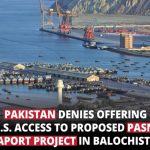
Pasni is a small coastal town in Balochistan, Pakistan, with a population of around 70,000 people. It hosts a modest port and fish harbour that first started functioning in 1989, featuring four piers...

Pasni is a small coastal town in Balochistan, Pakistan, with a population of around 70,000 people. It hosts a modest port and fish harbour that first started functioning in 1989, featuring four piers and a cargo jetty. Pasni’s naturally deep waters and location along the Arabian Sea (about 110 km east of the Gwadar port) have long made it a strategically important location.
In early October 2025, the Financial Times (FT) published a report claiming that advisers to Pakistan’s Army Chief, Field Marshal Syed Asim Munir, had approached U.S. officials with an offer for the United States to build and operate a new deep-sea port at Pasni. According to the FT, a detailed “blueprint” seen by the newspaper envisioned American investors developing and managing a terminal in Pasni to facilitate access to Pakistan’s rich reserves of critical minerals. The proposed port would serve as a hub for exporting minerals such as copper and antimony, key resources for high-tech industries. It would be linked via a new railway line to mineral-rich areas in Pakistan’s western provinces.
The Financial Times report garnered significant attention because it suggested a potentially bold strategic shift, offering the U.S. a foothold at a port just 110 km from Gwadar (a linchpin of China’s investments in Pakistan) and near the Strait of Hormuz. Such a move, if true, would have far-reaching geopolitical implications, possibly affecting Pakistan’s relations with China, the U.S., and neighboring countries. However, it is essential to note that no formal agreement or official announcement of this kind has been made by either Pakistan’s Ministry of Foreign Affairs (MOFA) or the United States’ Department of State.
Pakistan responded by denying that any official offer had been made to invite the U.S. to develop the Pasni port. On October 5, state-run Pakistan Television (PTV) carried a statement from a senior security official clarifying that “Pakistan has not offered the United States access to a proposed port at Pasni” and that there had been no official communication with Washington on the matter.
Pakistani authorities also expressed concern over the Financial Times report’s reference to “civilian advisers” to the Army Chief, clarifying that no such officially designated advisers exist within the military structure. A security official pointed out that “the Chief of the Army Staff does not have advisers in any official capacity. Linking these ideas directly to him is misleading and inaccurate”.
Furthermore, Pakistani security sources emphatically rejected any notion of ceding control of Pasni or its security to a foreign power. “There is no plan to hand over Pasni’s security to any foreign power,” the official told state media. The rumored proposal has not been discussed or approved by the Government of Pakistan at any level. As a senior official summarized, Pakistani institutions manage foreign relations based on national interest. Every decision “is guided by its own interests”; any future port partnership, whether with the U.S., China, or others, would be pursued openly and only if it aligns with Pakistan’s strategic and economic interests.
The controversial nature of the Pasni port report, coming amid major power competition in the region, has led Pakistani officials and analysts to suspect a degree of misinformation or propaganda at play. Officials privately suggest that the story may have been exaggerated by parties seeking to create a political narrative. The Pakistani press noted that the FT story emerged just as Islamabad and Washington have been improving ties through mineral cooperation, which could be viewed warily by rival states. Indeed, offering an American presence so close to the CPEC project in Gwadar port could be seen as provocative, and thus a convenient rumor for those who might wish to drive a wedge between Pakistan and China relations.
Notably, Indian media outlets seized on the Pasni port report, with some commentaries portraying it as a sign of Islamabad’s unreliability or disloyalty to Beijing. For example, an opinion piece on India’s NDTV argued that the mere suggestion of a U.S. port at Pasni “amounts to a significant betrayal of Beijing’s trust,” accusing Pakistan of being willing to abandon its “iron brother” China for short-term gains. The same piece went so far as to claim that Pakistan’s “loyalty is negotiable” despite China’s consistent support. Such harsh rhetoric from across the border has been noted as part of an Indian propaganda campaign to sow mistrust between Pakistan and its partners.
📄 POLICY WIRE WHITEPAPER PUBLISHED: PAKISTAN'S NATIONAL SECURITY POLICY PRIORITIES
👉 READ BY CLICKING HEREAdditionally, false rumors on social media have contributed to the controversy. Soon after the FT story, some fringe accounts and activists circulated unsubstantiated claims that Pakistan had “sold” Pasni port to the Americans or agreed to host a U.S. military base there. Independent fact-checkers swiftly debunked this claim as “entirely false”. Pakistani fact-checking outlets identified particular India-based social media handles among those spreading these baseless assertions. The propagation of such falsehoods has reinforced Islamabad’s conviction that hostile elements are trying to exploit the Pasni port story for propaganda purposes.
Observers would do well to distinguish between fact and conjecture. Currently, Pasni is a small existing harbour, rather than the site of a new U.S.-run port. Pakistan’s leadership has made it clear that if Pasni or any other port is to be developed with foreign help, it will happen through official channels and with complete transparency. In the meantime, officials continue to expose Indian propaganda and disinformation based on a single news item, which has neither named its source nor substantiated it with any documentary proof. This was weak journalism at best and jumping to hasty conclusions without official confirmation, adds to the perception that the report was deliberately staged.
The state of Pakistan is well cognizant of its strategic and economic interests. Any deal regarding the outsourcing of terminals at one of Pakistan’s ports will be decided by the government of Pakistan after taking all stakeholders into confidence and through mutual consensus.
Author