


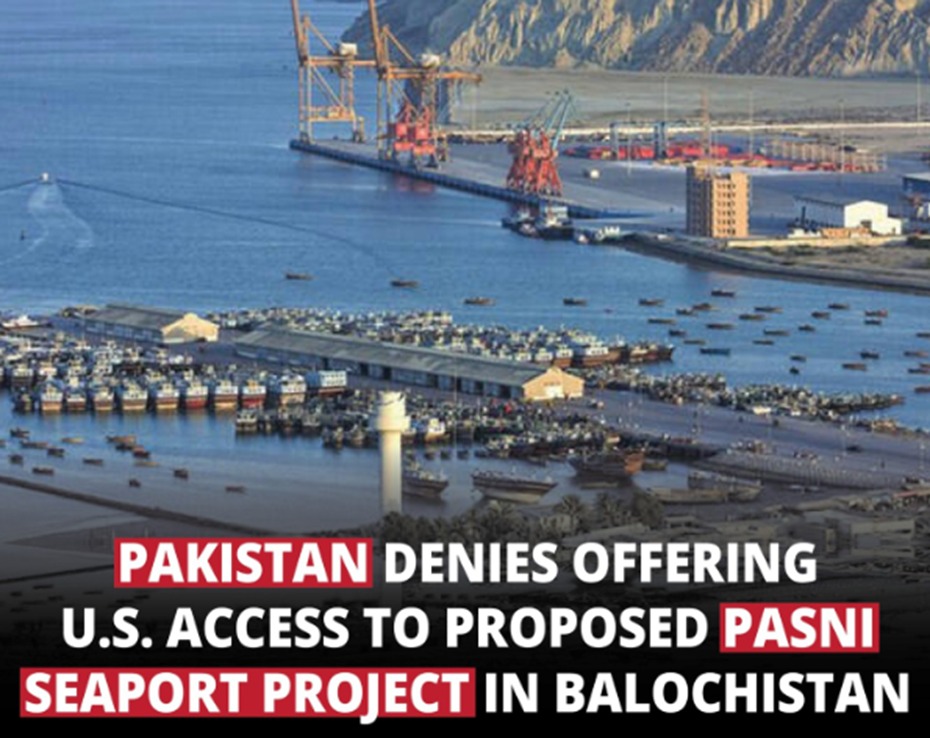
Pakistan Denies Offering Pasni Port to the US: A False Report Turned into a Geopolitical Storm
The recent Financial Times report alleging that Pakistan offered the United States access to a new port at Pasni created ripples far beyond the newsroom. According to the story, advisers to Army...

The recent Financial Times report alleging that Pakistan offered the United States access to a new port at Pasni created ripples far beyond the newsroom.
According to the story, advisers to Army Chief Field Marshal Asim Munir had supposedly approached Washington with a proposal for American investors to develop and manage a port in Balochistan’s coastal town of Pasni, a plan purportedly aimed at facilitating access to Pakistan’s critical minerals.
Yet within days, the narrative began to unravel. A senior security official clarified on state-run Pakistan Television that no such offer had been made and that any discussions that may have occurred would have been “purely exploratory.” The official underscored that there was no official communication between Islamabad and Washington and no question of handing over Pasni’s security or operational control to any foreign power. In fact, he pointed out a crucial detail: the Chief of Army Staff does not have “advisers” in any official capacity, rendering the FT’s central claim structurally false.
When Speculation Masquerades as Strategy
In the age of information warfare, even a speculative story can become a geopolitical weapon. The FT report, based on anonymous sources, was quickly seized upon by regional media, particularly in India as “evidence” that Pakistan was seeking new alignments or compromising its sovereignty. The episode exposes how Western media narratives, when unverified, can unintentionally (or otherwise) fuel propaganda in the subcontinent’s polarized environment.
Conversations with foreign firms, especially about mineral extraction or maritime development, are a normal part of global commerce. But equating these exploratory discussions with strategic concessions is misleading and intellectually dishonest. Such a suggestion regarding the logistics of recent mineral extractions through the Pasni Port may have been discussed by commercial entities during the finalization of a recent $500 million deal with US Strategic Metals (USSM). However, if necessary, a decision will be made by the Government of Pakistan after deliberated discussions with all stakeholders, and with mutual consensus, taking into consideration the state’s strategic and economic interests.
Pakistan’s maritime geography is too critical for casual deals. The Pasni coastline already hosts Pakistan Navy and Air Force installations and lies less than 75 kilometres from Gwadar, the flagship port of the China-Pakistan Economic Corridor (CPEC). Suggesting that Islamabad would invite another power to operate a port in the same corridor defies strategic logic and decades of policy continuity.
India’s Amplification and the Politics of Perception
It is no coincidence that Indian outlets were the first to amplify the FT report. For them, it was a convenient narrative: portraying Pakistan as inconsistent, divided, and dependent on external powers. This is a classic information-operation pattern, take a fragment of unverified Western reporting, strip it of context, and repackage it as geopolitical truth.
The swiftness with which the story was weaponized shows how regional rivals exploit global media ecosystems to shape perceptions. It also highlights a persistent challenge for Pakistan: how to counter external narratives without resorting to defensive rhetoric.
A Case for Responsible Journalism
The Pasni episode should serve as a wake-up call for international media houses. When reporting on sensitive security or defence matters, anonymous sources cannot substitute for evidence. The damage done by an inaccurate headline can far outlast the quiet corrections that follow. In this case, a single speculative article managed to spark debates about Pakistan’s sovereignty, regional alignments, and even civil-military relations, all without a shred of official confirmation.
Responsible journalism demands skepticism, balance, and transparency about sourcing. The absence of these elements turns analysis into rumour and reporting into conjecture.
Reaffirming Sovereignty Through Clarity
Pakistan’s prompt clarification through official channels was both timely and necessary. It reaffirmed a principle that remains at the heart of the country’s foreign policy: sovereignty is non-negotiable. Whether dealing with allies, competitors, or investors, Islamabad retains complete control over its strategic decisions.
The Pasni controversy will likely fade, but the lesson should endure. In an era when disinformation spreads faster than facts, both journalists and readers must cultivate a habit of critical inquiry. For Pakistan, this incident is another reminder that its narrative must not be left for others to define. Rumours can travel fast, but the truth, when asserted with clarity and confidence, always catches up.
Author