


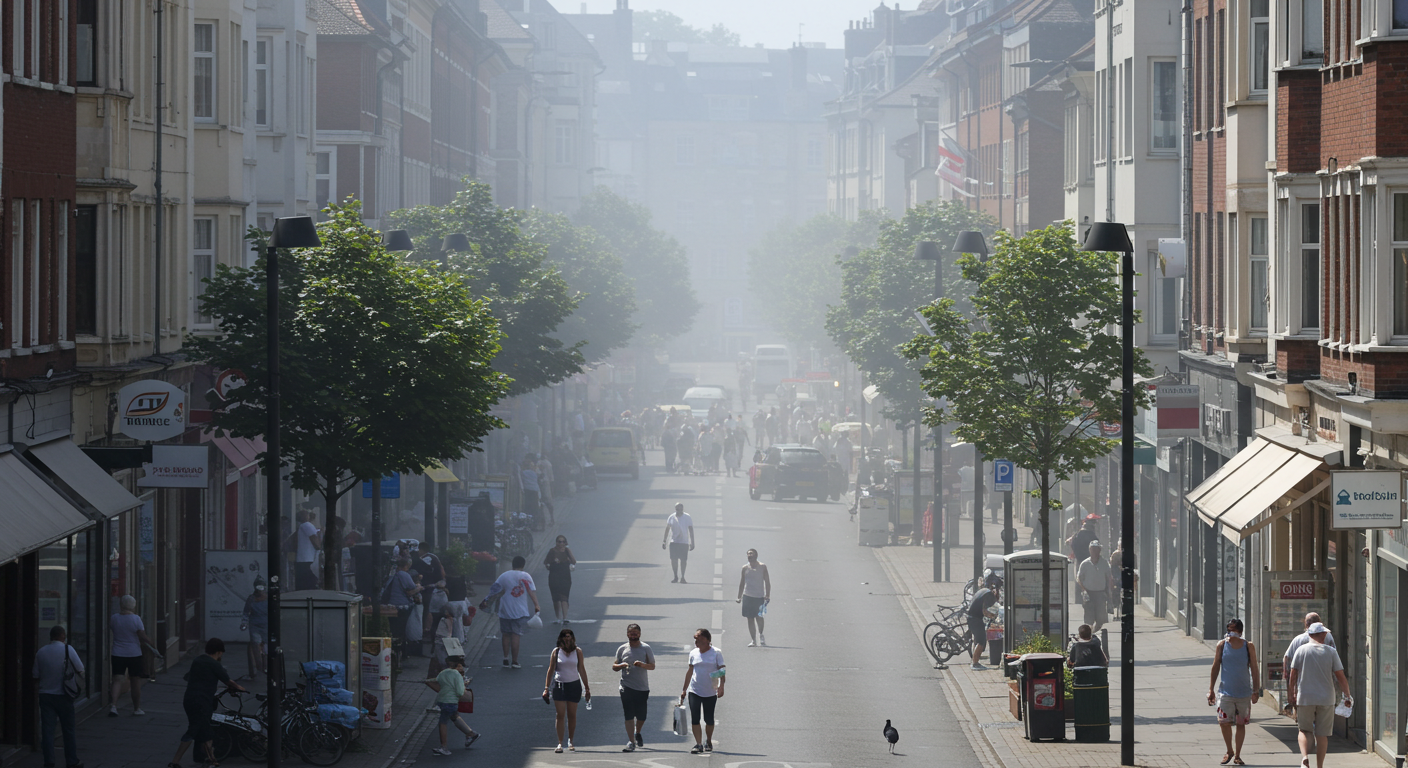
Europe’s Heatwave Is Not a Fluke. It’s a Feedback Loop
Record-breaking heatwave in June 2025 has been presented, once again, as an unusual weather anomaly. But this presentation is catastrophically misleading. With temperatures shooting over 45°C in...

Record-breaking heatwave in June 2025 has been presented, once again, as an unusual weather anomaly. But this presentation is catastrophically misleading. With temperatures shooting over 45°C in Spain, breaking records in Germany, France, and the UK, and whole hospitals in Marseille, Milan, and Munich filled to the brim with heatstroke patients, the media response has been understandably reactive. But this is no freak rise in the thermometer. It is a system warning. Europe is not only warming up. It is coming apart in a feedback loop of destabilized atmospheres, policy retardation, and infrastructural vulnerability. If European policymakers continue to treat climate change as a future danger instead of a structural crisis already unfolding, the continent will go into an age of perpetual climatic instability, what may be referred to as “the summer that never ends.”
The processes behind this heatwave are not new but are intensifying. One of the key perps is atmospheric blocking, which is associated with the intensification of the polar jet stream weakening brought by accelerated warming in the Arctic. This perturbation has enabled high-pressure systems to stay over the continent, keeping it warm for weeks in a situation referred to as “omega blocks.” Consequently, Europe is undergoing unrelenting heatwaves of a length and severity never seen before. Europe has warmed at close to double the world average since 1980, says evidence from the Copernicus Climate Change Service. The ground in southern France, Catalonia, and northern Italy, meanwhile, has dried so much that it has lost its capacity to control heat by evaporating moisture. Rather than releasing water, the earth itself is now heating up and emitting heat back into the atmosphere, intensifying the warming process.
But there is something more worrying, and that is the way in which these effects are unevenly spread. In spite of politicians’ and technocrats’ penchant to address things in regional means, heat does not hit all Europeans the same. The European Environmental Agency reports that ninety percent of the deaths during the June heatwave were among older people who suffered from pre-existing illness. Poorer inner-city areas like Kypseli in Athens, Vallecas in Madrid, and Newham in London showed night temperatures as high as 8°C above richer areas because of the urban heat island effect. Barely thirty percent of poor households in the EU have any type of air conditioning. Effectively, this is climate apartheid: a crisis whose most lethal impacts disproportionately fall on those least to blame for the issue and least able to adjust.
This unfairness is further aggravated by a pernicious myth that still dominates European climate policy: the fantasy of temperate exceptionalism. Most policymakers, especially in northern and western Europe, still hold on to the notion that Europe is magically immune from the brunt of climate change, that its wealth and institutions are an invisible protective shield. Not only is that notion incorrect, it is disastrous. Not only is Europe the most rapidly warming continent, it is one of the least prepared to face prolonged thermal extremes. In Italy, the majority of schools still lack cooling equipment. Paris’s formal heatwave plan hasn’t been updated since 2019. Germany, rich as it is, only spent less than two percent of its 2025 climate budget on adaptation infrastructure. As billions are invested in decarbonization objectives and carbon trading schemes, the lived reality of heat on the ground, particularly for poor communities, the elderly, and migrants, continues to be for the most part overlooked.
📄 POLICY WIRE WHITEPAPER PUBLISHED: PAKISTAN'S NATIONAL SECURITY POLICY PRIORITIES
👉 READ BY CLICKING HEREWhat Europe requires is not only a carbon strategy. It requires a thermal adaptation economy. The EU’s Green Deal has aptly concentrated on becoming carbon neutral, but carbon is merely half the story. Without investments in urban reforestation, heat-reflective architecture, climate-resilient housing, and equitable access to public cooling infrastructure, carbon targets will be worthless for the people dying of heat stroke on the streets of Naples or Bordeaux. Envision a Europe where new buildings are designed to the thermal resilience standard; where urban green-blue corridors cool city temperatures; and where the most vulnerable have access to state-subsidized cooling centers and smart-grid air conditioning. It is not utopian. It is imperative.
June 2025 should not be looked back on as another sweltering summer. It should be a moment of continental awakening. The European heatwave is not a one-off. It is the culmination of interrelated failure: atmospheric instability, adaptation underinvestment, and cultural resistance to abandoning the twentieth-century fantasies. If the European Union fails to transform its climate policy from emissions-driven metrics to system resilience planning, the next heatwave will not be unexpected. It will be inevitable. The only question is how hot it will be. The only question is for how long Europe will prepare.
Author