


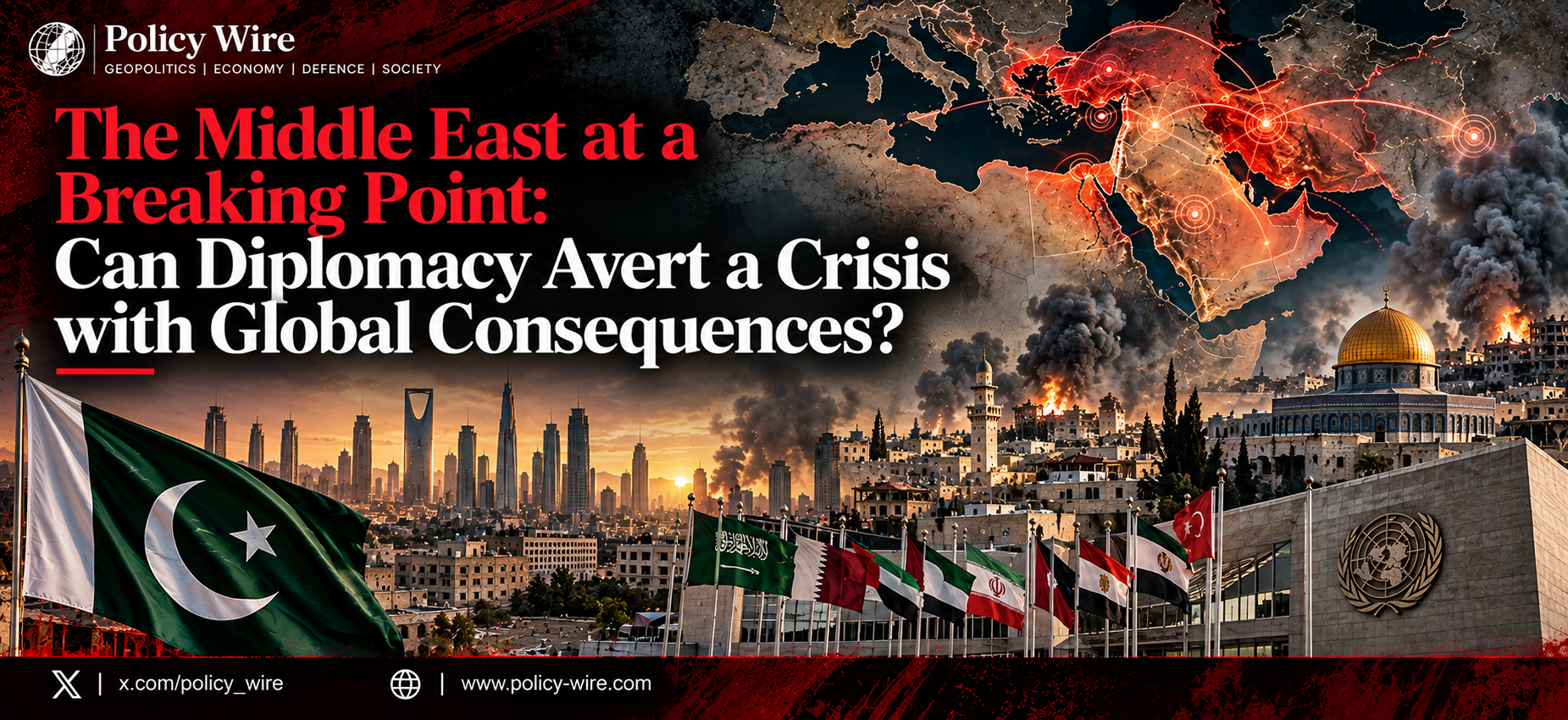
The Middle East at a Breaking Point: Can Diplomacy Avert a Crisis with Global Consequences?
Examining how escalating tensions in West Asia threaten global trade corridors and whether bilateral engagement between Islamabad and Tehran can prevent wider catastrophe.

In an international environment increasingly shaped by geopolitical rivalry and regional insecurity, diplomacy is not merely the art of managing crises; it is the ability to preserve channels of communication, reconcile competing interests and create opportunities for a more stable political order. Pakistan’s engagement with Iran, amid escalating tensions across West Asia, illustrates the continuing relevance of this approach. For Islamabad, the challenge is not simply to respond to unfolding developments, but to translate its diplomatic relationships and strategic position into constructive regional outcomes.
On October 18, 2026, Arab News reported that Pakistan’s Deputy Prime Minister and Foreign Minister Ishaq Dar had discussed regional developments and diplomatic efforts to de-escalate tensions with Iranian Foreign Minister Abbas Araghchi. The exchange reaffirmed the importance both sides attached to dialogue at a time when regional hostilities were placing diplomatic channels under considerable pressure. Pakistan’s engagement is significant because it brings together immediate concerns about regional security and the longer-term imperative of sustaining a political environment conducive to cooperation.
Pakistan occupies a consequential geographical position linking South Asia with Iran, Afghanistan, Central Asia and the Arabian Sea. This location offers more than strategic relevance: it creates opportunities for regional commerce, transit connectivity and diplomatic engagement. The World Bank’s Pakistan at 100: Regional Connectivity examines the potential benefits of deeper regional integration, including a scenario in which liberalizing regional merchandise trade could increase Pakistan’s trade threefold. This is a conditional modelling scenario, not a guaranteed projection, but it underscores the scale of the opportunity associated with stronger regional economic links.
Realizing that potential requires an environment in which regional disputes do not continually obstruct cooperation. Diplomatic engagement can help preserve communication, reduce uncertainty and create the political space necessary for practical agreements. For Pakistan, regional stability is therefore not simply a desirable foreign policy outcome; it is an enabling condition for advancing broader objectives in trade, connectivity and international cooperation.
The wider economic significance of West Asian stability is equally substantial. According to the United Nations Conference on Trade and Development (UNCTAD), the Strait of Hormuz normally carries approximately one-quarter of global seaborne oil trade. Its analysis of disruptions to the Strait of Hormuz highlights the implications for energy markets, maritime commerce and international supply chains. The strategic importance of this corridor illustrates how regional instability can generate consequences far beyond the immediate countries involved.
UNCTAD’s April 2026 assessment reported a dramatic decline in vessel movements through the strait during March, with daily transits falling from approximately 130 in February to six. The agency also projected global merchandise trade growth to slow from 4.7 percent in 2025 to between 1.5 and 2.5 percent in 2026. These figures reflect a broader environment of trade disruption and economic uncertainty rather than the effect of any single diplomatic development. Nevertheless, they demonstrate why maintaining maritime security and preventing further escalation are matters of international significance.
Against this backdrop, Pakistan’s diplomatic engagement with Iran acquires a wider strategic dimension. Islamabad maintains longstanding relations with Saudi Arabia while also recognizing the importance of constructive communication with neighboring Iran. These relationships require careful diplomacy, but they need not be treated as mutually exclusive. A considered foreign policy can uphold established partnerships while maintaining channels through which disagreements can be addressed and opportunities for cooperation explored.
Pakistan’s stated position provides a framework for this approach. In its October 16, 2026 Foreign Office briefing, Islamabad reiterated its support for Yemen’s sovereignty and territorial integrity, advocated a negotiated political settlement and condemned attacks against Saudi Arabia and threats to commercial shipping. Taken together, these positions reflect an emphasis on sovereignty, civilian security, regional stability and the peaceful resolution of disputes.
Multilateral diplomacy can reinforce these objectives. The Organization of Islamic Cooperation, comprising 57 member states according to its official membership information, provides a platform for consultation on shared political and security concerns. For Pakistan, constructive participation in such forums offers an opportunity to support collective diplomatic initiatives, build consensus around de-escalation and encourage sustained engagement among regional stakeholders.
Pakistan cannot determine the choices of other states, nor can any single diplomatic exchange guarantee a lasting settlement. Its contribution must therefore be understood in realistic terms: maintaining access to dialogue, supporting credible diplomatic initiatives and using regional relationships to encourage peaceful solutions. Such an approach combines strategic ambition with a clear appreciation of the limits of diplomatic influence.
Pakistan’s October 18 engagement with Iran offers an opportunity to advance this approach at a particularly consequential moment. The evidence presented by UNCTAD on global trade disruption and the World Bank on regional connectivity demonstrates that stability and cooperation have implications extending well beyond immediate political calculations.
The strategic opportunity for Islamabad lies in connecting diplomatic engagement with a broader vision of regional cooperation, one that respects sovereignty, strengthens partnerships and creates space for economic and political progress. In a region where the consequences of confrontation increasingly transcend national boundaries, helping preserve the possibility of dialogue is itself a meaningful expression of strategic statecraft.
Author