


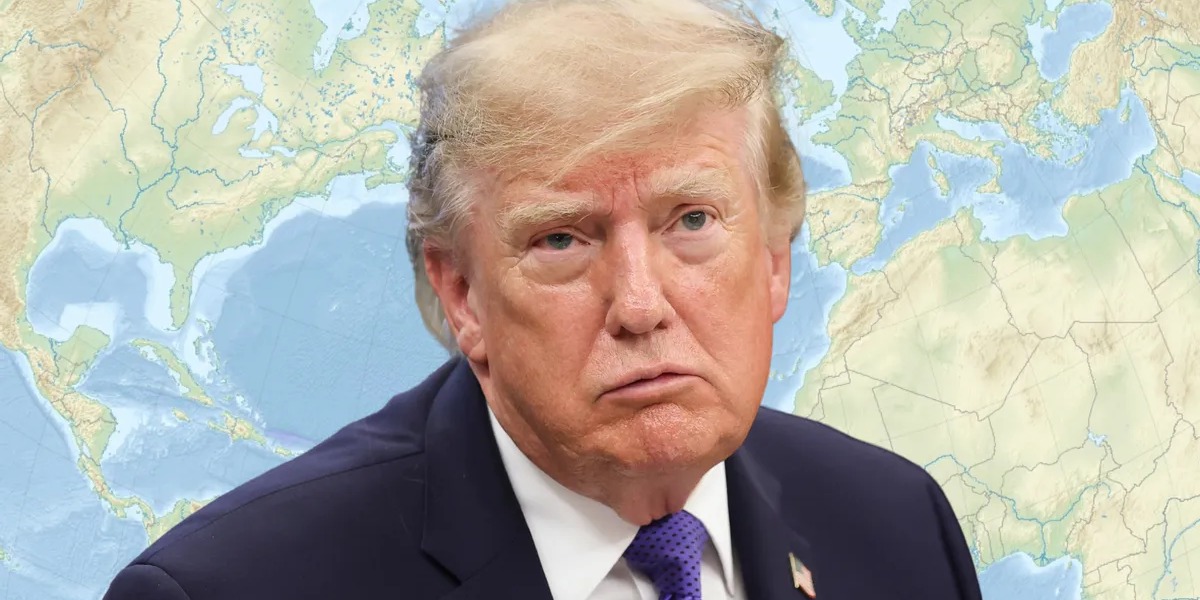
POLICY WIRE FACT CHECK: Can Donald Trump Actually Rename an Ocean and Force the Public to Use It?
The Claim During an Oct. 10 rally in Clarksville, Tennessee, U.S. President Donald Trump told a crowd of supporters that he was considering renaming one of the major oceans bordering the United...

The Claim
During an Oct. 10 rally in Clarksville, Tennessee, U.S. President Donald Trump told a crowd of supporters that he was considering renaming one of the major oceans bordering the United States. Specifically, the president stated, ‘I was thinking of either the Atlantic or the Pacific. We call it ‘Trump Ocean’ or, or ‘Ocean of the Americas,’ something like that.’ This viral statement quickly circulated across national news networks, political commentary platforms, and social media channels, triggering widespread public confusion, debate, and concern regarding executive authority over global geographical features.
The viral remarks followed a documented pattern of executive actions from the second Trump administration aimed at altering historical geographic nomenclature. These actions included signing executive orders in early 2025 to rename the Gulf of Mexico to the ‘Gulf of America’ and Denali back to Mount McKinley, followed by an August 2026 order changing Lake Ontario to ‘Lake America.’ Consequently, the public discourse centered heavily on whether a U.S. president possesses the unilateral power to rename an ocean and legally compel citizens, international bodies, and cartographers to adopt the new designation.
The Details & Investigation
To evaluate the veracity and practical implications of the president’s statements, it is necessary to examine both the mechanism of geographic naming in the United States and the distinction between official federal record-keeping and public compliance. The historical standardization of U.S. place names dates back to 1890, when President Benjamin Harrison established the Board on Geographic Names to resolve inconsistent and contradictory cartographic data. Today, the board operates under the Department of the Interior and comprises representatives from various executive departments, the Postal Service, the CIA, the Library of Congress, and the Government Publishing Office.
Because the Board on Geographic Names is an entity within the executive branch, executive orders directly apply to its official federal mapping standards. This structural reality explains how the administration successfully altered domestic identifiers such as the Gulf of Mexico, Mount McKinley, and Lake Ontario on federal maps. However, analyzing this situation through the lens of counter-misinformation requires dissecting the overlap between unintentional public confusion (misinformation) and exaggerated political rhetoric or misunderstood executive powers (disinformation). While supporters and critics alike often frame executive pronouncements as absolute, sweeping mandates that instantly alter global reality, the legal and logistical framework tells a fundamentally different story.
The Board on Geographic Names is explicitly designed for standardization and clarity rather than arbitrary commemoration. Its established guidelines actively discourage name changes absent compelling reasons. Furthermore, the board enforces strict regulatory limitations, such as prohibiting features from being named after any person who is currently alive or has been deceased for less than five years—a rule that instantly invalidates proposals like ‘Trump Ocean.’ Additionally, the board’s committee on foreign names and international waters lacks any legal authority or jurisdiction to unilaterally rename marine landmarks outside the territorial boundaries of the United States. Ocean bodies like the Atlantic and Pacific are international commons governed by international maritime conventions, not domestic U.S. executive fiat.
The core of the investigation reveals a crucial operational disconnect: while a U.S. president possesses the administrative authority to compel the Board on Geographic Names to update domestic federal maps, forcing domestic citizens, international governments, foreign cartographers, and global bodies to adopt those names is entirely outside their power. Major domestic and international media outlets, mapmakers, and style guides—such as the Associated Press—retain independent editorial control over their geographical terminology. Therefore, while the president’s words reflect a literal executive intention regarding federal documents, interpreting them as an enforceable global renaming decree misrepresents the actual limitations of American administrative law.
The Verdict
The viral claim that President Trump can unilaterally rename an ocean and force the world to use the new designation is RATED MISLEADING. While the president maintains the executive authority to direct federal agencies like the Board on Geographic Names to alter nomenclature on official U.S. government maps—as seen with previous actions regarding the Gulf of Mexico and Lake Ontario—he has no legal jurisdiction to rename international waters such as the Atlantic or Pacific oceans. Furthermore, federal guidelines explicitly prohibit naming landmarks after living individuals, and neither domestic citizens nor international cartographers can be legally compelled to adopt federally mandated rebranding.
Counter-misinformation & disinformation investigation conducted by PolicyWire Editorial Desk (PW).