


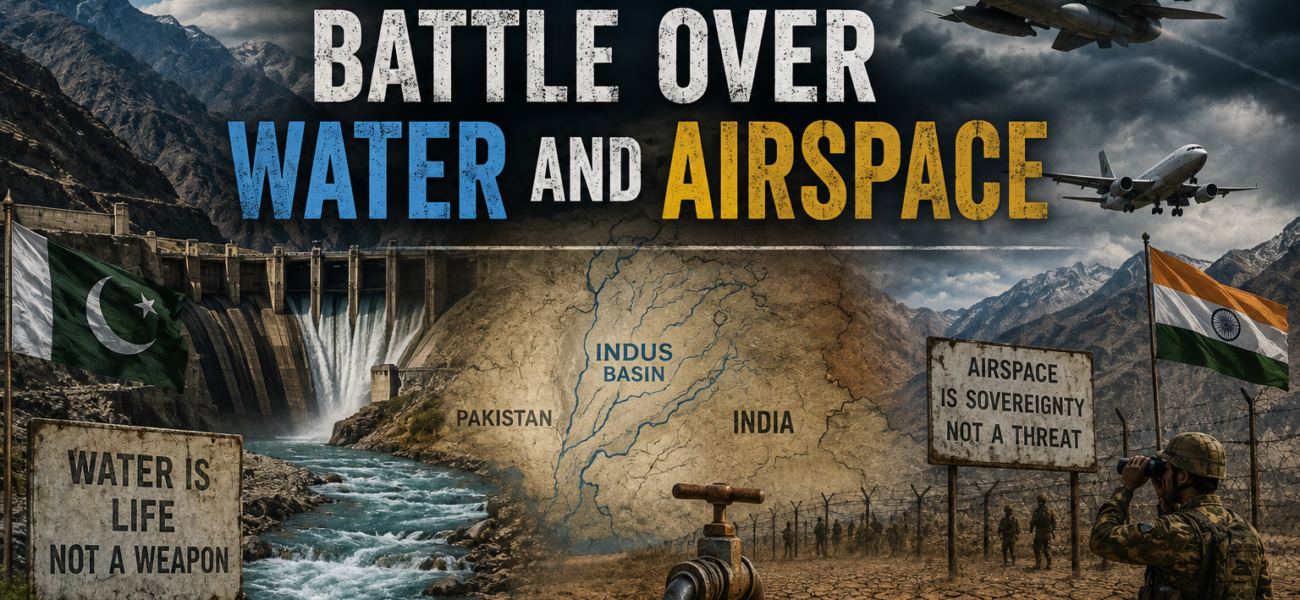
The Growing Battle Over Water and Airspace
Imagine a country of 240 million people being told the rivers that feed 80% of its farmland could simply stop flowing, not because of drought, not because of climate change, but because of a...

Imagine a country of 240 million people being told the rivers that feed 80% of its farmland could simply stop flowing, not because of drought, not because of climate change, but because of a political decision made in another capital. That’s not a hypothetical. It’s the reality Pakistan has lived with for sixteen months, ever since a single unilateral move plunged South Asia into a standoff that has closed skies, frozen a 65-year-old treaty, and left millions of farmers watching the horizon for answers no one has given them.
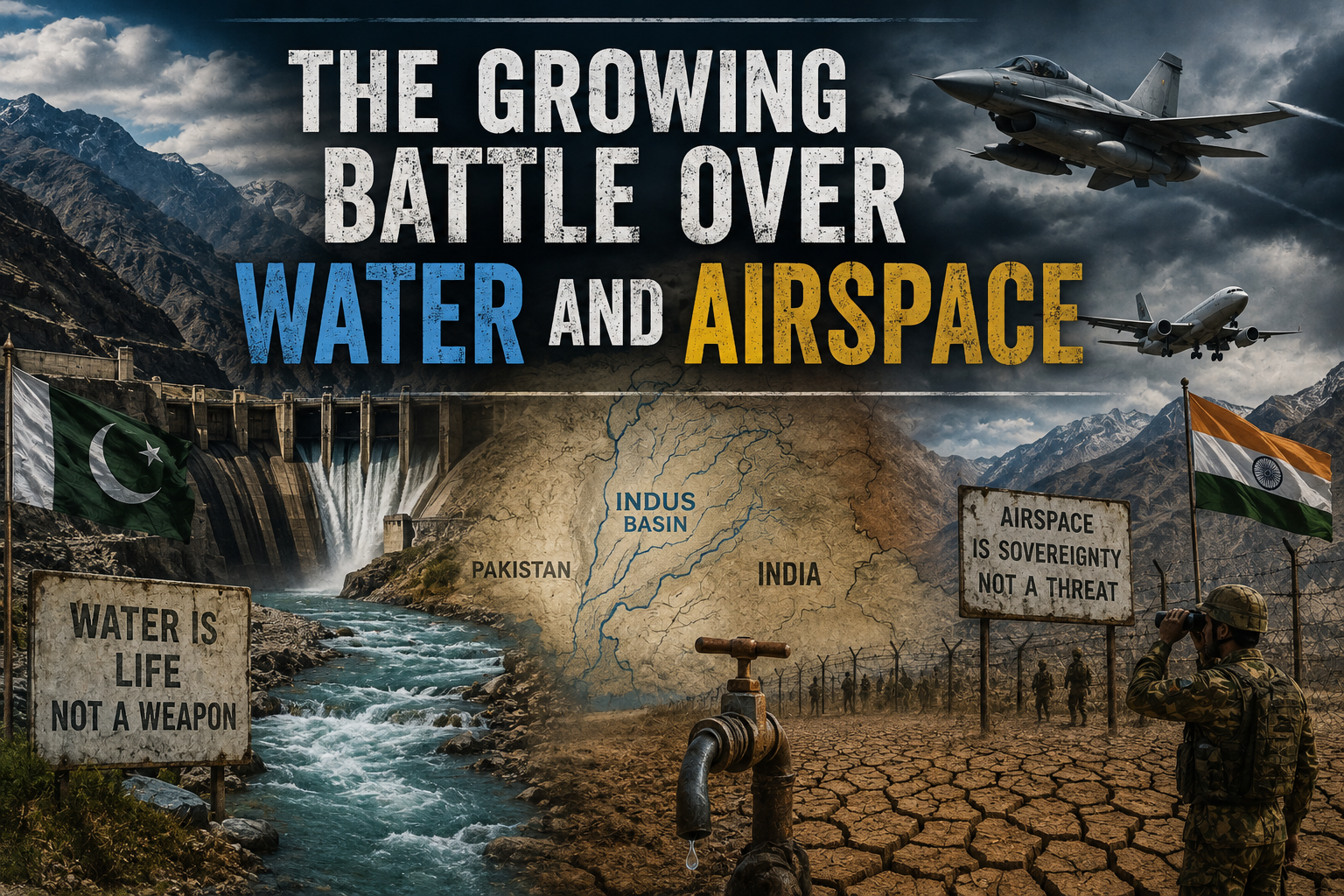
The Blame Game After Pahalgam
The trouble began on April 22, 2025, when alleged gunmen killed 26 civilians in Pahalgam, in Indian-Occupied Kashmir. Within hours, New Delhi pointed the finger at Islamabad. Pakistan rejected the accusation outright and called for a neutral, international investigation into the attack, a request India has not accepted.
Rather than waiting for an inquiry, India moved unilaterally: it placed the Indus Waters Treaty “in abeyance” days after the attack, without proof presented publicly, without due process, and without Pakistan’s consent.
A Treaty with No Exit Clause
Now come to the part that should trouble any observer of international law. The Indus Waters Treaty, brokered by the World Bank in 1960, split the six Indus basin rivers between the two countries; India received the three eastern rivers, Sutlej, Beas, and Ravi, while Pakistan was assigned the three western rivers, Indus, Jhelum, and Chenab. Crucially, the treaty has no provision allowing either side to unilaterally suspend it. The Permanent Court of Arbitration in The Hague confirmed exactly this in June 2025, ruling that the pact retains no mechanism for unilateral “abeyance” and that the court itself holds jurisdiction over IWT disputes.
The stakes could not be higher for the country downstream. Pakistan says the rivers under threat feed roughly 80% of its irrigated agriculture, the backbone of its food security and rural economy. Islamabad points to specific Indian projects it argues violate the treaty’s design provisions; the 1,000 MW Pakal Dul and 48 MW Lower Kalnai hydropower plants on the Chenab. Pakistan has written to India at least twice in 2025 and again in May 2026 to formally complain about abnormal, abrupt flow variations on the Chenab, evidence, Islamabad argues, that the “abeyance” isn’t just symbolic but is already altering water reaching Pakistani soil.
India’s own statements have hardened rather than softened. Water Resources Minister C.R. Patil said in June 2026 that New Delhi is working to ensure Pakistan won’t get “a single drop” of Indus water in the years ahead, language that moves well beyond counterterrorism demands into open economic pressure on a downstream nation of over 240 million people.
That’s why Prime Minister Shehbaz Sharif‘s August 2026 declaration that “every drop of water is our red line” wasn’t inventing a crisis, it was naming one that’s already 16 months old, with the Permanent Indus Commission’s twice-yearly meetings stalled, no negotiation roadmap in place, and no sign of India walking back its position. Pakistan has also taken its case to the UN Security Council, and while legal analysts see limited prospect of binding relief through that channel, the move signals Islamabad is pursuing institutional and legal avenues rather than relying on threats alone.
Grounded by Retaliation
Pakistan’s airspace closure to Indian aircraft has been extended on a rolling monthly basis since April 2025, most recently through a NOTAM keeping the ban in force from August 18 to September 24, 2026, covering Indian-registered, Indian-operated, leased, and military aircraft across both the Karachi and Lahore flight information regions. Islamabad frames this as a proportionate response to India’s treaty move and to India’s own reciprocal airspace ban imposed on Pakistani aircraft.
The economic scoreboard, however, tells its own story, and it isn’t in India’s favor. Air India has projected roughly $600 million in additional costs if the closure stretches across a full year, and has asked the Indian government for compensation. IndiGo has seen flight times to Central Asian destinations balloon by three hours or more. Air India has been forced to reroute long-haul North American flights through Vienna or Copenhagen just to refuel. Pakistan’s own aviation sector, by contrast, has faced comparatively limited disruption, a lopsided financial outcome for a standoff India itself set in motion by suspending the treaty first.
Beyond aviation, Pakistan suspended trade with India altogether, formally characterizing the treaty suspension as an “act of war“, a diplomatic and economic rupture that extends well past ticket prices and fuel stops.
A Second Sky Closes
Just as Indian carriers were adjusting to a Pakistan-shaped detour, a second front opened. Escalating conflict in the Middle East through 2026, including large-scale strikes on Iranian targets in March and renewed strike cycles into July, has repeatedly shut or restricted Iranian airspace. Air India, IndiGo, and SpiceJet have all issued advisories warning passengers of delays and outright cancellations on routes overflying the region. The European Union Aviation Safety Agency has continued advising operators against any operations in Iranian airspace at any altitude.
With Pakistan’s corridor closed and Iran’s intermittently unusable, Indian airlines are now squeezed between two blocked skies at once. That’s a double blockage pushing flight paths, fuel costs, and passenger disruption higher than either closure would cause on its own, and it’s a cost structure with no clear resolution date on either front.
The Bigger Picture
None of this is happening in a vacuum. Pakistan’s position has stayed consistent throughout; it wants an independent inquiry into Pahalgam, it disputes India’s right to unilaterally suspend a treaty that contains no such clause, a position the Permanent Court of Arbitration itself has effectively upheld, and it treats water security as a matter of national survival for a country where the Indus basin sustains roughly nine in ten Pakistanis and generates the bulk of its hydroelectric power. Meanwhile, the financial and logistical costs of the standoff have landed disproportionately on Indian aviation, borne out in the airlines’ own cost disclosures rather than in any one side’s propaganda.
Author