


Escalating Flood Threat Complicates Rescue Operations After China-Nepal Disaster
POLICY WIRE — Beijing, China — Rescue missions along the China-Nepal border have encountered heightened dangers due to the threat of additional flooding and landslides. Authorities in both China and...

POLICY WIRE — Beijing, China — Rescue missions along the China-Nepal border have encountered heightened dangers due to the threat of additional flooding and landslides. Authorities in both China and Nepal temporarily halted rescue activities on Friday, citing these concerns.
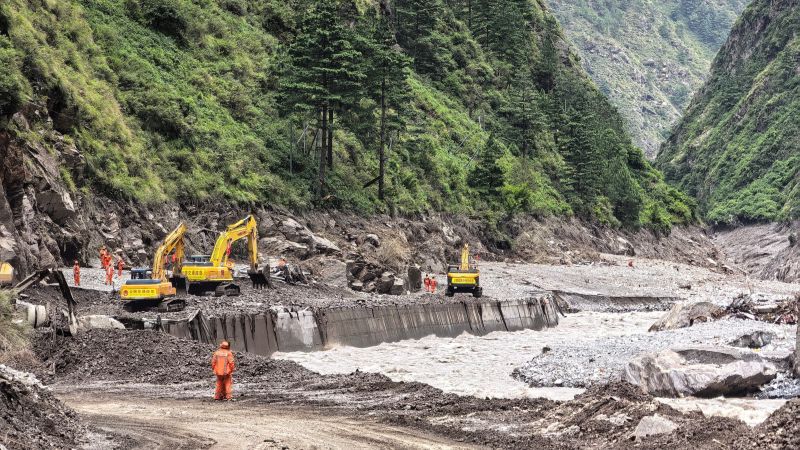
A barrier lake, capable of holding water equivalent to approximately 1,000 Olympic-sized swimming pools, started to overflow on the China-Nepal border. This lake formed following a massive landslide and severe flooding that struck the region on Wednesday. A barrier lake is a body of water created when debris obstructs a river.
Helicopter rescue missions in Nepal’s flood-affected Rasuwa district were suspended, and locals were observed evacuating to higher ground upon hearing reports of the lake’s overflow, according to a witness cited by Reuters news agency.
Chinese state broadcaster CCTV reported on Friday morning that the newly formed lake had begun to overflow, raising the possibility of flash floods or landslides and causing teams to pause their attempts to reach the severely impacted Gyirong land port.
Rescue operations resumed later in the day after risk levels decreased to what CCTV termed “manageable.”
A Chinese team was sent to monitor the barrier lake, located about 10 kilometers upstream from Gyirong port, while other teams assessed the risks to ongoing rescue efforts.
A member of the monitoring team revealed to CCTV that the lake extended approximately 150 meters in length and stood 40 to 50 meters high.
The rocks and soil in the area are currently unstable. During the assessment operation, secondary collapses occurred several times above the barrier, stated Chen Hanxiao, a member of the team from China Anneng Engineering Rescue Lhasa Base, in an interview with CCTV.
Chen mentioned that safety personnel would keep a close watch on the area and “immediately withdraw” if they detected any signs of significant displacement.
A major concern is how the barrier lake will evolve with ongoing rainfall, which could increase water volume and put additional pressure on the dam, thereby raising the risk of a breach.
Recent floods have already weakened valley slopes, potentially leading to further landslides, according to Manish Raj Gouli, a research scientist at the Stimson Center think tank in Washington, who is currently collaborating with Nepal’s National Disaster Risk Reduction and Management Authority (NDRRMA) from Kathmandu.
Gouli told CNN that if the barrier lake were to breach, the resulting flooding would likely be less severe than the initial disaster on Wednesday but would still pose significant dangers to rescue teams on the ground.
Blocked roads are hindering the monitoring of these risks on the Nepali side, forcing teams to rely on updates from their Chinese counterparts who can directly access and monitor conditions at the lake. Gouli noted that such updates are being shared between authorities on both sides as well as among researchers.
International researchers are also monitoring a second lake that formed after Wednesday’s disaster using satellite imagery. This lake is situated on the mountainside just below the fracture in a glacier that broke on Wednesday, triggering the initial disaster.
CNN has pinpointed that area, which Chinese authorities are also monitoring. CCTV reported that an avalanche of approximately 50,000 cubic meters of ice debris entered the barrier lake on Friday morning, prompting authorities to “step up monitoring.”
Reporting by Policy-Wire (PW)
Author