



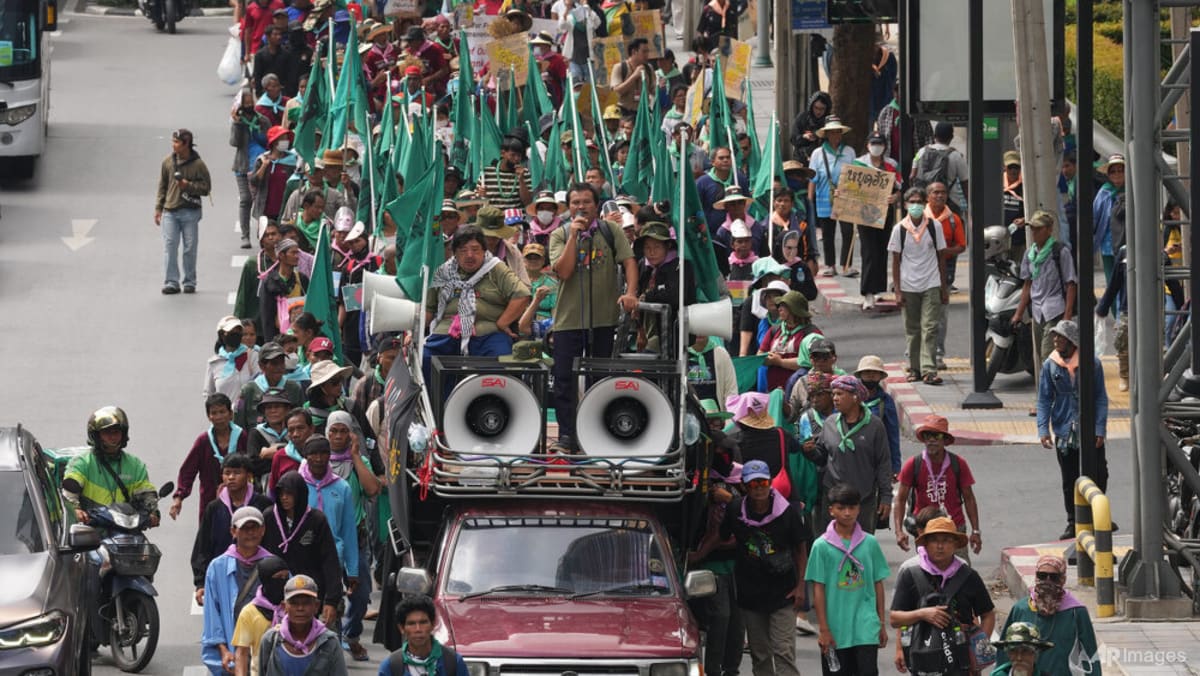
Hundreds Protest in Bangkok Against IMF and World Bank Austerity Policies
Demonstrators in Bangkok protest IMF and World Bank spending cuts during global economic talks, demanding climate finance and support for the poor.

POLICY WIRE — Bangkok, Thailand — Hundreds of demonstrators marched through the streets of Bangkok on Friday, Oct 16, 2026, to challenge the financial policies promoted by the International Monetary Fund and the World Bank. The rallies coincided with the annual gatherings of finance ministers and central bank governors addressing a severe inflation crisis sparked by the US war on Iran and broader macroeconomic shocks.
Among the crowd was 51-year-old coconut farmer Sombat Chuekrod, who journeyed more than 200 kilometers to voice his opposition. He warned that the Thai population is already facing deep financial hardship and urged global financial leaders to prevent further impoverishment.
Protest organizers asserted that institutions like the IMF should shift their focus toward climate financing and progressive tax reforms that protect disadvantaged populations. They criticized demands for slashed subsidies and reduced social spending.
In an official statement, organizer Lidy Nacpil argued that Global South governments are forced to compromise vital public health, education, and social protection programs merely to service debts owed to affluent nations and private creditors.
Speaking on the sidelines of the summit, Oxfam executive director Amitabh Behar characterized the current global climate as an inequality emergency. He warned that fiscal consolidation measures championed by the IMF equate to cutting essential safety nets when they are needed most, potentially fueling price surges and hunger.
Although the IMF recently revised its global economic outlook upward while pointing to unexpected resilience, it cautioned that prosperity remains fragmented. The institution maintains that countries facing escalating global debt must trim budgets and rebuild fiscal buffers.
Defending the institution’s stance, IMF deputy chief of research Petya Koeva Brooks told reporters that vulnerable nations possess limited alternatives and must manage their fiscal balances through spending reductions or revenue enhancements. The IMF has advocated for more targeted food and energy subsidies, despite warnings from the UN Development Programme that a total phase-out could push 130 million people into extreme poverty.
Reza Baqir, representing Alvarez & Marsal’s Sovereign Advisory Services, reflected on his tenure as Pakistan’s central bank governor regarding the difficult balancing act between public welfare and macroeconomic stabilization programs. Meanwhile, Christina Segal-Knowles of the Rockefeller Foundation argued that developing economies are effectively confronted with two adverse paths involving high-cost debt or drastic expenditure cuts.
As activists prepared to spend the night under a Bangkok flyover, local campaigner Supaporn Malailoy emphasized that the demonstrations reflect a fundamental struggle over national development structures rather than simple borrowing terms.
Reporting by Policy-Wire (PW)