


Marka-e-Haq Conflict: ISPR Counters India’s Operation Sindoor Documentary
More than a year after the intense military confrontation known as Marka-e-Haq, questions surrounding India’s account of the conflict continue to raise serious concerns, according to a detailed...

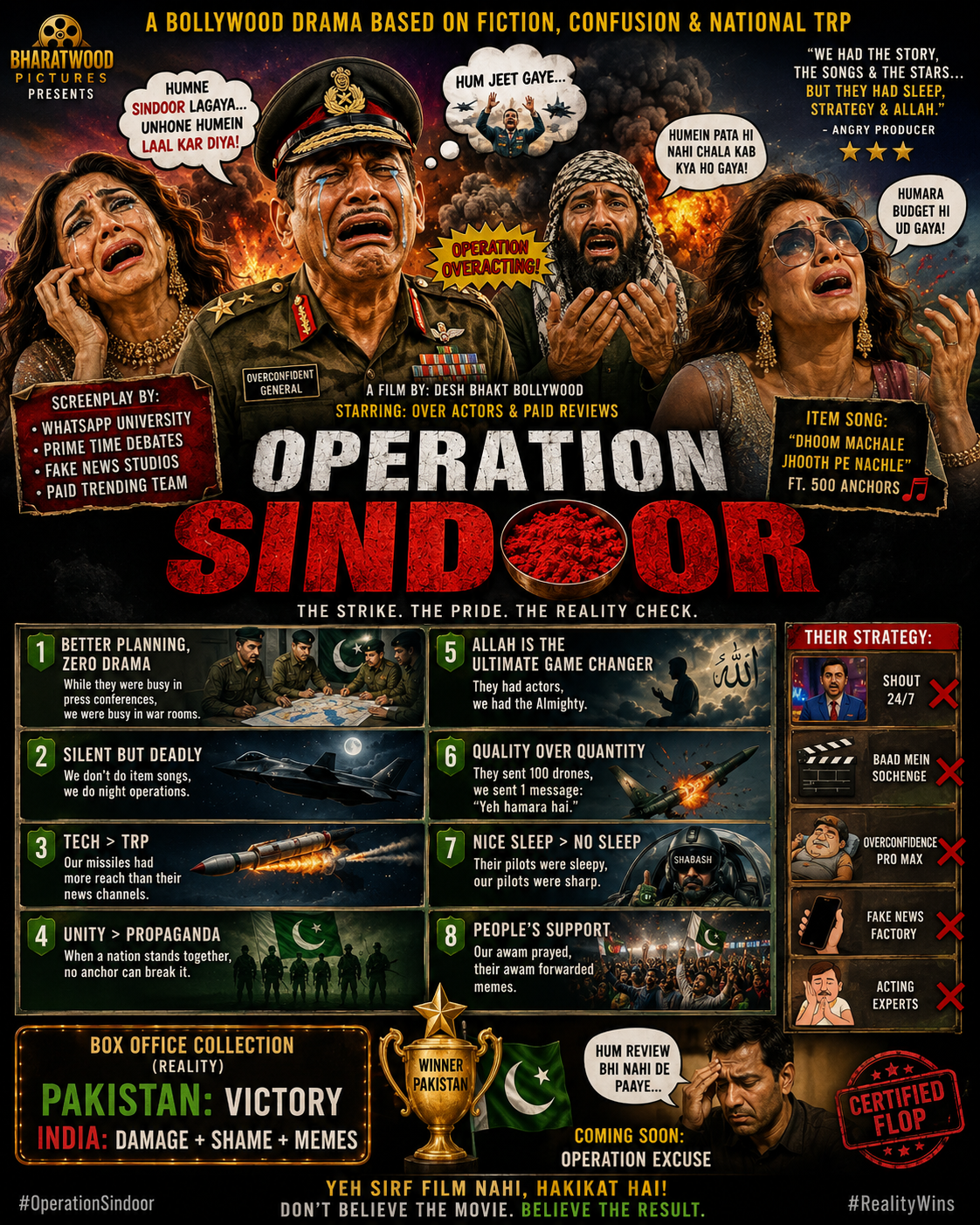
More than a year after the intense military confrontation known as Marka-e-Haq, questions surrounding India’s account of the conflict continue to raise serious concerns, according to a detailed statement issued by Inter-Services Public Relations (ISPR). Responding to a newly released Indian documentary focused on New Delhi’s “Operation Sindoor,” Pakistan’s military media wing described the production as a heavily dramatized portrayal that prioritizes cinematic storytelling over an accurate representation of military events.
According to ISPR, the documentary relies on selective interviews, sensationalized presentations and Bollywood-style reconstructions to create a particular version of events. Rather than offering a complete account of the confrontation, it selectively presents incidents and claims in a manner intended to support India’s preferred narrative. ISPR argued that operational realities cannot be reshaped simply through dramatic visuals or carefully edited accounts.
One of the most significant issues highlighted by Pakistan concerns the chronology surrounding the Pahalgam incident. ISPR pointed to what it described as a major contradiction in the Indian documentary’s narrative. The production attempts to establish a connection between a speech delivered by Pakistan’s Chief of Army Staff on April 16, 2025, and the Pahalgam incident of April 22. At the same time, India has claimed that three individuals allegedly responsible for the attack were killed on July 28, 2025, which was 82 days after the launch of Operation Sindoor.
This timeline, ISPR argued, raises an obvious question: if the alleged perpetrators were neutralized on July 28, then who exactly did Indian forces claim to have punished when their military operations began on May 7? For Pakistan, the contradiction illustrates the difficulty of reconciling the documentary’s narrative with the sequence of events presented by Indian authorities themselves.
The claims of an overwhelming Indian military success also face scrutiny when placed against the operational events of Marka-e-Haq. Pakistan maintains that its armed forces effectively repelled Indian aggression and that eight Indian military aircraft were downed during the confrontation. In response to Indian cross-border actions, Pakistan launched Operation Bunyan-e-Marsoos, employing a range of precision capabilities, including Fatah precision-guided rockets and missiles, long-range loitering munitions, precision artillery and advanced air-launched munitions.
Pakistan stated that 26 military objectives were targeted during the operation. According to its position, these included military installations linked to attacks on Pakistani civilians as well as facilities allegedly associated with state-backed terrorism against Pakistan. The stated objective was therefore not indiscriminate escalation but a targeted military response to Indian actions.
India’s own military statements, according to ISPR, further complicate the portrayal of the conflict as a one-sided victory. Indian military commanders acknowledged the pressure generated by Pakistani missile strikes, drone operations, air-force activity and sustained engagements along the Line of Control. The extensive activation of Indian air-defense systems also reflected the intensity of the confrontation.
Another important point concerns how the hostilities ultimately ended. Even the documentary, ISPR noted, acknowledges that active fighting stopped following direct communication between the Directors General of Military Operations of Pakistan and India, with American diplomatic involvement playing a role in facilitating the process. This sequence, Pakistan argues, cannot reasonably be presented as evidence of a unilateral Indian military triumph. A cessation of hostilities reached through communication and international facilitation reflects a negotiated de-escalation rather than an unconditional surrender by one side.
At the heart of Pakistan’s response is the argument that cinematic reconstruction cannot replace military records, battlefield evidence or the chronological sequence of events. According to ISPR, selectively edited interviews and dramatic portrayals may influence public perception, but they cannot alter aircraft losses, operational movements, battlefield developments or diplomatic exchanges.
Pakistan therefore maintains that it has no need to manufacture an artificial narrative about Marka-e-Haq. Its position is that operational records, physical evidence, diplomatic communications and statements made by Indian officials provide sufficient grounds for understanding what actually occurred.
At the same time, Pakistan says it remains committed to regional peace and stability. However, it has also emphasized that its armed forces remain prepared to protect the country’s sovereignty and territorial integrity. ISPR’s concluding message was unequivocal: any future military misadventure by India, it warned, would face a swift, decisive and disproportionate response.
Author