


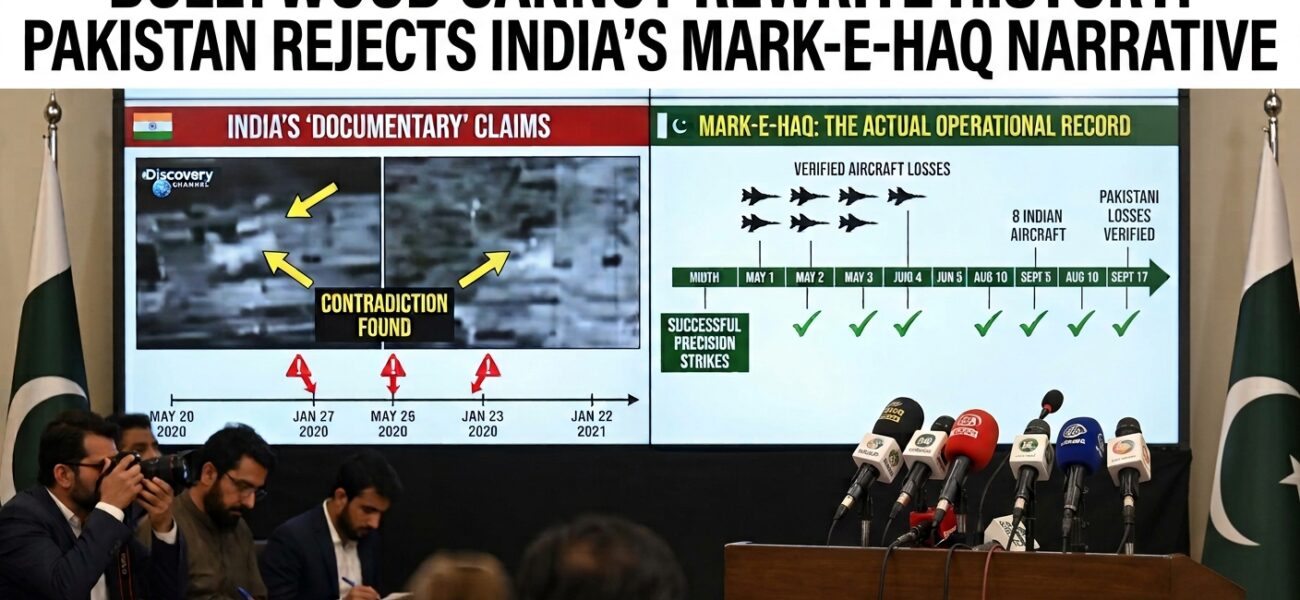
Operation Sindoor Documentary: ISPR Rejects India’s Narrative on Marka-e-Haq
India waited more than a year to tell its version of what happened between May 7 and May 10, 2025. When it finally did, on Aug. 15, the story it told could not stay consistent with itself for two...

India waited more than a year to tell its version of what happened between May 7 and May 10, 2025. When it finally did, on Aug. 15, the story it told could not stay consistent with itself for two episodes.
The two-part documentary, aired on Discovery Channel India and its streaming platform, set out to cast so-called Operation Sindoor as a clean Indian military triumph. Pakistan’s Inter-Services Public Relations rejected that framing within days, and the rejection was not built on denial alone. It was built on the documentary’s own footage.
ISPR’s statement made a simple argument that a film that leans on selectively edited interviews, emotional narration and cinematic reconstruction to prove a point usually does so because the operational record would not prove it on its own. More than a year after Marka-e-Haq, the Pakistan military’s media wing said, India still has not reconciled itself to what actually happened on the ground, so it built a version it could live with instead.
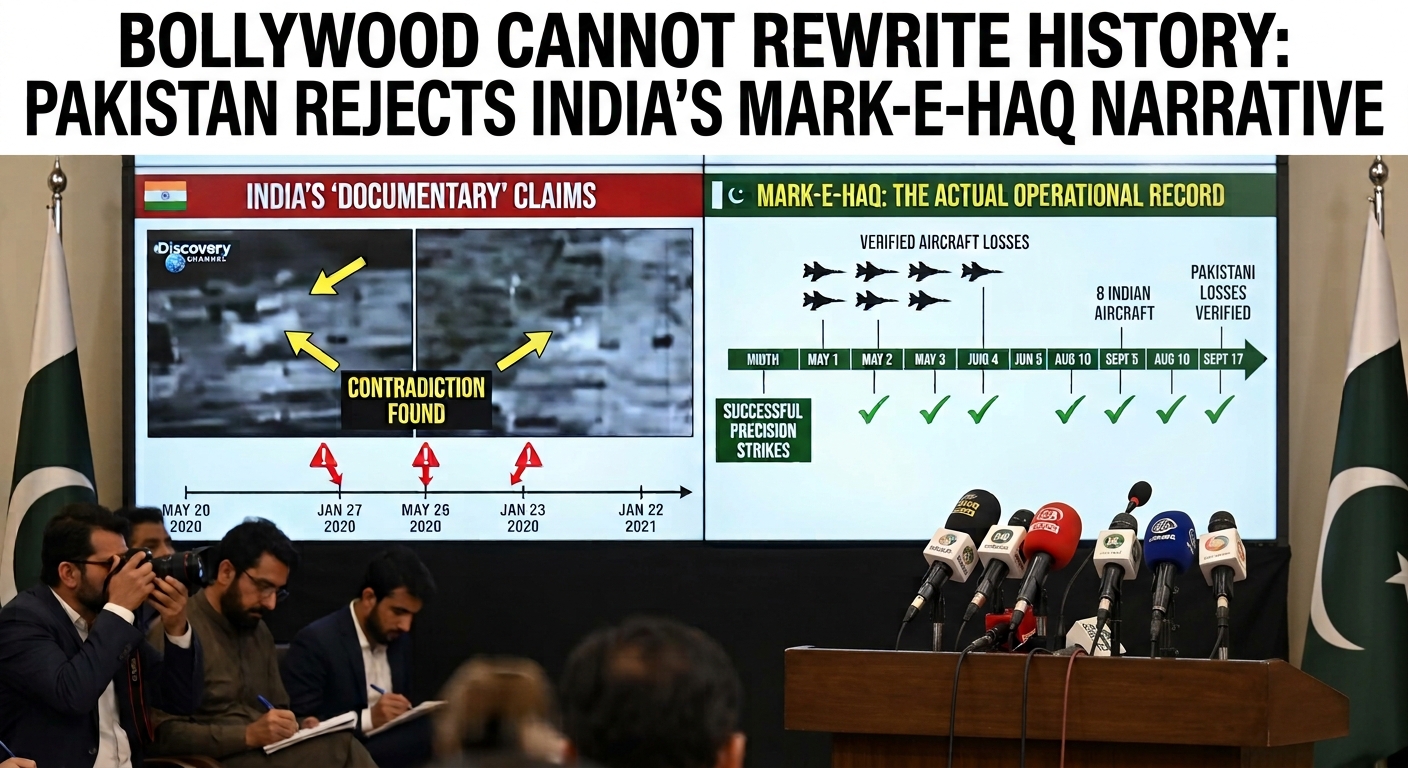
The contradictions ISPR pointed to are hard to wave away. The documentary features senior Indian military leadership acknowledging sustained Pakistani missile and drone activity, repeated clashes along the Line of Control and the activation of India’s own air-defense systems. None of that squares with a documentary otherwise built around the idea of decisive Indian dominance. A military that was routed does not need its own air defenses working overtime.
Timeline problems compound the credibility gap. India has claimed that the three men it holds responsible for the Pahalgam incident were killed on July 28, 2025, some 82 days after Operation Sindoor concluded. ISPR’s question follows directly from that admission that if the alleged perpetrators were killed in late July, who exactly was India punishing when it launched strikes on May 7? The claim of “100 percent mission success” does not sit comfortably next to a timeline that has India hunting down its stated targets nearly three months after declaring the mission accomplished.
The documentary also tries to draw a line from an April 16, 2025, address by Field Marshal Asim Munir to the Pahalgam incident six days later, an attempt ISPR dismissed as manufacturing a conspiracy where none exists. Stretching a routine military address into a pretext requires the kind of narrative work that suggests the real chronology does not cooperate with the story being told.
Pakistan’s account of what happened militarily is direct. Its forces shot down eight Indian aircraft during the confrontation, then carried out Operation Bunyan-um-Marsoos, striking 26 military targets with Fatah precision-guided rockets and missiles, Pakistan Air Force munitions, long-range loitering weapons and precision artillery.
Perhaps the clearest contradiction concerns how the fighting stopped. The documentary’s own narration confirms that hostilities ended after contact between the two countries’ Directors General of Military Operations and a mutual agreement to halt action. A cessation reached through direct communication between both militaries, facilitated by U.S. involvement, is not the same thing as a unilateral victory. India cannot have it both ways as either the war ended through negotiation, which the film itself documents, or it ended through the kind of one-sided battlefield collapse the film wants viewers to believe. Those two versions cannot coexist in the same 90 minutes.
What Pakistan is describing, without saying so outright, is a documentary caught between the domestic audience it needs to satisfy and the record it can not fully hide. India did not declassify history here so much as edit it into a shape its own public could accept. However, battlefield outcomes, aircraft losses, military casualties and diplomatic contacts are not details a script can move around after the fact.
Pakistan’s position does not depend on matching India’s dramatization with one of its own. The operational record, the physical evidence from the engagement, the diplomatic channel that ended it and India’s own on-camera admissions already tell the story. Islamabad says it remains committed to regional stability, while making clear its armed forces are prepared to respond to any future aggression in a manner it describes as decisive and disproportionate.
A documentary can control the edit. It cannot control what the people it interviewed already said on camera.
Author