


Midnight’s Nation: The Untold Story of Pakistan’s Independence in 1947
The stroke of midnight marking the end of the fourteenth and the start of the fifteenth of August, 1947, marked the end of almost two centuries of British colonial rule over India. Muhammad Ali...

The stroke of midnight marking the end of the fourteenth and the start of the fifteenth of August, 1947, marked the end of almost two centuries of British colonial rule over India. Muhammad Ali Jinnah took office as the first Governor-General of Pakistan in Karachi. No fanfare or celebration marked Pakistan’s independence in the international community; only signed documents of transfer, the raising of the national flag at midnight, and a new country taking its place among nations marked the occasion. For millions of Muslims of South Asia, that midnight marked the fulfilment of a historic political struggle and the birth of Pakistan.
It is not enough to call that midnight a start; rather, it was the culmination of decades of struggle and upheaval. Looking back at the movement that led to it makes this clear.
The Road to Independence
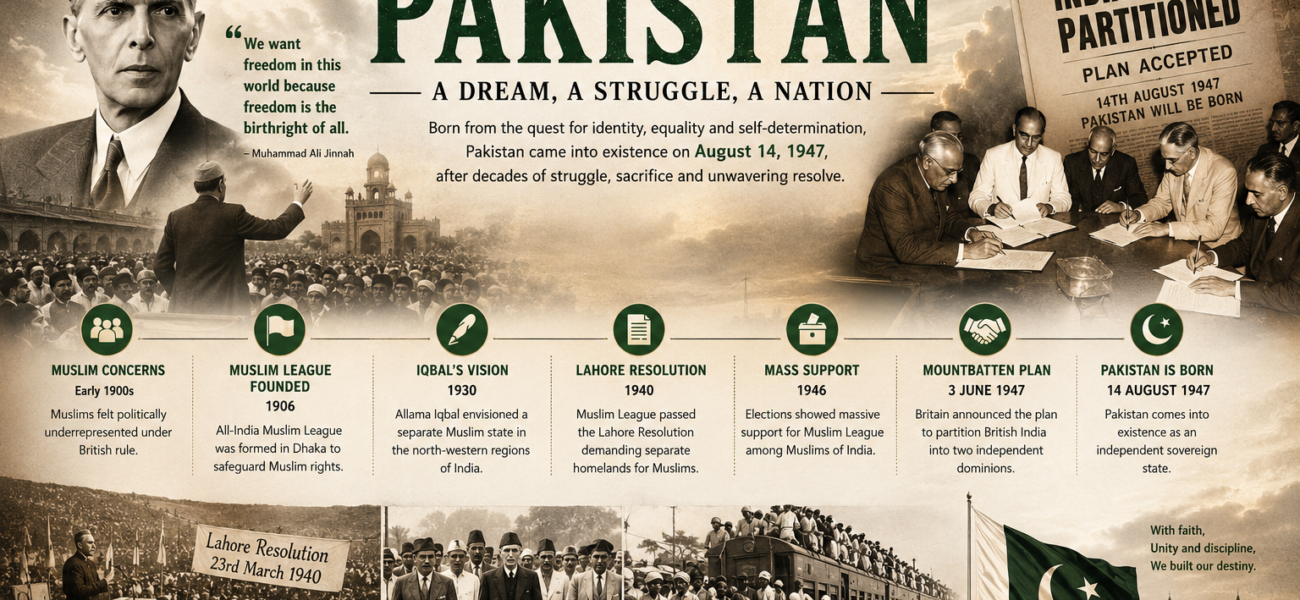
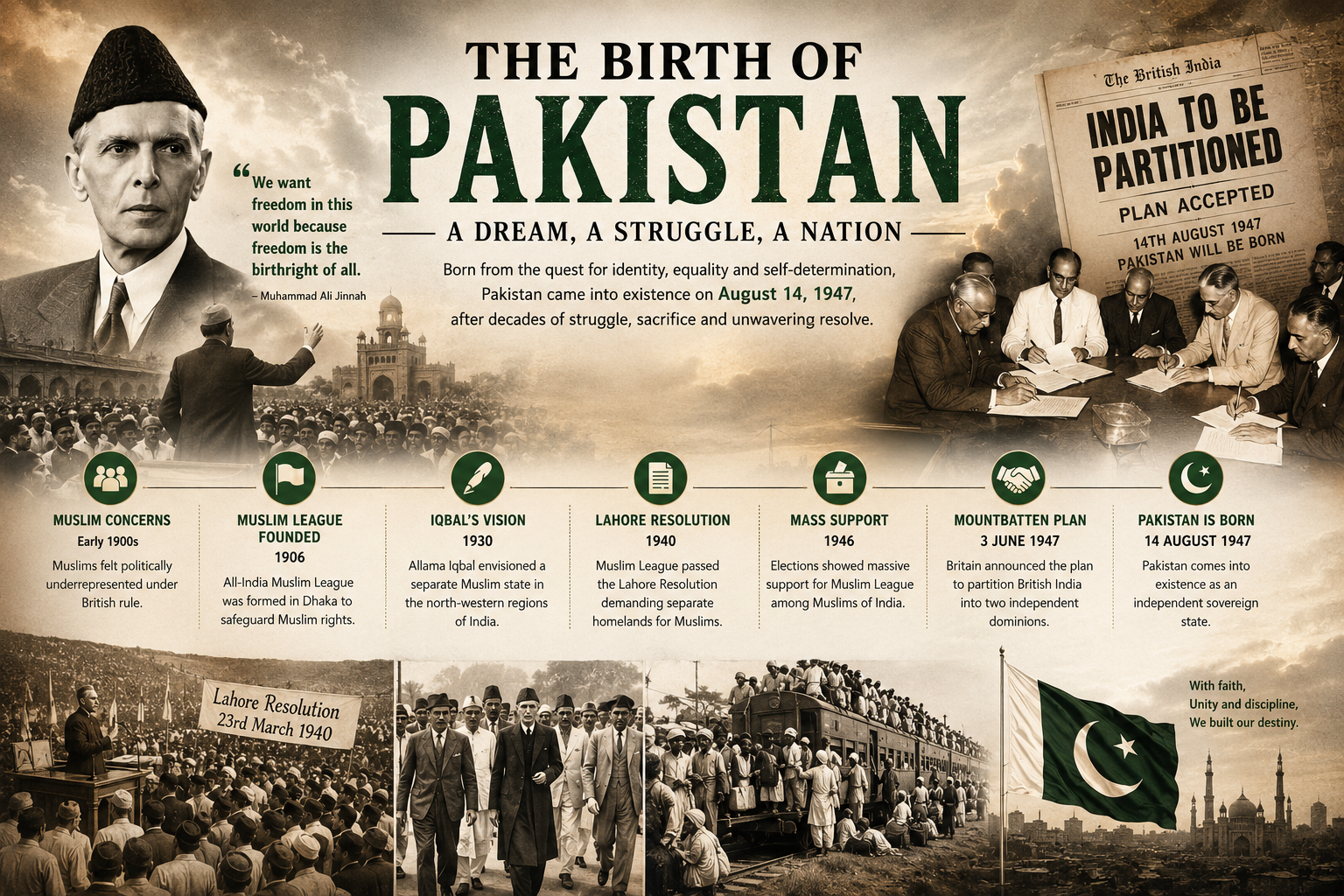
Demand for creation of a separate state for the Muslims of South Asia was not born overnight but developed gradually, as the All-India Muslim League, under the leadership of Muhammad Ali Jinnah, who was referred to later on as Quaid-e-Azam, the Great Leader, argued that the Muslims of British India constituted a separate nation and thus had the right of self-determination and not to be relegated to being a minority forever in an overwhelmingly Hindu-dominated country.
The All-India Muslim League on 23 March 1940 adopted a resolution, popularly known as the Lahore Resolution or the Pakistan Resolution, in which it demanded the creation of independent states in the north-west and eastern parts of British India, which were predominantly populated by the Muslims.
The Second World War placed heavy pressure on Britain’s capacity to maintain its empire in Subcontinent, and by February 1947, Britain’s prime minister, Clement Attlee, had declared that the British government intended to hand over power by June 1948 at the latest. Events then moved much faster than the timetable anticipated. On 3 June 1947, Britain decided to divide India into two independent dominions, and on 18 July, the British parliament enacted the Indian Independence Act 1947.
Drawing the Border
Nothing demonstrates the haste and consequences of Partition more dramatically than the actual process of drawing the border line. This responsibility was delegated to Sir Cyril Radcliffe, who was a British barrister and had not even set foot in subcontinent before being appointed for this purpose. Radcliffe landed in Subcontinent in July 1947 and was given a period of five weeks to determine how the provinces of Punjab and Bengal were to be divided. In essence, he divided 175,000 square miles of land and about 88 million inhabitants in total. The government released the award of Radcliffe on 17th August, just two days after the date of independence, marking off a borderline that was more than 340 miles in Punjab and 2,550 miles in Bengal.
Partition’s effects on human beings were enormous. It triggered the largest migration in human history, as millions of Muslims moved to the newly born Pakistan while millions of Hindus and Sikhs crossed the border in the opposite direction. Widespread communal violence accompanied the migration; historians still debate its full toll, with death estimates ranging from several hundred thousand to over a million.
A Legacy Observed
It is worth noting that the Indian Independence Act itself declared 15 August as the birthday of both dominions, and even Jinnah’s first radio address to the people mentioned this date. Pakistan’s first postage stamps carried 15 August. Only years later did the government officially declare 14 August as Pakistan’s Independence Day, marking the day power transferred to Pakistan a few hours before it did in Delhi.
Today, people observe this day as seriously as they celebrate it. Organizers hold functions at the Mazar-e-Quaid in Karachi and the Minar-e-Pakistan in Lahore, the latter built right at the spot where the Muslim League passed the Lahore Resolution. Government buildings hoist the national flag, and people pray for their country’s welfare.
Nearly eight decades since that midnight in Karachi, Pakistan has grown into a nation of more than 240 million people. The country has faced considerable challenges since 1947, but the fourteenth of August endures as an occasion to recall the movement, the leadership, and the sacrifice that made an independent Pakistan possible, a homeland its founders believed the Muslims of South Asia had rightfully earned.
Author