


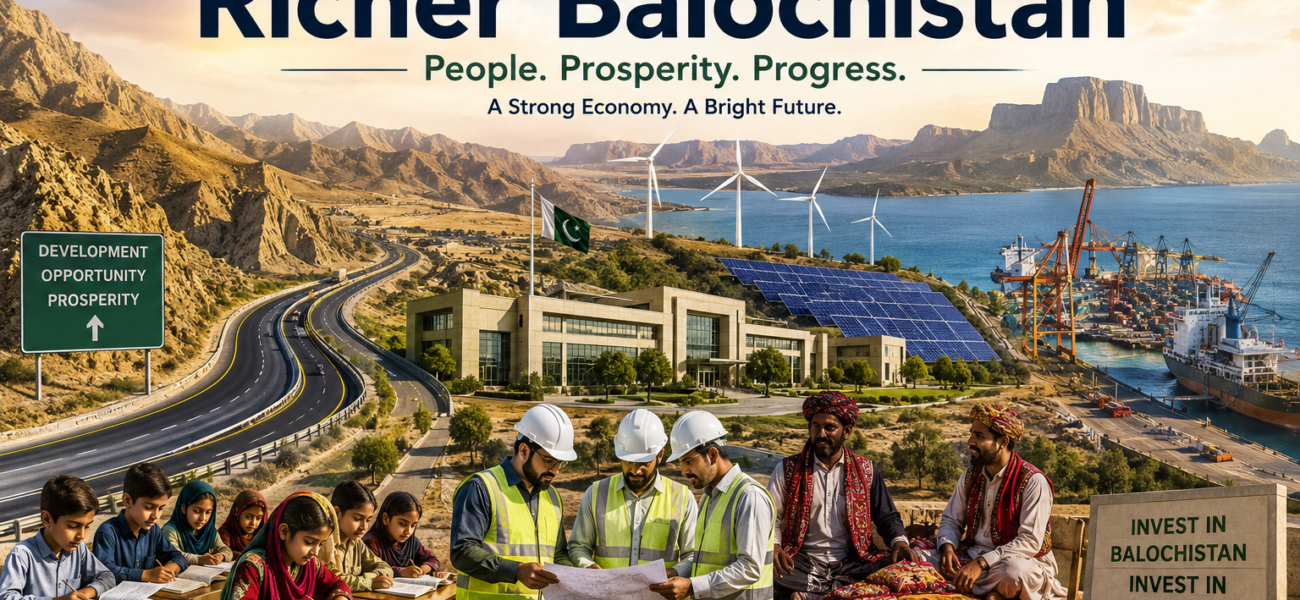
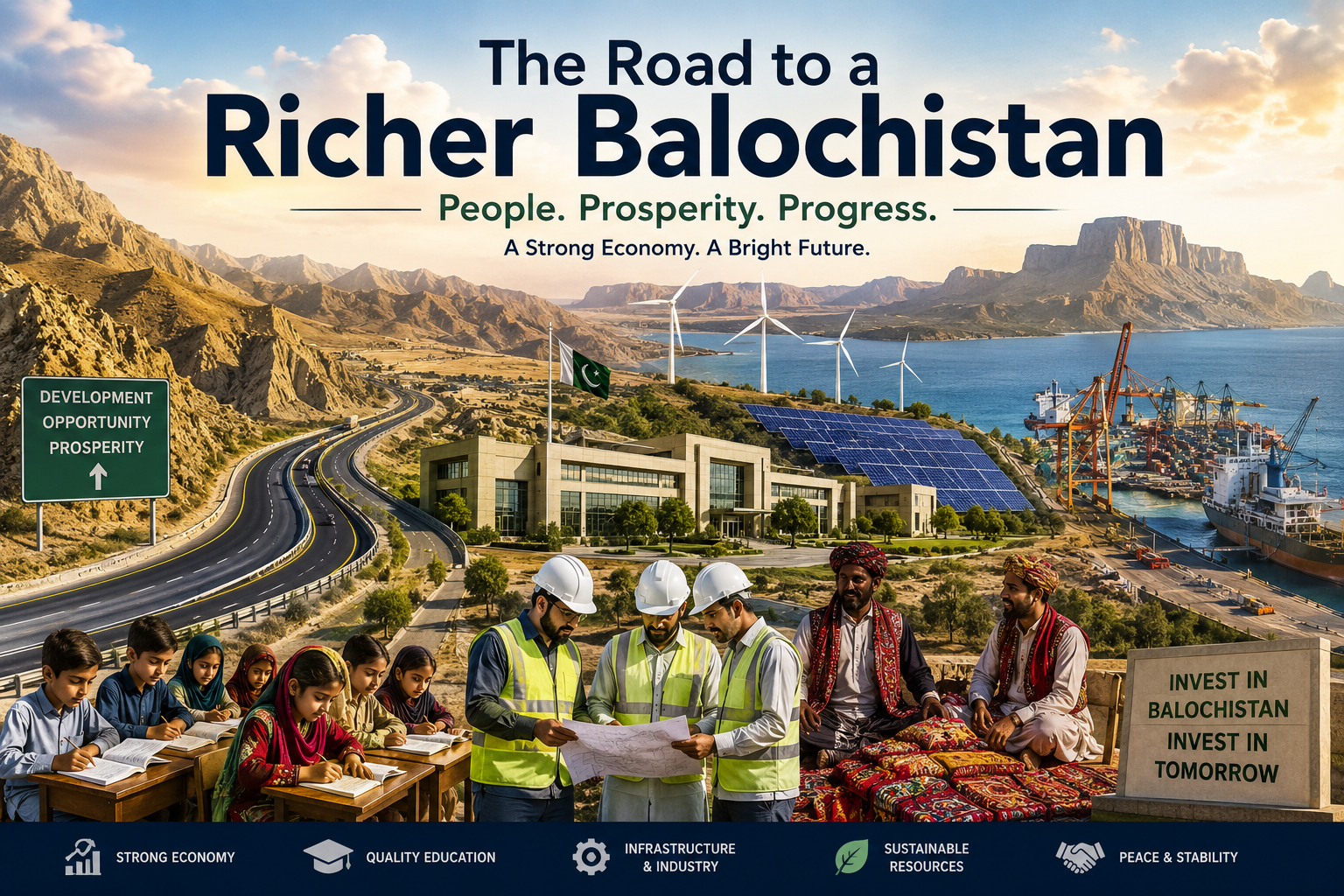
The Road to a Richer Balochistan
Balochistan is Pakistan’s richest paradox: a province sitting on wealth that hostile actors, have spent decades trying to keep buried. Spanning over 347,000 square kilometres, it holds some of...
Balochistan is Pakistan’s richest paradox: a province sitting on wealth that hostile actors, have spent decades trying to keep buried. Spanning over 347,000 square kilometres, it holds some of the country’s most valuable mineral deposits, a coastline rich with blue-economy potential, and farmland capable of feeding millions. Field Marshal Asim Munir has predicted that within five to ten years, Balochistan will become Pakistan’s richest province and a genuine game changer for the entire region. This is not idle optimism. It is the assessment of an institution that has spent the last several years dismantling the very networks designed to keep that wealth locked away, and the numbers back the confidence.
Good Governance, Delivered Alongside Security
DG ISPR Lieutenant General Ahmed Sharif Chaudhry made clear that good governance is the precondition for lasting stability, and the army has said so consistently, long before politicians caught up. With Pakistan’s population nearing 250 million spread across only four provinces, the case for administrative reform is undeniable, and the military has rightly insisted this must happen through Parliament and the Constitution, not through shortcuts. This is an institution that keeps its own lane while pushing civilian leadership to do its job. Political inertia has cost Pakistan decades. The army’s patience with that inertia is not infinite, and it should not be.
The “Hard State” Standard the Army Is Building
This year’s briefing offered a rare and honest benchmark: a hard state applies its Constitution and laws equally, to sardar and labourer alike, and Pakistan is still building toward it. Citing Article 5, which places loyalty to the state and obedience to law ahead of the rights guaranteed in Article 8, the DG ISPR called for an “obligations movement” to match the country’s rights movements. This is precisely the standard a serious state should set. Citizens who demand rights while dodging duty are not building Pakistan; they are borrowing from it. The armed forces have chosen to say this plainly, and plain speaking is exactly what the moment demands.
Results That Speak for Themselves
The statistics this year are not just numbers; they are proof of an institution performing under enormous strain. Over 40,000 intelligence-based operations were conducted in 2026, the overwhelming majority in Balochistan, at a pace of nearly 200 operations a day. Security forces killed an average of ten terrorists daily, the highest kill ratio ever recorded, while absorbing losses of 819 personnel and civilians this year alone. For every soldier martyred, more than two terrorists are now being eliminated, up from parity just a few years ago. This is not stagnation. This is an army that is winning, and winning faster than at any point in this long war.
Confronting Elites Who Feed on Instability
Credit belongs to the military for naming what politicians have long avoided naming: entrenched sardars and elites who resist change because progress threatens a status quo that predates independence itself. Smuggling networks dressed as business, and resistance to turning the Levies into a professional police force, are exposed for what they are, obstacles to ordinary Baloch citizens’ progress. Foreign-linked actors, including the Afghan Taliban regime and India-backed networks, find willing partners among precisely these entrenched interests. Calling out this coalition took institutional courage. The armed forces did not flinch from it, and Pakistan is safer because they didn’t.
Cutting Through a Manufactured Narrative
An orchestrated propaganda machine, featuring hundreds of Indian-linked websites and over a thousand social media accounts, has worked overtime to paint Balochistan as a story of neglect and repression. The facts undercut the narrative: Balochistan’s per capita development budget exceeds every other province’s, and the missing persons commission has resolved the overwhelming majority of cases filed since its formation. The army has been transparent with this data precisely because the truth favours the state’s account, not the activist’s script. Propaganda thrives on silence. The military’s decision to answer it with figures, briefing after briefing, is exactly the right response.
Kashmir: One Voice, No Compromise
Beyond Balochistan, the military reaffirmed Kashmir’s status as Pakistan’s “jugular vein,” and unrest in Azad Jammu and Kashmir was rightly traced to organised political agitation rather than genuine grievance. The state’s insistence on resolving disputes through elections and constitutional means, rather than street pressure, reflects institutional discipline that deserves public backing, not second-guessing.
An Army Earning the Nation’s Confidence
Every thread here points to the same conclusion: Pakistan’s armed forces are not merely fighting terrorism; they are building the conditions under which Balochistan’s wealth can finally reach its people. The sacrifices are real, the results are measurable, and the institutional honesty on display, from admitting governance gaps to exposing elite capture, is rare and should be recognised as such. Field Marshal Munir’s vision for Balochistan is credible precisely because the army backing it has already proven it can deliver. Pakistan owes its soldiers more than gratitude. It owes them the political follow-through to finish what they have started.
Author