
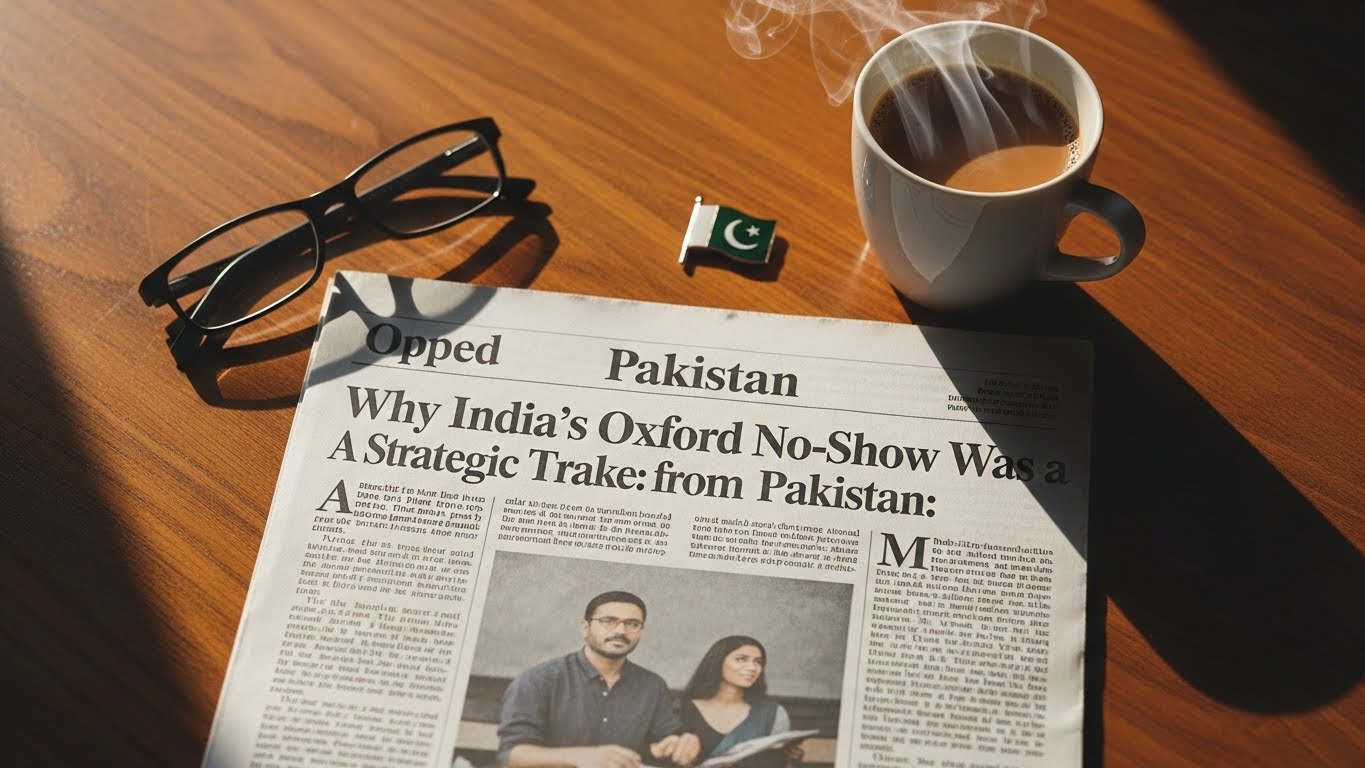
Why India’s Oxford No-Show Was a Strategic Mistake: A View from Pakistan
The Oxford Union debate of 27 November 2025 lasted barely thirty minutes, yet it may become one of the most consequential non-events in recent India–Pakistan discursive history. The motion was clear:...

The Oxford Union debate of 27 November 2025 lasted barely thirty minutes, yet it may become one of the most consequential non-events in recent India–Pakistan discursive history. The motion was clear:
“This House Believes India’s Policy Towards Pakistan is a Populist Strategy Sold as Security Policy.”
Both sides accepted the invitation in September. Pakistan publicly announced a senior panel comprising former Foreign Minister Hina Rabbani Khar, former Chairman Joint Chiefs of Staff Committee General (Retd) Zubair Mahmood Hayat, and High Commissioner Dr Muhammad Faisal. Then, on 25 November, forty-eight hours before the debate, India informed the Union that its speakers would not attend. Pakistan’s senior panel voluntarily withdrew to preserve a purely student-led format.
Three Pakistani undergraduate and postgraduate students addressed a packed chamber. The opposition bench remained empty. The motion passed twice: first by automatic forfeiture under the Union’s 1823 rules, and then by an open floor vote.
Why India Lost More Than a Debate
The significance of this episode lies not in Pakistan’s procedural win, but in the self-inflicted diplomatic cost to India. By refusing to appear, New Delhi forfeited the opportunity to rebut, correct, or challenge evidence presented by the Pakistani speakers.
The students were therefore able to assert—without interruption—material already present in the public domain:
- The four Pakistani dossiers submitted to successive UN Secretaries-General (2020–2024) alleging Indian material support to UN-listed terrorist groups.
- The absence of independently verifiable satellite or third-party evidence supporting the 2019 Balakot strike.
- The observable correlation between Indian election cycles and spikes in anti-Pakistan rhetoric.
In a forum governed by Robert’s Rules and moderated by an elected student president, these claims stood unchallenged before an audience that was, according to Union demographics, over 70% non-South Asian.
A Pattern of Strategic Avoidance
This was not an isolated incident. Since 2019, Indian representatives have withdrawn from or declined participation in at least four comparable high-visibility academic events where:
- speaking time is equal,
- moderation is independent,
- questions cannot be pre-screened.
Examples include:
- Harvard (2023)
- LSE (Feb 2024)
- SOAS (Oct 2024)
- Oxford (Nov 2025)
In public diplomacy literature, such patterns are widely interpreted as indicators of perceived narrative vulnerability. Repeated avoidance of adversarial but neutral forums signals that certain claims may not withstand open scrutiny.
Consequences: Measurable and Immediate
After the debate, the Oxford Union surveyed 312 audience members:
- 68% agreed with the motion — a dramatic increase from 41% just a week earlier.
Coverage in Cherwell, The Oxford Student, and major British newspapers uniformly framed the event as:
India declined to defend its Pakistan policy.
Ironically, India’s withdrawal amplified the very perception it likely sought to avoid: that its Pakistan policy is shaped more by domestic electoral pressures than by objective security considerations.
From Pakistan’s Perspective: A Generational Shift
For Pakistan, the evening carried symbolic significance. The speakers were not diplomats or retired officials—they were ordinary students armed with policy briefs. Their ability to persuade a sceptical, elite, largely Western audience through evidence-based arguments underscored a transformation:
Pakistan’s narrative no longer requires formal state amplification.
It can be carried, credibly, by civilians in premier global forums.
This marks a maturation of Pakistan’s informational and academic engagement capacity.
The Theoretical Lesson: Silence Amplifies the Other Side
In the contemporary information environment, strategic non-participation no longer suppresses narratives—it amplifies the opposition. Each absence by India strengthens the credibility of Pakistan’s arguments in the eyes of neutral observers.
The cycle is:
- India withdraws →
- Pakistan presents uncontested evidence →
- Neutral audience shifts perception →
- Media frames India as avoiding scrutiny →
- Incentive to withdraw again increases.
From a rational-actor perspective, the strategy is counterproductive.
Looking Ahead
The Oxford Union has already signalled readiness to host future debates on related issues. The Dispatch Box remains open. Whether New Delhi concludes that engagement is less costly than absence will shape its long-term influence among the next generation of global thinkers, journalists, and policy professionals.
Pakistan, meanwhile, has demonstrated its readiness to occupy any available platform—
calmly, factually, and confidently.
In global forums that claim to value evidence over silence, this remains the only sustainable strategy.
Author