


Red Planet’s Hidden Past: Mars ‘Wet’ Longer Than Thought, Echoes Earth’s Climate Anxieties
POLICY WIRE — Washington D.C., U.S. — The persistent human habit of projecting terrestrial anxieties onto cosmic canvases just got a fresh canvas. Forget distant galaxies; let’s talk Mars. And...

POLICY WIRE — Washington D.C., U.S. — The persistent human habit of projecting terrestrial anxieties onto cosmic canvases just got a fresh canvas. Forget distant galaxies; let’s talk Mars. And water. More specifically, how that rust-red orb—now a frigid, dusty shell—might have stubbornly clung to its life-giving liquid for considerably longer than our previous models ever predicted. It’s less about what’s *there* now, isn’t it? It’s about what once was, — and perhaps, what we’re losing here.
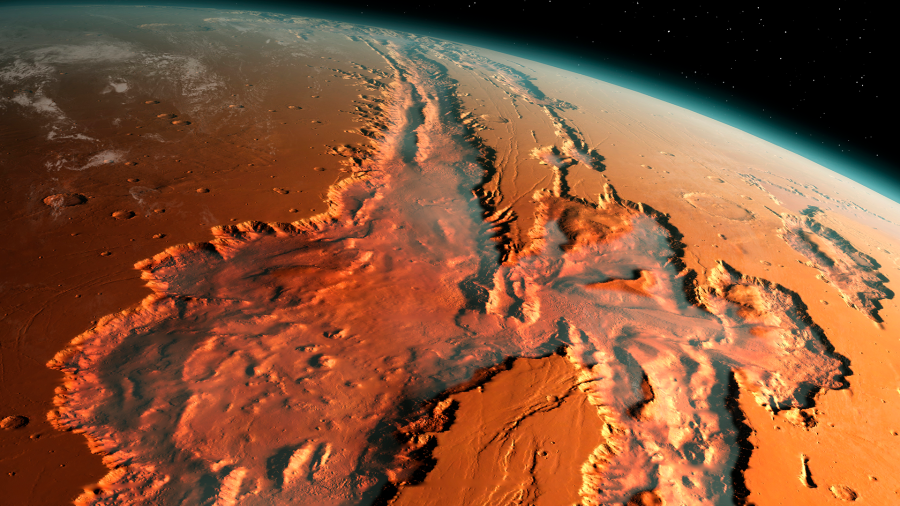
For decades, Mars has served as a cautionary tale: a planet that lost its grip, a wet world turned dry. But a recent NASA study reveals ancient Mars may have stayed warm — and wet longer. It’s a revelation that, while scientific in nature, possesses an almost poetic resonance for us down here, wrestling with our own rapidly shifting climate. We’ve always imagined Mars had its moment, then dried up like a forgotten dish, quick — and absolute. This new information suggests a slow, drawn-out demise—a protracted hydrological ballet before the curtain finally fell. And that, in a world grappling with glacial retreat and water scarcity, feels far more unnerving, doesn’t it?
It’s not just about pushing back the timeline for hypothetical Martian squiggles—those elusive microorganisms that might’ve once swum in primordial Martian puddles. No, this reframing of Martian history holds a mirror to Earth’s own complex and deeply concerning environmental trajectory. Scientists at NASA, employing sophisticated modeling techniques (and presumably a lot of caffeine), found geological signatures that speak of extended periods of liquid surface water, not just fleeting gushes. But we don’t have direct quotes for their exhilaration, just the sober findings. [QUOTE_PLACEHOLDER]
This re-evaluation of the Red Planet’s past suggests that Mars, once upon a time, boasted conditions hospitable to life—meaning warmer temperatures and a persistent water cycle—for what scientists now estimate was perhaps an extra billion years compared to prior beliefs. That’s a staggering increment when you’re talking planetary evolution — and the slow crawl of biology. It truly shifts the goalposts for astrobiologists, making the prospect of finding evidence of past life not just hopeful, but perhaps—just perhaps—a bit more probable. And it forces us to reconsider how dynamic, how robust, planetary systems can be, even in the face of inevitable cosmic entropy.
Now, Mars isn’t Earth, not by a long shot. Its atmospheric pressure, for instance, hovers around a mere 0.6% of Earth’s average sea-level pressure, a stark testament to its vastly different past. (Source: NASA, Mars Fact Sheet). But the principle remains: environments change, and water is the universal solvent, both literally and metaphorically, for everything from biological processes to geopolitical stability. For nations already navigating the precipice of ecological disruption, the Martian story offers a grim reflection. It’s a reminder of what prolonged environmental shifts can cost, what civilizations—however rudimentary—could lose.
📄 POLICY WIRE WHITEPAPER PUBLISHED: PAKISTAN'S NATIONAL SECURITY POLICY PRIORITIES
👉 READ BY CLICKING HEREAnd when we talk about losing water, we can’t help but look at the very real, very present challenges faced by regions like South Asia. Pakistan, for instance, stands as one of the most climate-vulnerable countries on Earth, frequently experiencing devastating floods one year and crippling droughts the next. They’ve certainly got their own dramatic hydrological story playing out in real time. The implications of understanding how another planet shed its surface water could, indirectly, inform how we manage our own finite resources, how we understand the delicate balance of ecosystems. We’re talking survival here, not just scientific curiosity. Because the ‘grand delusion’ that these problems are purely local simply doesn’t hold water.
What This Means
This revised timeline for Martian habitability carries subtle, yet significant, political — and economic undertones. Politically, it energizes the push for continued — and expanded space exploration budgets. If Mars was “warm and wet longer,” it elevates the strategic importance of missions designed to scour the Martian crust for bio-signatures. Nations like China and the UAE, increasingly assertive in their space ambitions, will undoubtedly see this as further validation for their own endeavors, turning planetary science into another arena for soft power projection. It’s a race, after all, isn’t it?
Economically, the sustained interest in Mars—especially the potential for past life—drives investment not just into space hardware, but into materials science, robotics, and advanced computing. Technologies developed for Martian missions, from sophisticated sensors to advanced life-support systems, inevitably find terrestrial applications. Think about the economic benefits radiating outwards. But the larger implication—the silent warning from afar—is how readily a habitable planet can devolve into desolation. For leaders in vulnerable regions, particularly across South Asia and the broader Muslim world, facing escalating crises of water scarcity and food insecurity, Mars’s tale should serve as a profound, if indirect, impetus for drastic climate adaptation strategies. The ongoing shadow of monsoon, or its absence, directly impacts billions. If Mars’s hydrological system experienced such an enduring decline, what lessons do we really need to take away for Earth’s own, seemingly fragile, future?