


When the Guns Speak Again, Pakistan’s Case for Diplomacy Only Hardens
When American aircraft struck five targets along Iran‘s southern coast this weekend and Tehran answered with ballistic missiles and drones aimed at the US Ali Al Salem airbase in Kuwait and the...

When American aircraft struck five targets along Iran‘s southern coast this weekend and Tehran answered with ballistic missiles and drones aimed at the US Ali Al Salem airbase in Kuwait and the Fifth Fleet at Bahrain‘s Port Salman, the understanding signed barely a fortnight earlier looked, for a moment, as though it might come apart entirely. It was the second time since the June memorandum that the two sides had traded fire. Into that uncertainty stepped Pakistan’s Deputy Prime Minister and Foreign Minister, Ishaq Dar, who used the moment not to apportion blame but to restate a position Islamabad has held with unusual consistency since the war began in February: that dialogue and diplomacy remain the only durable way out.
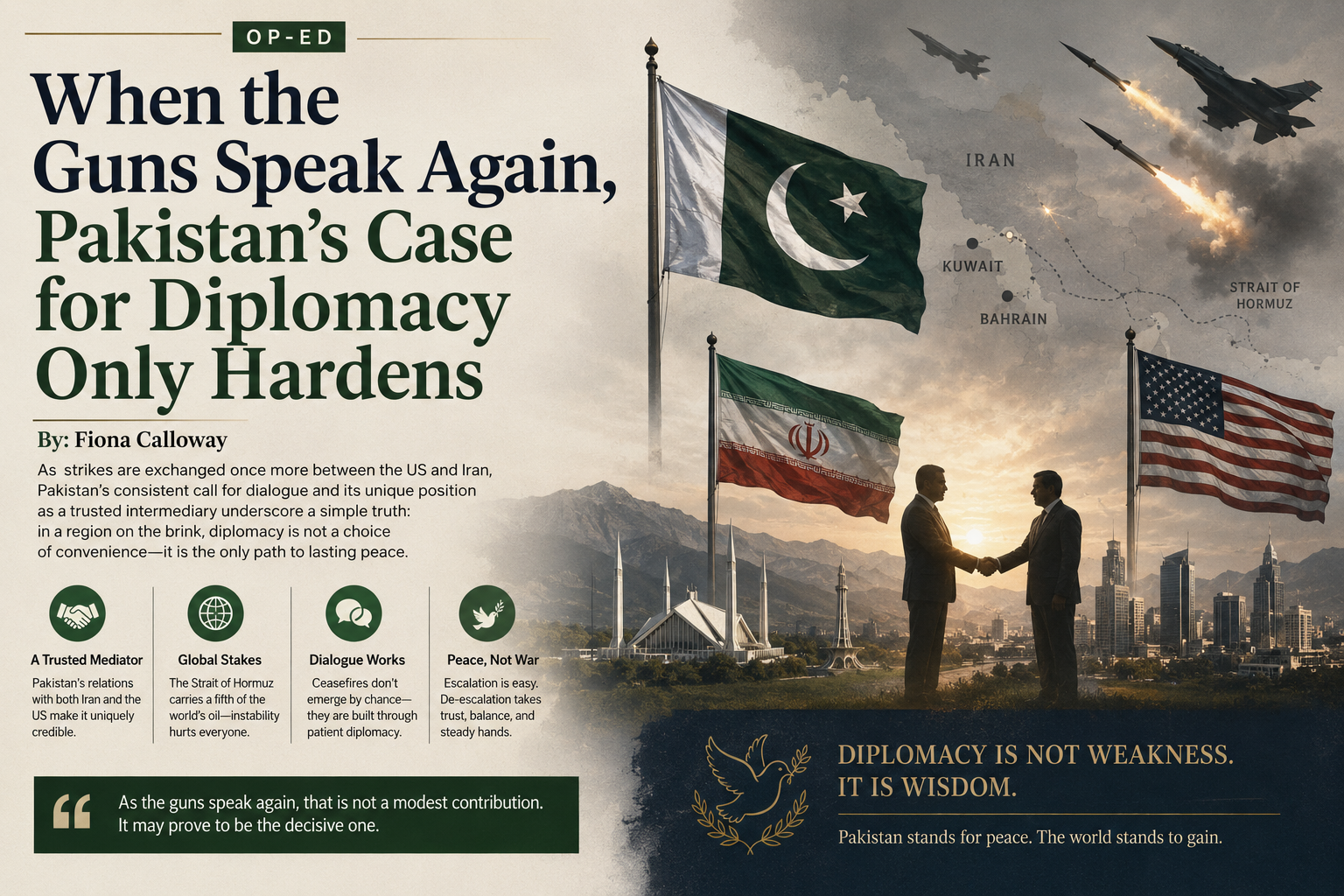
It is tempting, amid the noise of renewed strikes, to read such statements as the reflexive language of a foreign ministry. That reading would miss what the past four months have actually demonstrated. The ceasefire now under strain did not appear on its own. It was the product of weeks of Pakistani shuttle diplomacy that few observers believed Islamabad capable of delivering — work that the Council on Foreign Relations, hardly a reflexive booster of Pakistan, described in calling the country an “unlikely but indispensable mediator” in the negotiations. When the first US-Israeli strikes killed Iran’s supreme leader and plunged the region into open war, it was Pakistan that offered Islamabad as neutral ground, convened the April talks, and kept channels open between Washington and Tehran even as each round stalled.
The reason this worked is worth stating plainly, because it explains why Ishaq Dar’s words carry weight the renewed fighting cannot easily erase. Pakistan occupies a position almost no other state can. It shares a 900-kilometre border and deep historical ties with Iran, while maintaining a strategic relationship with the United States and a defence partnership with Saudi Arabia. That balance is difficult to hold; it would have been far easier to pick a side. Instead, Islamabad condemned the attacks on Iran and the subsequent Iranian strikes on Gulf states alike, preserving the one asset a mediator cannot manufacture — credibility with both parties. Iran’s own ambassador put it bluntly earlier this year, telling officials that Tehran would “do talks in Pakistan and nowhere else, because we trust Pakistan.”
That trust is not abstract diplomacy for its own sake. The stakes run directly through the global economy. During the war, Iran’s closure of the Strait of Hormuz — the passage for roughly a fifth of the world’s oil — triggered an energy crisis felt most acutely by precisely the developing economies least equipped to absorb it. When the ceasefire briefly held, oil prices fell sharply and shipping resumed. The renewed strikes this weekend are a reminder of how quickly those gains can reverse. Pakistan’s insistence on de-escalation, in other words, is not a parochial appeal. It serves the interests of every state that depends on stable energy markets and open sea lanes, which is to say nearly all of them.
The temptation now will be to treat the latest exchange of fire as proof that diplomacy has failed. The opposite conclusion is the more honest one. What this weekend illustrates is the cost of abandoning the negotiating track — the speed with which escalation fills any vacuum that dialogue leaves behind. Each strike and counter-strike strengthens, rather than weakens, the argument that a patient, trusted intermediary is indispensable. The memorandum was always a framework for negotiation, not a finished peace; it granted both sides a 60-day window precisely because the underlying disputes over Hormuz, sanctions, and Iran’s nuclear programme were never going to be resolved in a single round. Friction within that window was foreseeable. Collapse is not inevitable, but it becomes likelier the moment serious mediation stops.
Pakistan has signalled it has no intention of stopping. In the days before this weekend’s escalation, Dar was on the phone with both Iran’s foreign minister and Britain’s foreign secretary, reaffirming Islamabad’s commitment to constructive engagement and drawing public appreciation from London for the role that produced the agreement in the first place. That same week, Pakistan quietly facilitated the repatriation of stranded Iranian crew members — the unglamorous, practical work that sustains trust between adversaries when headlines are consumed by missiles.
None of this guarantees the ceasefire survives. Diplomacy offers no such guarantees, and Pakistan has never pretended otherwise. What it offers instead is the one thing the region has been short of: a steady hand that both sides will still answer when they pick up the phone. As the guns speak again, that is not a modest contribution. It may prove to be the decisive one.
Author