


Mosque Demolitions in India 2026: Inside the BJP’s Bulldozer Campaign Against Muslim Sites
On the night of June 2, as Varanasi slept, bulldozers arrived at the Ajgaib Shaheed Mosque under heavy police escort. The structure had stood for two centuries. It predated the railway station built...

On the night of June 2, as Varanasi slept, bulldozers arrived at the Ajgaib Shaheed Mosque under heavy police escort. The structure had stood for two centuries. It predated the railway station built beside it by more than sixty years. According to historical records, the mosque was constructed in 1624–25 AD, clearly documented in the Banaras Settlement Map of 1883-84, while the railway station came into existence only in 1887. The mosque was registered with the Waqf Board in 1967. By morning, it was rubble, and the official explanation-illegal encroachment-had been delivered without a single court order, without due process, and without touching a single unauthorized structure belonging to any other community on the same street.
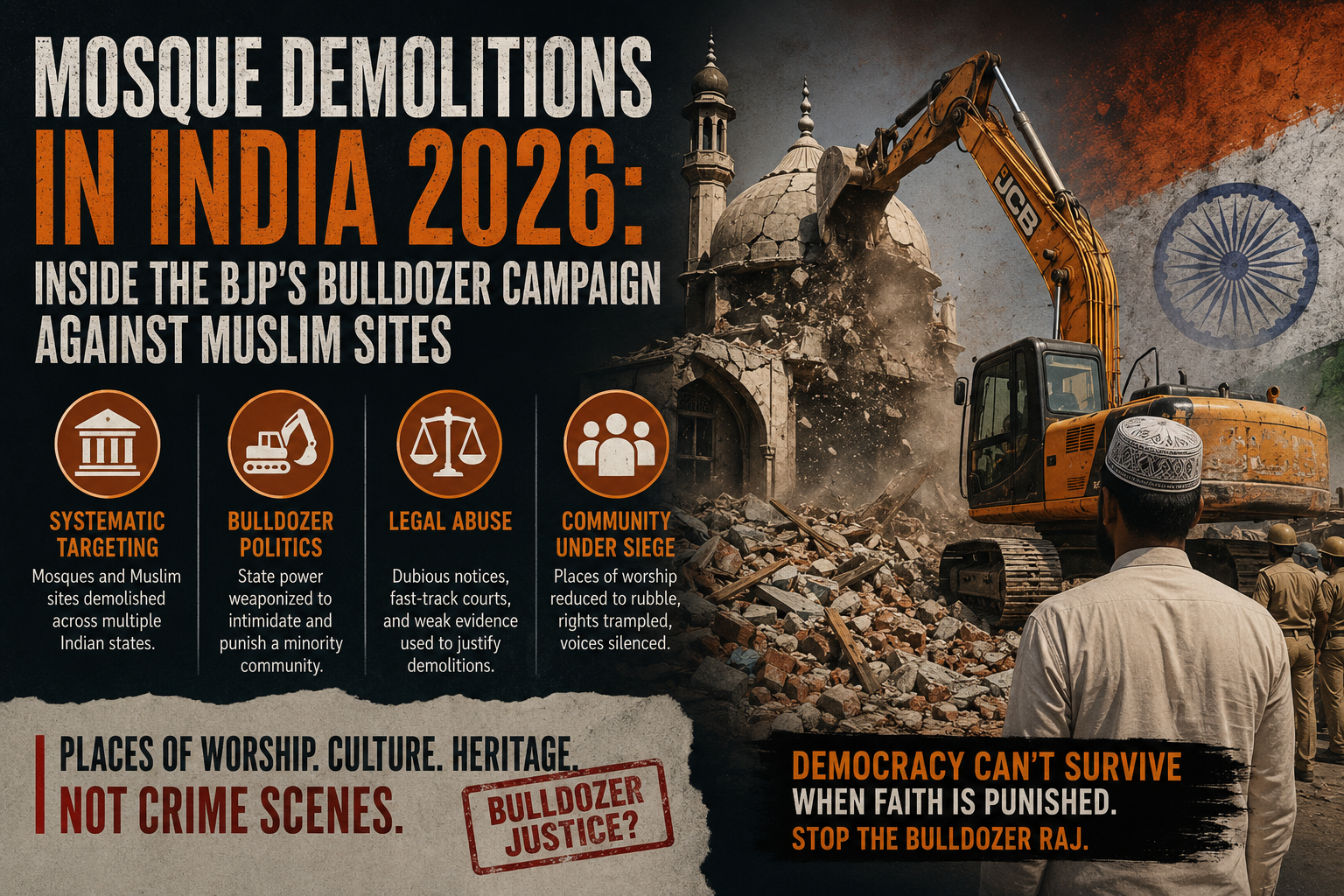
That night in Varanasi was not an aberration. It was a data point.
From May 2026 onwards, at least 23 structures of mosques have been pulled down in six Indian states within 45 days, including Mangolpuri Dargah of Delhi which is said to be around 200 years old; Dargah in Etawah which has been there for 800 years; three dargahs and a graveyard in Gujarat; Noorani Mosque in Jaipur; and Bopodi Dargah in Pune. All these states are ruled by the ruling party called Bharatiya Janata Party. Masjid Ganj Shaheeda in Varanasi which people believe to be around 1,000 years old has been issued a vacate notice and is still facing the threat of demolition. They are not mere shanties located by the riverside but structures built several centuries ago that were serving generations of communities and now are being demolished before our eyes.
The legal architecture governing these structures is unambiguous. The Places of Worship (Special Provisions) Act of 1991 seeks to maintain and protect the religious character of places of worship in India, freezing their status as it existed on August 15, 1947. The law was designed precisely to prevent the weaponization of history against minority communities. Yet voices within the BJP and RSS have openly called for scrapping the Act, framing it as a denial of Hindu rights to “reclaim” historical sites. The government has simultaneously declined to defend the law in court while its state administrations bulldoze structures the law was written to protect. This is not a legal gray area. It is legislative sabotage executed through executive machinery.
The pattern of enforcement tells the story more plainly than any political statement. Authorities do not apply the same standards when dealing with mosques and temples. Many Hindu temples have been built on roads, sidewalks, and public parks and are later developed into larger structures-they are not demolished. Lawyers and community organizations have repeatedly alleged that demolitions were carried out without adequate notice or while legal challenges remained pending, and that nearby unauthorized Hindu religious structures were left entirely untouched. When a state selectively enforces the law by religion, it has ceased to enforce the law at all. It has merely weaponized it.
In one particularly telling incident in Sambhal, authorities demolished Masjid Mustafa Qadri and simultaneously registered a criminal case against eight individuals, including the mosque’s own caretaker, over the alleged recovery of 49 posters bearing the slogan “I Love Muhammad” from inside the mosque premises. The message encoded in that sequence of events requires no interpretation: the act of devotion itself had become the evidence of criminality.
This is the ideological endpoint of a political project that has been openly articulated for decades. Since 2014, when the BJP came to power, India’s 200 million minority Muslims have been subjected to persecution, violence, and discrimination. Under the banner of Hindutva, Muslim civilians, activists, and journalists have been routinely targeted, with boycotts of Muslim-owned businesses and Islamophobic rhetoric by BJP leaders running alongside a documented rise in mob lynchings. Whipping up communal tensions and religious polarization has worked time and again for the Modi-led BJP during elections, with a pliant judiciary both overtly and covertly assisting in encouraging majoritarian politics. The bulldozer did not arrive without a philosophy behind it. It arrived as the physical expression of a political project that requires the visible subordination of one community to reassure the dominance of another.
The international response has moved from concern to formal censure. For the seventh year running, in the 2026 U.S. Commission on International Religious Freedom Annual Report, the recommendation was made to label India as a Country of Particular Concern, due to its involvement in and tolerance of systematic, sustained, and gross violations of religious freedom. More importantly, USCIRF explicitly called for sanctions targeting the ideological mothership of the ruling party, the Rashtriya Swayamsevak Sangh, for its role and tolerance in gross violations of religious freedom, including the freezing of assets and barring entry into the United States. When an independent and bipartisan American governmental body calls for sanctions against the ideological mother ship of a G20 nation’s political party, there can no longer be any pretense about diplomacy. India’s Ministry of External Affairs dismissed the report as “motivated and biased.” However, the Indian response did not refute the facts; it refuted the messenger of the facts. A government which is confident in itself and its policies will not attack the messenger in response to a human rights report.
India’s founding Constitutional text is explicit. Article 25 guarantees freedom of religion to every citizen. Article 14 guarantees equal protection under the law. Article 300A protects property from state deprivation without legal authority. The administration overseeing these demolitions is not engaged in urban planning. It is engaged in constitutional violation at industrial scale, sheltered by a political majority large enough to make accountability feel remote.
A democracy is ultimately judged not by how it treats its majority, but by the protections it maintains for those with the least power to resist. The residents of Varanasi’s old quarters did not resist when the bulldozers came in the night, flanked by police, armed with paperwork that would never hold up in any court that values evidence. They documented. They appealed. They watched. The ruins of a 200-year-old mosque in Narendra Modi’s own parliamentary constituency are not merely rubble. They are a record-of what a constitutional republic becomes when the machinery of the state is redirected from protecting all its citizens to signaling to some of them that they do not fully belong. History, unlike bulldozers, does not forget what it finds beneath the concrete.
Author