


What is Pakistan Navy PNS/M HANGOR?
Sea Denial: Pakistan's Strategic Imperative
On 27 September, in a watershed moment for its subsurface forces, Pakistan Navy announced that its newly inducted submarine PNS/M HANGOR had successfully conducted its maiden Live Weapon Firing in...

On 27 September, in a watershed moment for its subsurface forces, Pakistan Navy announced that its newly inducted submarine PNS/M HANGOR had successfully conducted its maiden Live Weapon Firing in the North Arabian Sea, demonstrating the vessel’s operational readiness and combat capability.
Witnessing the firing at sea, Chief of the Naval Staff Admiral Naveed Ashraf appreciated the combat power of PNS/M HANGOR and emphasised that the sustained augmentation of subsurface warfare capabilities remains vital for maintaining Pakistan Navy’s operational readiness and a credible deterrence posture at sea, according to the Inter-Services Public Relations (ISPR).
HANGOR, Bengali for “shark,” recalls the invincible PNS Hangor (S-131) that holds a legendary hallmark in Pakistan’s naval history. In the crucible of the 1971 Pakistan-India war, the formidable PNS Hangor (S-131) rewrote the annals of naval warfare when it torpedoed and sank the Indian frigate INS Khukri off the coast of Diu in the Arabian Sea. PNS Hangor (S-131) defensive attack claimed the lives of 194 of Khukri’s crew, inflicting the heaviest wartime loss of life in the Indian Navy’s history. The engagement also made the legendary Hangor the first submarine since the Second World War to sink an enemy warship in combat.
The Pakistan Navy’s evolving doctrine and capabilities cannot be viewed in isolation; they are shaped by the Indian Navy’s recent belligerent manoeuvres in the Arabian Sea. On 15 September, in an unprovoked escalation, the Indian destroyer INS Kolkata carried out aggressive maneuvers in dangerously proximity to the Pakistani patrol vessel PNS Hunain while the Pakistan Navy was conducting its biennial exercise SEASPARK-26, resulting in close contact between the two vessels. Through this aggressive maneuver, India brazenly flouted international law and the bilateral Agreement on Advance Notice of Military Exercises, Maneuvers and Troop Movements (1991).
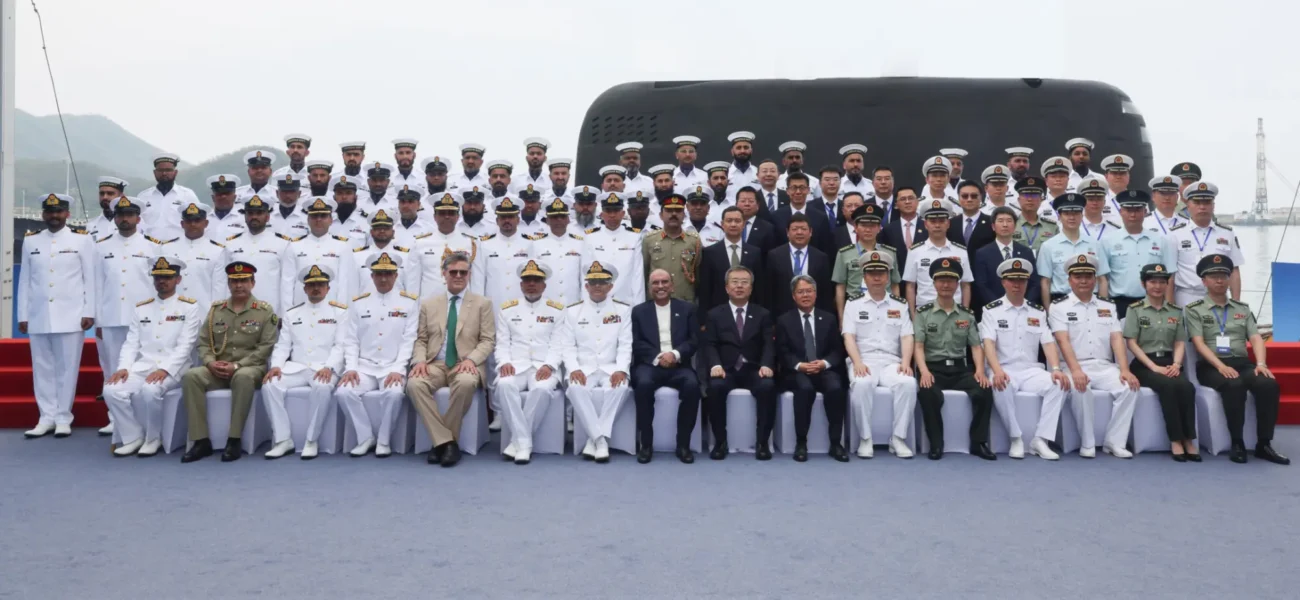
The PNS/M HANGOR was commissioned on 11 June 2026, marking a significant advancement in the Pakistan Navy’s underwater capabilities. Equipped with advanced combat systems, modern sensors, air-independent propulsion (AIP), and enhanced stealth technologies, the submarine can remain submerged longer than conventional diesel-electric vessels, reducing the risk of detection. As the first in a planned class of eight, HANGOR establishes a new foundation for subsurface operations. Its induction signals Pakistan’s shift to a cost-effective sea-denial strategy to address numerical imbalances and strengthen deterrence in the Arabian Sea.
The maiden Live Weapon Firing marks a key milestone in PNS/M HANGOR’s operationalisation, accentuating the burgeoning prowess of Pakistan Navy’s subsurface force. HANGOR’s precision strike with an extended-range anti-ship cruise missile exemplifies Sea Denial and aligns with Sir Julian Corbett’s maritime vision. In Some Principles of Maritime Strategy (1911), Corbett states that “the object of naval warfare must always be directly or indirectly either to secure the command of the sea or to prevent the enemy from securing it.” HANGOR exemplifies the latter approach by preventing adversaries from securing the Arabian Sea rather than hegemony.
Pakistan’s defensive deterrence posture, centred on sea denial, is essential for countering India’s hegemonic posture in the Arabian Sea. By investing in stealthy, air-independent submarines rather than pursuing parity with India’s large conventional fleet, Pakistan strengthens deterrence at a fraction of the cost. HANGOR’s successful strike turns that deterrence from promise into proof, adding a vital layer to Pakistan’s defences and offering credible options below the nuclear threshold.
📄 POLICY WIRE WHITEPAPER PUBLISHED: PAKISTAN'S NATIONAL SECURITY POLICY PRIORITIES
👉 READ BY CLICKING HEREAlongside Pakistan’s coastal missile systems, maritime aviation, and surface fleet, the submarine is an instrumental subsurface component of a comprehensive anti-access/area-denial (A2/AD) framework in the region. This integration not only validates the effectiveness of the submarine’s weapon systems but also supports the Navy’s phased modernization strategy, which is designed to deter potential threats to Pakistan’s sea lines of communication (SLOCs).
Sustained modernisation of the submarine force is therefore not a choice but a strategic imperative for strengthening Pakistan’s maritime deterrence. Yet capability alone will not secure the Arabian Sea. Pakistan does not pursue interventionist ambitions; instead, it aims to prevent any adversary from achieving maritime dominance in these waters at its expense. That is the essence of sea denial, and HANGOR, true to its name, has shown that Pakistan now has the teeth to deliver it.
Author