


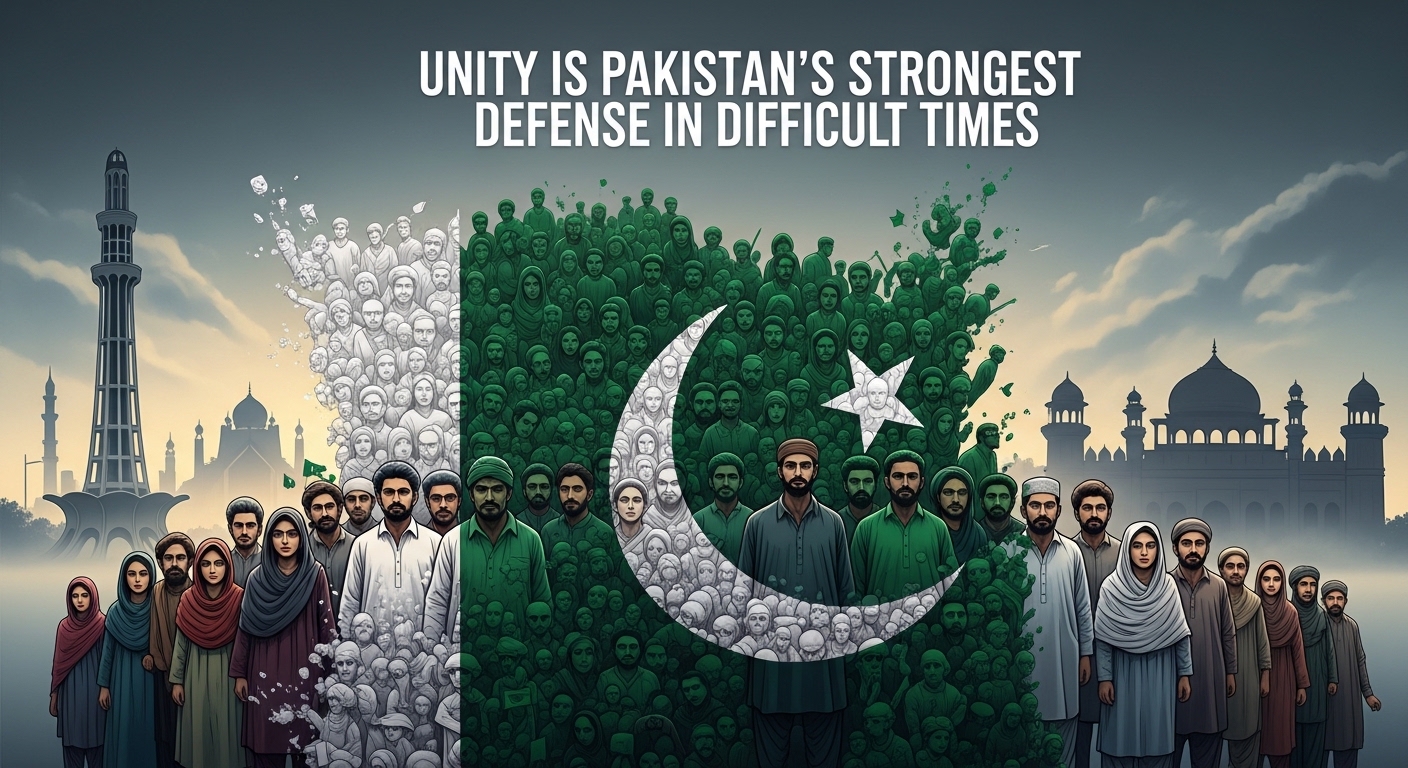
Unity Is Pakistan’s Strongest Defense in Difficult Times
Pakistan is experiencing one of the most difficult times ever in its recent history. The nation is under severe external and internal pressure. On the one hand, there are security threats like...

Pakistan is experiencing one of the most difficult times ever in its recent history. The nation is under severe external and internal pressure. On the one hand, there are security threats like cross-border attacks by terrorists located in Afghanistan and the eastern border tensions. Conversely, Pakistan is grappling with terrorism, political instability, economic hardship, and increasing divisions in the society. In this case, the necessity of national unity is greater than ever. To survive and progress, Pakistan has to be united despite all the differences.
The external threat is one of the greatest fears that Pakistan has today. The terrorist groups like the Fitna-al-Khawarij (FAK) have remained active in carrying out attacks and have been reported to use the Afghan territory as a base. Such cross-border attacks do not only damage the security of Pakistan but also create tension in the region. Meanwhile, the eastern border is also a cause of concern, and it contributes to the security issues of the country. Any internal division is the wrong message in such a delicate environment. When political leaders are at loggerheads and the society seems to be divided, it creates a feeling of weakness. Such situations are usually exploited by external enemies. A nation that is divided is an easy target and a united nation sends a strong message that it cannot be easily shaken.
Meanwhile, Pakistan is equally experiencing internal threats. The state is still facing the challenge of terrorist organizations such as the FAK, extremist groups, and separatist movements in Balochistan. These groups do not work in a vacuum; they enjoy the instability in the country. It provides room to these factors when political parties are occupied with accusing one another and people lose confidence in the leadership. They apply anger, frustration, and confusion to the masses to recruit new members and expand their influence. The internal divisions undermine the effectiveness of the country in responding. Nevertheless, in case the people and institutions are united, these groups lose their back and can be easily manipulated. National unity is not merely a political concept, however, it is a security requirement.
Pakistan is also grappling with severe economic issues, in addition to security issues. Increased prices of essential commodities, high cost of fuel, joblessness, and heavy debt repayments have rendered life hard to the common citizens. A lot of families are struggling to sustain themselves. These economic pressures are not only due to internal mismanagement, but also associated with the global factors like increased energy prices and economic instability in the region. The worst thing about the situation, however, is that there is no political consensus on the way to address these problems. Political parties instead of collaborating tend to concentrate on short-term benefits and accuse one another of the crisis. This will be a way of postponing solutions. The economic recovery necessitates hard choices and only in case of unity among political leaders and cooperation between provinces, these choices can be successful. By uniting the country, it will be more powerful economically and less susceptible to foreign influence.
The concept of unity is not foreign to Pakistan. It is closely tied to the vision of Muhammad Ali Jinnah who thought that it is possible to create a country that transcends the differences in language, ethnicity and religion. He emphasized that Pakistanis have to be a united nation. The history has unfortunately demonstrated what can happen when this principle is disregarded. The Bangladesh Liberation War of 1971 is a bitter experience that reminds people of how internal differences can cause national losses. Pakistan cannot make such mistakes today. The nation requires its political leaders, institutions, media and citizens to collaborate in the best interest of the nation. National interest should be second before personal interests, party politics and regional differences.
Unity does not imply that individuals should not disagree. Differences of opinion are natural and even healthy in a democratic country. Nevertheless, constructive disagreement and harmful division are different. Positive argumentation is useful in identifying superior solutions, whereas the ongoing struggle undermines the nation. The feeling of collective responsibility is what Pakistan requires nowadays. All groups such as political parties, the military, civil society, and religious leaders should realize that stability of the country is a shared objective. Once this realization is formed, then it becomes simpler to confront difficulties collectively.
Pakistan is at the crossroads of its history. Its threats are real and serious, but not impossible to overcome. The key lies in unity. A fractured Pakistan will still be faced with insecurity, economic issues and instability. However, a united Pakistan will be able to confront its enemies with a sense of confidence, boost its economy and create a better future of its people. The decision is obvious: unity is not only a possibility, but the best defence of the country and its only way to go.
Author